Search for brain health foods and you will be told that walnuts contain DHA, that avocados prevent Alzheimer’s, and that a handful of berries can slow dementia. None of those is true, and the real picture is more useful than any of them.
What the research genuinely supports is less dramatic and more actionable: a small number of eating patterns are consistently linked to slower cognitive decline, and a handful of specific foods turn up in those patterns again and again. No single food will sharpen your memory. But the foods below are the ones with something behind them, and this article is about what that something actually is.
Key Takeaways
- Patterns beat superfoods. The strongest evidence is for whole eating patterns — the MIND and Mediterranean diets — not for individual ingredients.
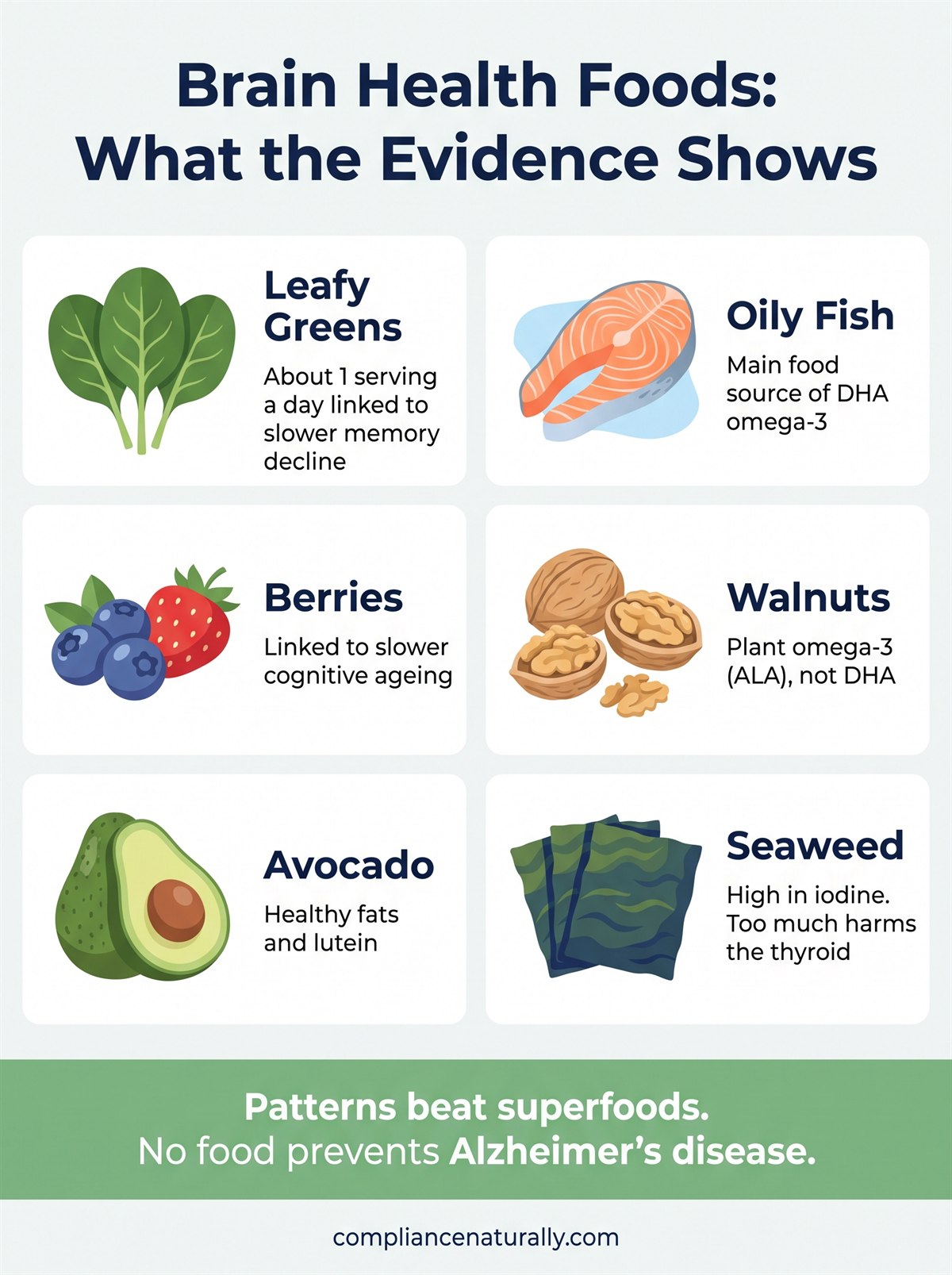
- Green leafy vegetables have the cleanest single-food finding: about one serving a day was associated with cognitive decline equivalent to being 11 years younger.
- Oily fish is the practical source of DHA, the omega-3 that brain tissue uses. Walnuts and flax provide ALA, which your body converts to DHA only in small amounts.
- No food prevents or slows Alzheimer’s disease. Anything claiming otherwise is ahead of the evidence.
- Almost all of this research is observational, which means it shows associations rather than proving cause — a limitation worth keeping in mind throughout.
Fish
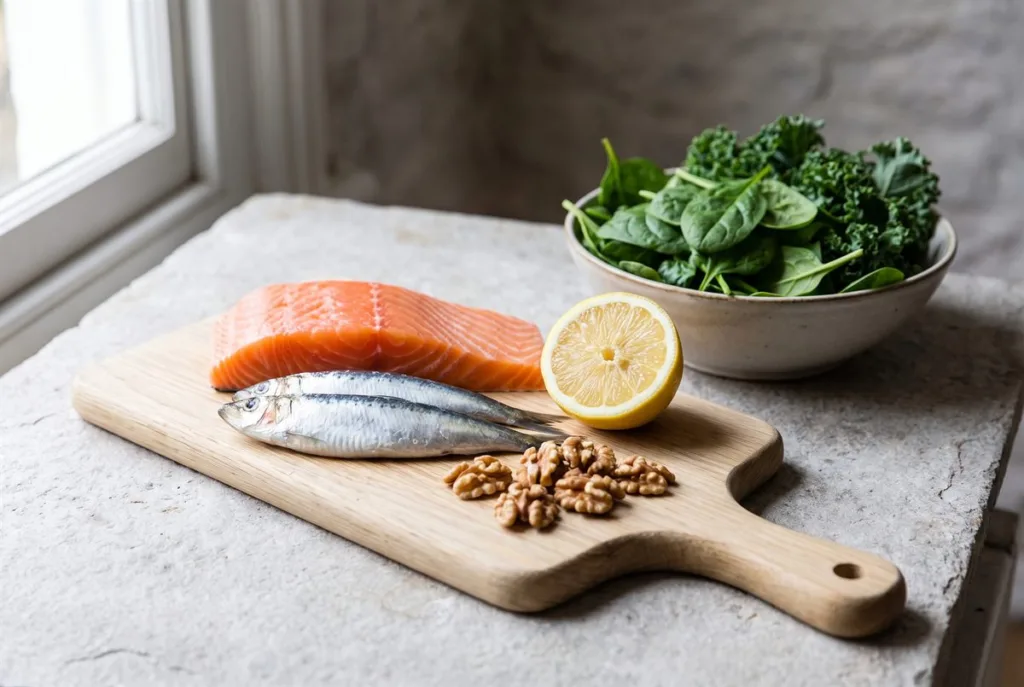
Oily fish is the one food on this list that supplies the omega-3 your brain actually runs on. Around 60% of the brain is fat, and DHA — one of the two long-chain omega-3s found in fish — is a structural component of the membranes of brain cells.
Observational studies have repeatedly linked regular fish consumption with slower cognitive decline and lower rates of dementia. Salmon, sardines, mackerel, herring and trout are the richest sources, and two servings a week is the usual recommendation.
A caution on the strength of that evidence: trials in which people were given omega-3 supplements have generally failed to show the cognitive benefit that the fish-eating studies suggest. That gap is one of the genuine puzzles in this field. It might mean the benefit comes from the whole food rather than the isolated fat, or that it accrues over decades rather than over the length of a trial, or that fish-eaters differ from non-fish-eaters in other ways. It is a reason to eat fish and not to assume a capsule does the same job.
Green Leafy Vegetables
If you only change one thing, change this one. Leafy greens have the most convincing single-food finding in the whole of diet-and-cognition research.
In a study that followed around 960 older adults for roughly five years, those who ate the most green leafy vegetables — about one serving a day — declined more slowly on memory and thinking tests than those who ate the least. The size of the gap was about the same as being 11 years younger.
Spinach, kale, collards, chard, romaine and rocket all count, raw or cooked. They carry folate, vitamin K, lutein, beta-carotene and vitamin E, and the researchers found the association held for several of those nutrients individually, which is part of why the finding is taken seriously.
The honest caveat: this is an observational study. People who eat a serving of greens a day differ from people who eat none in all sorts of ways that are hard to adjust away. It shows a strong association; it does not prove that the greens caused the difference.
One serving a day is a low bar — a side of spinach, a handful of rocket on a sandwich, a cup of romaine in a salad. Of everything on this page, it is the easiest change to make.
Nuts
Walnuts are the nut most often singled out for brain health, and they do have a real research base — a systematic review of cohort studies and randomised trials found associations between walnut consumption and a range of health outcomes, cognitive measures among them.
Here is the correction that matters, because it is repeated almost everywhere: walnuts do not contain DHA. They are the nut richest in alpha-linolenic acid (ALA), the plant form of omega-3. Your body converts a little ALA into the longer-chain EPA and DHA that brain tissue uses, but only a small fraction of it. So walnuts are worth eating, and they are not a substitute for oily fish if DHA is what you are after.
What they do bring, reliably: unsaturated fat, fibre, plant protein, magnesium, and more vitamin E than most foods. Vitamin E is an antioxidant that protects cell membranes, and low vitamin E intake has been linked with poorer cognitive performance — though supplementing it has not been shown to help, which is the same pattern as with omega-3.
Almonds, hazelnuts, pecans and pistachios all carry vitamin E and healthy fats too. A small handful most days is the amount these studies tend to describe. Nuts are calorie-dense, so the portion is the thing to watch.
Berries
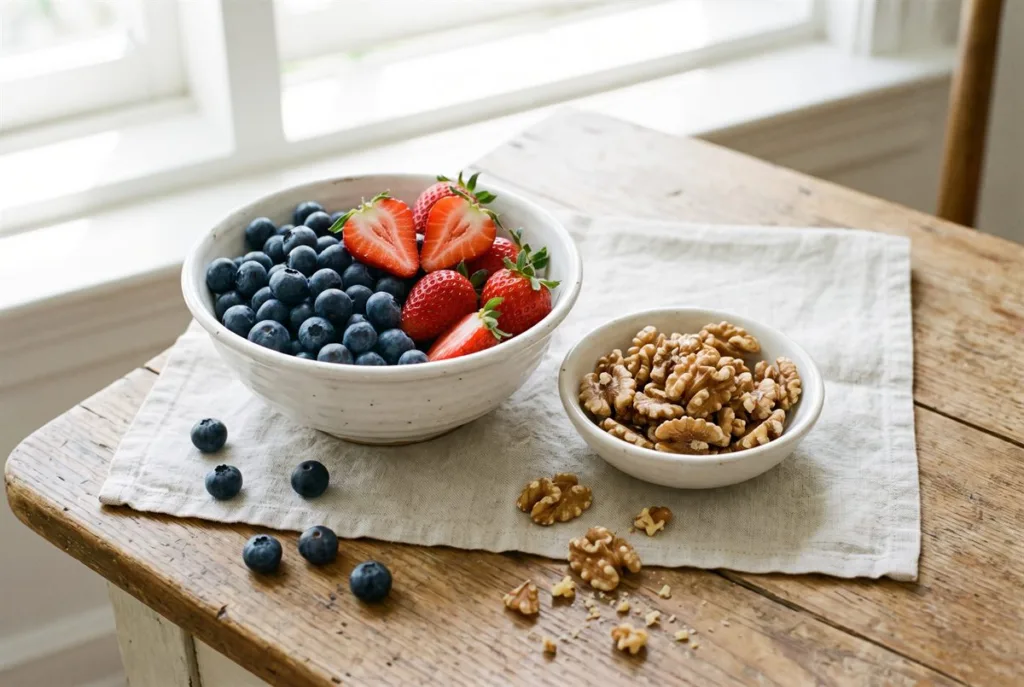
Berries are rich in anthocyanins — the pigments that make them red, blue and purple — and higher berry intake has been linked with slower cognitive decline in long-running observational research. In the Nurses’ Health Study, which tracked the diets of 16,000 women for two decades before testing their cognition after age 70, greater intake of blueberries and strawberries was associated with slower cognitive decline — an effect the researchers described as delaying cognitive ageing by up to two and a half years.
Strawberries also bring vitamin C and manganese; blueberries are among the densest sources of anthocyanins in the supermarket. Frozen berries are nutritionally comparable to fresh and often cheaper, so they are a reasonable default.
What berries do not do is slow Alzheimer’s disease. No food has been shown to do that once the disease has started, and claims to the contrary are the single most common overstatement in this whole subject area. Berries belong in a brain-healthy diet. They are not a treatment.
Avocado
Avocados are mostly monounsaturated fat — the same fat family as olive oil — and they are a good source of potassium, fibre and the carotenoid lutein. Lutein is best known for its role in eye health and has drawn increasing interest for the brain, where it accumulates in neural tissue; the studies linking lutein levels to cognitive measures are real but small and few.
Two corrections, because both errors are widespread:
Avocados are not a meaningful source of omega-3. They contain a trace of ALA and no EPA or DHA. If you read that avocado omega-3 protects against Alzheimer’s, both halves of that sentence are wrong.
No food prevents Alzheimer’s disease. The National Institute on Aging is unambiguous on this: no food, diet or supplement has been shown to prevent it.
What is fair to say is that diets built around monounsaturated fat are associated with better cardiovascular health, and that what is good for your blood vessels is generally good for your brain — a large share of cognitive decline has a vascular component. That is a reasonable case for avocado, olive oil and nuts. It is not a case for avocado as medicine.
Avocados are also calorie-dense. Half of one is a normal portion.
Seaweed
Seaweed is the odd one out here, and it comes with a caution rather than a recommendation.
It is genuinely nutrient-dense: a source of magnesium, iron, several B vitamins, and the one mineral almost nothing else in the diet provides in quantity — iodine. Iodine matters a great deal for the brain, particularly before birth and in infancy, because the thyroid hormones it enables are essential to neural development.
The catch is the dose. Iodine content varies enormously between species — kelp and kombu can carry many times an adult’s entire daily requirement in a single portion — and consistently high iodine intake disrupts thyroid function rather than supporting it. Too much is a recognised cause of both hyperthyroidism and hypothyroidism, and that risk extends to the newborns of mothers with very high intakes.
So: eat seaweed as a seasoning, a snack or a side rather than as a daily supplement, treat kelp and kombu with more caution than nori, and if you are pregnant or have a thyroid condition, ask your doctor before making it a habit.
The claims you will see about seaweed protecting against neurodegenerative disease come from cell and animal studies. They are early-stage work, not findings about people.
What the Evidence Says About Brain Health Foods
Pull the individual foods together and a pattern appears — which is, in the end, the real finding of this field.
The MIND diet was designed specifically around the research on diet and cognition. It is a blend of the Mediterranean and DASH diets and it emphasises green leafy vegetables, other vegetables, berries, nuts, beans, whole grains, fish and olive oil, while limiting red meat, butter, cheese, fried food, pastries and sweets. In observational studies, people who ate this way showed meaningfully slower cognitive decline.
It is worth knowing what happened when it was put to a randomised trial. Over three years, 604 older adults were assigned either to the MIND diet or to a control diet, both with mild calorie restriction. Both groups improved on cognitive tests, and the difference between them was not statistically significant.
That result does not overturn the observational evidence, but it does set its limits honestly: the pattern is strongly associated with better cognitive ageing across populations over decades, while the proof that adopting it in later life changes an individual’s trajectory is not yet in hand. Three years may simply be too short, or the control diet may have been too good a comparison.
Either way, the foods on this list are the same ones recommended for your heart and your blood vessels, the benefits of eating them are not in dispute, and the downside risk is nil. That is a reasonable basis for action even while the trial evidence catches up.
Before You Try This
This article is for general information. It is not medical advice, and it is not a substitute for talking to someone who knows your history.
Food and supplements affect people differently, and a few of the ingredients here interact with common prescriptions. Talk to your doctor, pharmacist or a registered dietitian before you change your diet for a health reason, start a supplement, or try anything described here as a remedy — and especially if you are pregnant or breastfeeding, taking medication, managing a chronic condition, or buying for a child.
If something you eat or drink makes you feel unwell, stop and get medical help.
Brain Health FAQ
What is the single best food for brain health?
No single food does it alone, and the research points at eating patterns rather than superfoods. The MIND diet — a blend of the Mediterranean and DASH diets — emphasises leafy greens, berries, nuts, beans, whole grains, fish and olive oil, and limits fried food, pastries, red meat and butter. If you want the one food with the cleanest single finding behind it, it is green leafy vegetables.
Do omega-3 supplements work as well as eating fish?
The evidence says not, or at least not that we can show. Studies of people who eat fish regularly find slower cognitive decline; trials giving people omega-3 capsules have generally not reproduced that benefit. Whole foods are the better bet.
Do walnuts contain DHA?
No. Walnuts contain ALA, the plant form of omega-3, which your body converts into DHA only in small amounts. DHA comes from oily fish and from algae-based supplements. This is one of the most commonly repeated errors about brain foods.
Can diet prevent Alzheimer’s disease?
No food, diet or supplement has been shown to prevent Alzheimer’s disease, and the National Institute on Aging says so directly. Diets like the MIND pattern are associated with slower cognitive decline in general, which is a different and more modest claim.
How quickly can diet affect brain health?
Some effects, like steadier energy and focus from balanced meals, show up within days. Benefits for memory and cognitive ageing build over years of consistent habits, alongside sleep, exercise and social activity.
Should I take supplements for brain health instead?
For most people, whole foods are the better choice. Supplements marketed for memory are not reviewed by the FDA for effectiveness before they are sold, so read labels carefully and talk to your doctor before starting one. Our guide to the difference between food and supplements explains how the rules differ.
Is seaweed safe to eat every day?
In small amounts, for most people, yes — but iodine content varies hugely by species and consistently high intakes can disrupt thyroid function. Kelp and kombu are the ones to be careful with. If you are pregnant or have a thyroid condition, ask your doctor first.
Does drinking water matter for brain health?
Yes. Even mild dehydration can affect attention, mood and short-term memory. Water, herbal tea and water-rich foods like cucumbers, oranges and watermelon all count toward your daily fluid needs, so keep a glass nearby while you work or study.
Sources and Further Reading
- Nutrients and bioactives in green leafy vegetables and cognitive decline: Prospective study — Morris MC et al. Neurology. 2018;90(3):e214-e222
- Trial of the MIND Diet for Prevention of Cognitive Decline in Older Persons — N Engl J Med. 2023;389(7):602-611
- Dietary intakes of berries and flavonoids in relation to cognitive decline — Devore EE et al. Ann Neurol. 2012;72(1):135-143
- Walnut consumption and health outcomes with public health relevance — Nutr Rev. 2022;81(1):26-54
- NIH Office of Dietary Supplements: Omega-3 Fatty Acids
- NIH Office of Dietary Supplements: Iodine
- NIH Office of Dietary Supplements: Vitamin E
- National Institute on Aging: What Do We Know About Diet and Prevention of Alzheimer’s Disease?
- Harvard Health: Foods Linked to Better Brainpower


3 thoughts on “Brain Health Foods: What the Research Actually Supports”