Short answer: The brain health foods with the most research behind them are green leafy vegetables, oily fish, berries, nuts, beans, whole grains and olive oil, the core of the MIND diet. In one study, older adults who followed it most closely had a 53% lower rate of Alzheimer’s disease. No single food sharpens memory or prevents dementia, and eating patterns matter more than any “superfood.”
Search for brain foods and you’ll be told that walnuts contain DHA, that avocados prevent Alzheimer’s, and that a handful of berries can slow dementia. None of those is true. This guide covers the foods that do have evidence behind them, how much of each the research describes, the MIND diet food list, the foods to limit, and what the best trial found.
Key Takeaways
- Patterns beat superfoods. The strongest evidence is for whole eating patterns, the MIND and Mediterranean diets, not individual ingredients.
- Leafy greens have the cleanest single-food finding: about one serving a day was linked to cognitive decline equal to being 11 years younger.
- Oily fish is the practical source of DHA, the omega-3 found in brain cell membranes. Walnuts and flax provide ALA, which your body converts to DHA only in small amounts.
- No food prevents or slows Alzheimer’s disease. Anything claiming otherwise is ahead of the evidence.
- Most of this research is observational. It shows associations, not proof of cause, and a three-year MIND diet trial found no significant difference from a healthy control diet.
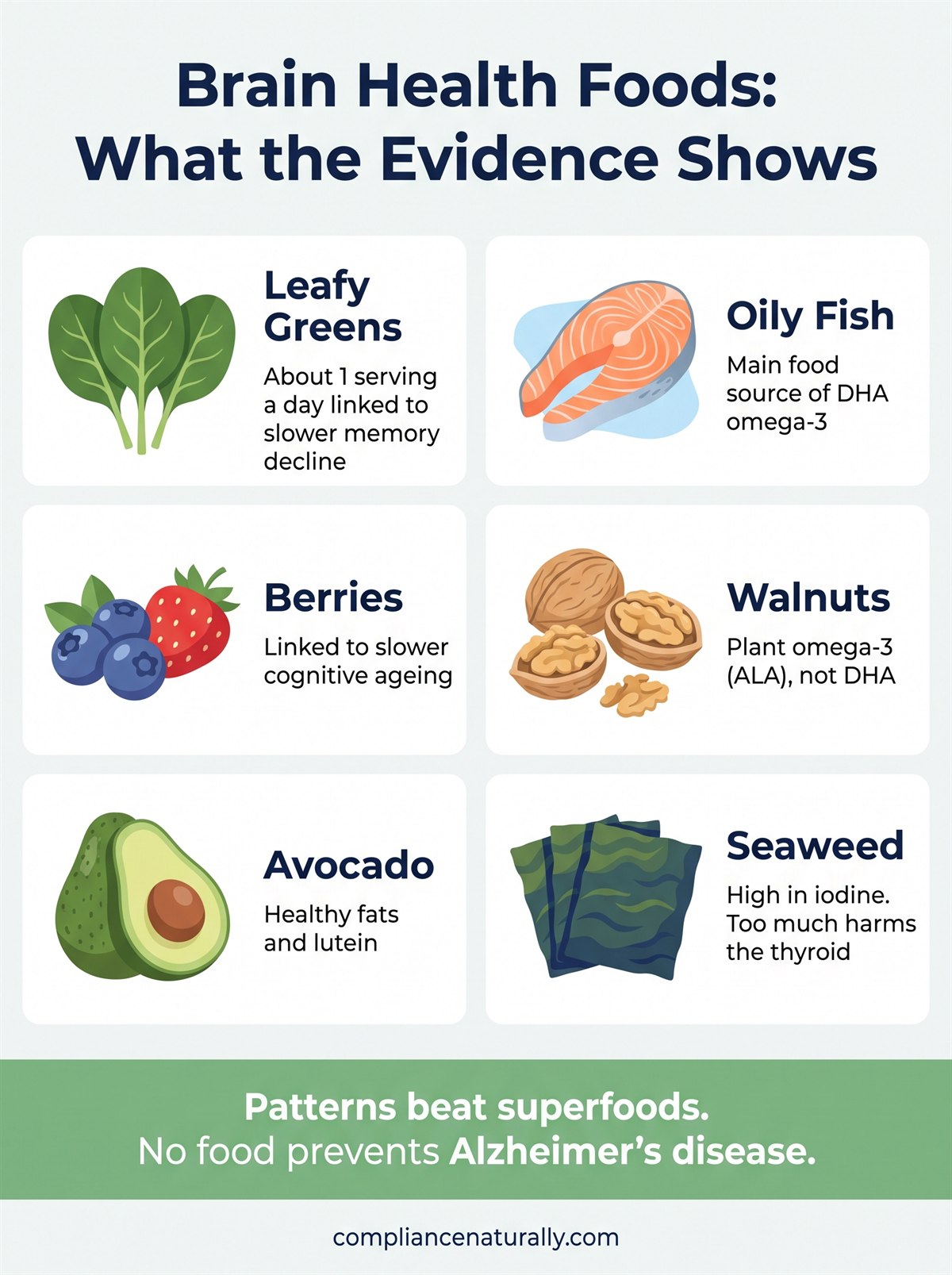
Brain Health Foods at a Glance
| Food | Key nutrients | Strength of evidence | Amount in the research |
|---|---|---|---|
| Green leafy vegetables | Folate, vitamin K, lutein, nitrate, vitamin E | Strongest single-food finding (observational) | About 1 serving a day (MIND: 6+ a week) |
| Berries | Anthocyanins and other flavonoids | Good (large long-term cohort) | 2+ servings a week |
| Oily fish | DHA and EPA omega-3s | Good for eating fish; weak for supplements | 1 meal a week (MIND); 2 a week is the general heart advice |
| Nuts | Vitamin E, unsaturated fat, ALA (walnuts) | Moderate; more research needed | 5+ servings a week |
| Beans and lentils | Fiber, folate, plant protein | Part of the MIND pattern | More than 3 servings a week |
| Whole grains | Fiber, B vitamins | Part of the MIND pattern | 3+ servings a day |
| Olive oil | Monounsaturated fat, polyphenols | Part of the MIND and Mediterranean patterns | Your main cooking oil |
| Avocado | Monounsaturated fat, lutein, potassium | Limited and indirect | Half an avocado is a normal portion |
| Seaweed | Iodine, magnesium, iron | Animal and cell studies only; caution on iodine | Small amounts as a seasoning or side |
1. Green Leafy Vegetables
If you change only one thing, change this. Leafy greens have the most convincing single-food finding in diet and cognition research.
In a study that followed 960 older adults for about five years, those who ate the most green leafy vegetables, about one serving a day, declined more slowly on memory and thinking tests than those who ate the least. The gap was equal to being 11 years younger. Spinach, kale, collards, chard, romaine and arugula all count, raw or cooked. The researchers found the link held for several of their nutrients individually (vitamin K, lutein, folate, nitrate, vitamin E and kaempferol), which is part of why the finding is taken seriously.
The caveat: it’s observational. People who eat greens every day differ from people who don’t in ways that are hard to adjust for. But one serving a day is a low bar: a side of spinach, a handful of arugula on a sandwich or a cup of romaine in a salad.
2. Oily Fish
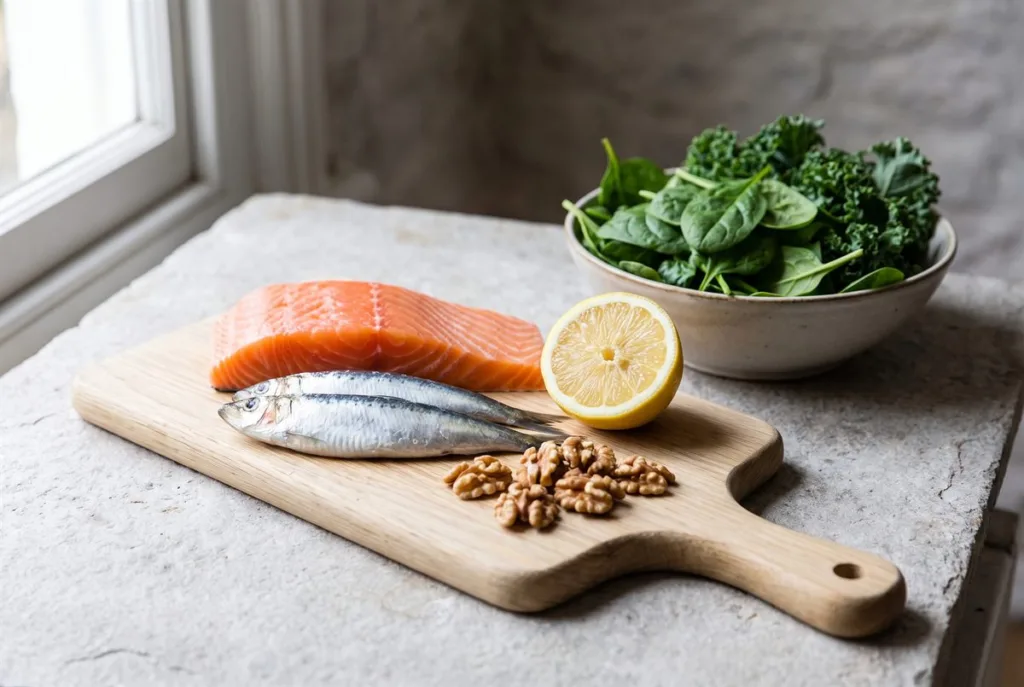
Oily fish is the one food here that supplies DHA, a long-chain omega-3 that is a structural part of brain cell membranes. Salmon, sardines, mackerel, herring and trout are the richest sources. Observational studies have repeatedly linked regular fish eating with slower cognitive decline and lower rates of dementia. The MIND diet’s target is modest: one fish meal a week.
A caution: trials that gave people omega-3 supplements have generally failed to show the cognitive benefit the fish-eating studies suggest. The benefit may come from the whole food, may build over decades, or may reflect other differences between people who eat fish and those who don’t. It’s a reason to eat fish, not to assume a capsule does the same job.
3. Berries
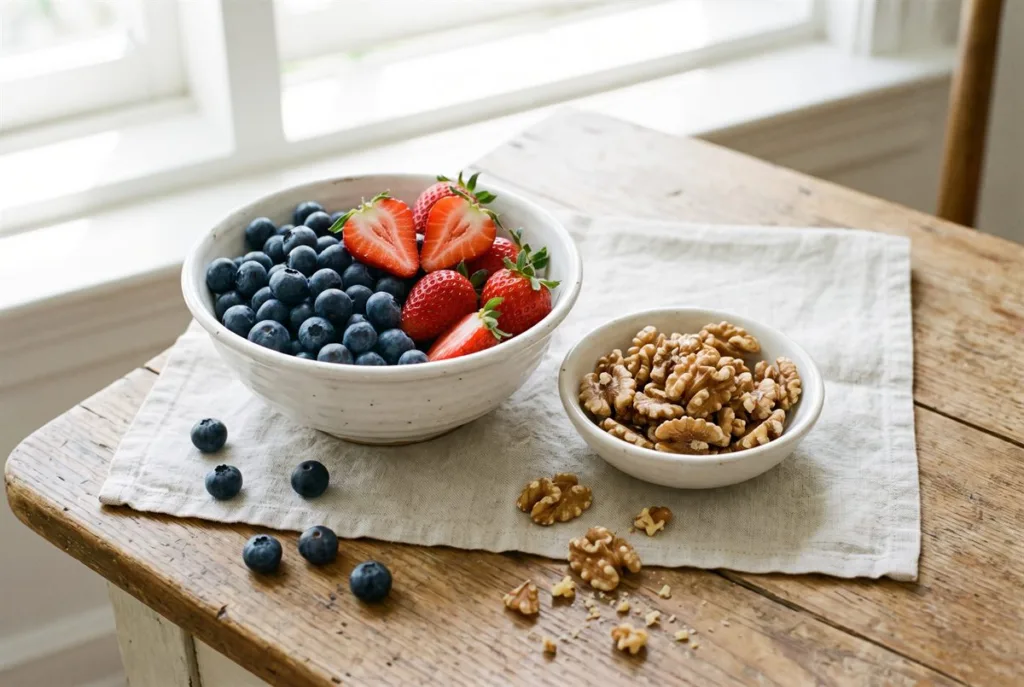
Berries are rich in anthocyanins, the pigments that make them red, blue and purple. In the Nurses’ Health Study, which tracked the diets of more than 16,000 women for about two decades before testing their memory and thinking after age 70, higher intake of blueberries and strawberries was linked to slower cognitive decline. The researchers estimated that berries delayed cognitive aging by up to 2.5 years.
Frozen berries are nutritionally comparable to fresh and often cheaper. What berries don’t do is treat Alzheimer’s disease. They belong in a brain-healthy diet; they aren’t medicine.
4. Nuts
Walnuts are the nut most often singled out for brain health. A 2022 systematic review found that walnuts improve blood lipids and are linked to lower heart disease risk, while evidence for cognitive health is accumulating but not yet firm.
The correction that matters: walnuts do not contain DHA. They are the nut richest in ALA, the plant form of omega-3. Your body converts only a small fraction of ALA into DHA, so walnuts are worth eating but are not a substitute for fish.
Almonds, hazelnuts, pecans and pistachios bring vitamin E and healthy fats too. The MIND diet calls for nuts at least five times a week. A small handful is a serving; nuts are calorie-dense. For a less common option, see our guide to pine nuts.
5. Beans, Whole Grains and Olive Oil
These three rarely make “superfood” lists, but they are core parts of the MIND pattern: beans more than three times a week, whole grains three or more times a day, and olive oil as your main oil. They bring fiber, B vitamins and unsaturated fat, and they replace the refined grains and saturated fat the diet limits. To spot real whole grains on a package, check that a whole grain is the first ingredient (see how to read nutrition labels).
6. Avocado
Avocados are mostly monounsaturated fat, the same fat family as olive oil, and a good source of potassium, fiber and lutein. Lutein accumulates in brain tissue, and studies linking it to cognition are real but small.
Two corrections: avocados are not a meaningful source of omega-3 (they have a trace of ALA and no EPA or DHA), and no food prevents Alzheimer’s disease. The fair case for avocado is that diets built on monounsaturated fat support heart and blood vessel health, and much cognitive decline has a vascular component.
7. Seaweed (With a Caution)
Seaweed is nutrient-dense and one of the few foods rich in iodine, which the thyroid needs to make hormones essential for brain development before birth and in infancy. The catch is the dose. Iodine varies enormously by species, and kelp and kombu can carry many times the daily requirement in one portion. Consistently high iodine intake can disrupt thyroid function.
Eat seaweed as a seasoning, snack or side rather than a daily supplement, be more careful with kelp and kombu than nori, and ask your doctor first if you’re pregnant or have a thyroid condition. Claims that seaweed protects against neurodegenerative disease come from cell and animal studies, not people.
MIND Diet Food List
The MIND diet (Mediterranean-DASH Intervention for Neurodegenerative Delay) was designed around research on diet and the brain. It scores 15 food groups: 10 to eat and 5 to limit.
| Eat | MIND target | Limit | MIND target |
|---|---|---|---|
| Green leafy vegetables | 6+ servings a week | Red meat and meat products | Fewer than 4 a week |
| Other vegetables | 1+ a day | Butter and stick margarine | Less than 1 tablespoon a day |
| Berries | 2+ a week | Cheese | Less than 1 serving a week |
| Nuts | 5+ a week | Pastries and sweets | Fewer than 5 a week |
| Beans | More than 3 a week | Fried or fast food | Less than once a week |
| Whole grains | 3+ a day | ||
| Fish | 1+ a week | ||
| Poultry | 2+ a week | ||
| Olive oil | Main cooking oil | ||
| Wine | 1 glass a day |
Source: Morris MC et al., Alzheimer’s & Dementia, 2015. The wine component is part of the original score, but that is not a reason to start drinking. The 2025-2030 Dietary Guidelines for Americans advise consuming less alcohol for better overall health. For the wider picture, see the Dietary Guidelines for Americans.
Eggs are not one of the MIND diet’s food groups, but they are the richest everyday source of choline, a nutrient the brain uses to make the messenger chemical acetylcholine and one most Americans get too little of. See our choline foods chart and calculator.
Foods to Limit for Brain Health
The MIND diet’s “limit” list is a practical answer to “what foods are bad for your brain?”: red and processed meat, butter, full-fat cheese, pastries and sweets, and fried or fast food. These are high in saturated fat, refined starch or added sugar, and they tend to crowd out the foods above. No single food damages your brain, but a diet built on ultra-processed foods leaves less room for the ones linked to healthier aging.
What the Evidence Actually Shows
| Study | Design | Finding |
|---|---|---|
| Morris et al., Alzheimer’s & Dementia 2015 (923 adults, about 4.5 years) | Observational | Highest MIND diet scores linked to a 53% lower rate of Alzheimer’s disease; moderate scores to about 35% lower |
| Morris et al., Neurology 2018 (960 adults, about 4.7 years) | Observational | About 1 serving a day of leafy greens linked to decline equal to being 11 years younger |
| Devore et al., Annals of Neurology 2012 (16,010 women) | Observational | More blueberries and strawberries linked to cognitive aging delayed by up to 2.5 years |
| Barnes et al., New England Journal of Medicine 2023 (604 adults, 3 years) | Randomized trial | Both the MIND group and a control group with mild calorie restriction improved; the difference was not statistically significant |
The trial doesn’t overturn the observational evidence, but it sets honest limits. The MIND pattern is strongly associated with better cognitive aging across populations over decades. Proof that switching to it later in life changes an individual’s path isn’t in hand yet; three years may be too short, or the control diet may have been too good a comparison. Either way, these are the same foods recommended for heart health, and the downside risk is close to nil.
Brain Food for Studying
No food gives a short-term boost to test scores the way marketing suggests. What helps on a study day is ordinary: regular meals so you aren’t running on empty, enough water, and sleep. A breakfast of oats with berries and nuts, or eggs with whole-grain toast, covers several MIND foods at once. Long-term, the foods above matter more than anything eaten the night before an exam.
Before You Try This
This article is general information, not medical advice. Talk to your doctor, pharmacist or a registered dietitian before changing your diet for a health reason or starting a supplement, especially if you are pregnant or breastfeeding, take medication or manage a chronic condition. If something you eat or drink makes you feel unwell, stop and get medical help.
Frequently Asked Questions
What is the best food for brain health?
No single food does it alone; the research points to eating patterns. If you want the one food with the cleanest finding, it’s green leafy vegetables, at about one serving a day.
What foods improve memory?
Leafy greens, berries, oily fish and nuts are the foods most consistently linked to slower memory decline with age. The effect builds over years and works best as part of a pattern like the MIND diet.
What is on the MIND diet food list?
Ten foods to eat (leafy greens, other vegetables, berries, nuts, beans, whole grains, fish, poultry, olive oil and wine) and five to limit (red meat, butter and margarine, cheese, pastries and sweets, and fried or fast food).
Do omega-3 supplements work as well as eating fish?
Not as far as research can show. People who eat fish regularly have slower cognitive decline, but trials of omega-3 capsules have generally not reproduced that benefit.
Do walnuts contain DHA?
No. Walnuts contain ALA, the plant form of omega-3, which your body converts to DHA only in small amounts. DHA comes from oily fish and algae-based supplements.
Can diet prevent Alzheimer’s disease?
No food, diet or supplement has been proven to prevent Alzheimer’s disease. Diets like MIND are associated with slower cognitive decline and lower Alzheimer’s rates in observational studies, which is a more modest claim.
Should I take brain supplements instead?
For most people, whole foods are the better choice. Supplements marketed for memory don’t need FDA approval for effectiveness before they’re sold. Our guide to how supplements are regulated explains the rules.
Is seaweed safe to eat every day?
In small amounts, for most people, yes. But iodine varies hugely by species, and consistently high intake can disrupt thyroid function. Be careful with kelp and kombu.
Sources and Further Reading
- Morris MC, et al. MIND diet associated with reduced incidence of Alzheimer’s disease. Alzheimers Dement. 2015;11(9):1007-1014.
- Morris MC, et al. Nutrients and bioactives in green leafy vegetables and cognitive decline: Prospective study. Neurology. 2018;90(3):e214-e222.
- Barnes LL, et al. Trial of the MIND Diet for Prevention of Cognitive Decline in Older Persons. N Engl J Med. 2023;389(7):602-611.
- Devore EE, et al. Dietary intakes of berries and flavonoids in relation to cognitive decline. Ann Neurol. 2012;72(1):135-143.
- Lockyer S, et al. Walnut consumption and health outcomes with public health relevance: a systematic review. Nutr Rev. 2022;81(1):26-54.
- Omega-3 Fatty Acids. NIH Office of Dietary Supplements.
- Iodine. NIH Office of Dietary Supplements.
- What Do We Know About Diet and Prevention of Alzheimer’s Disease? National Institute on Aging.