Short answer: Organic food is not clearly more nutritious than non-organic food, but it does carry fewer pesticide residues. Large reviews find only small or inconsistent differences in vitamins and minerals, somewhat higher levels of some antioxidants in organic crops, and more omega-3 fats in organic milk. Residues on conventional produce are almost always within EPA safety limits. If your budget is limited, eating more fruits and vegetables of any kind matters more than buying organic.
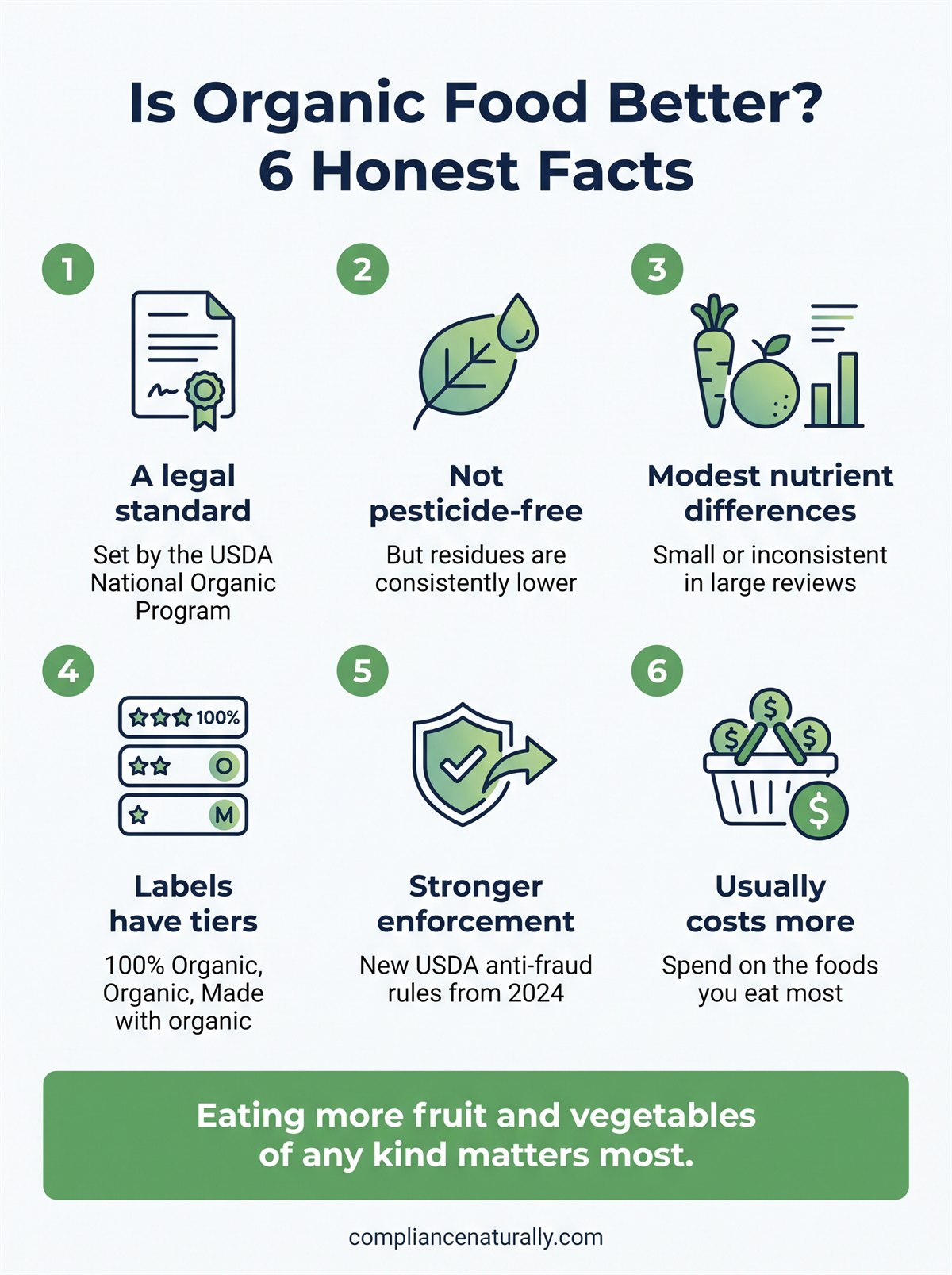
“Is organic food better?” depends on what you mean by better: more nutritious, safer, better for the environment, or worth the money. This guide compares organic and non-organic food on each, explains what the USDA Organic seal legally means, and shows where organic is most and least worth paying for, using the 2026 Dirty Dozen and Clean Fifteen lists.
Organic vs Non-Organic Food: Side-by-Side
| What to compare | Organic | Non-organic (conventional) |
|---|---|---|
| Synthetic pesticides | Most prohibited; a limited list of approved substances, mostly natural, is allowed | Allowed within EPA limits |
| Pesticide residues | Found less often | Found about four times more often in a large review, usually below EPA tolerances |
| Synthetic fertilizers and sewage sludge | Prohibited | Synthetic fertilizers allowed |
| Genetic engineering (GMOs) and irradiation | Prohibited | Allowed |
| Antibiotics and growth hormones in livestock | Prohibited | Antibiotics allowed under FDA rules; hormones allowed in beef cattle but banned by law in pork and poultry |
| Vitamins and minerals | Similar; differences small or inconsistent | Similar |
| Antioxidants (polyphenols) | Often somewhat higher in organic crops | Often somewhat lower |
| Omega-3 fats in milk | Higher (about 56% more in one meta-analysis) | Lower |
| Cadmium (a toxic metal) | Lower on average | Higher on average |
| Price | Usually higher | Usually lower |
| Certification | Certified and inspected yearly under the USDA National Organic Program | No certification needed |
Is Organic Food More Nutritious?
Mostly no, with a few exceptions. A 2012 Stanford review in the Annals of Internal Medicine concluded that the published research “lacks strong evidence that organic foods are significantly more nutritious than conventional foods.” A larger 2014 meta-analysis of 343 studies in the British Journal of Nutrition did find meaningful differences in some compounds:
- Several types of antioxidant polyphenols were an estimated 19% to 69% higher in organic crops.
- Cadmium, a toxic metal, was significantly lower.
- Pesticide residues were found four times more often on conventional crops.
A 2016 meta-analysis of milk found about 56% more total omega-3 fats in organic milk, likely because organic cows eat more grass, but also less iodine and selenium. Whether these differences improve health is not proven. Vitamin and mineral levels are broadly similar, and how fresh produce is, how it is stored, and the variety you buy often matter more than whether it is organic.
Is Organic Food Safer? Pesticides Explained
Organic does not mean pesticide-free. Organic farmers can use a short list of approved substances, most of them natural. But residues are found much less often on organic produce, and eating organic lowers the pesticide levels measured in people’s urine.
That does not mean conventional produce is unsafe. The USDA’s Pesticide Data Program tests thousands of samples every year, and the vast majority have residues below the safety limits (tolerances) set by the EPA. The real question is whether long-term, low-level exposure to multiple residues matters. Research on that is still limited.
The health-outcome evidence is mostly observational. A French study of about 69,000 adults (NutriNet-Santé, 2018) found that people who ate the most organic food had a 25% lower risk of cancer than those who ate the least. But organic buyers also tend to eat more fruit and vegetables, exercise more and smoke less, so the study cannot prove that organic food itself was responsible.
When Is Organic Worth the Price? The 2026 Dirty Dozen and Clean Fifteen
The Environmental Working Group (EWG), an advocacy group, ranks produce each year using USDA residue data. Many shoppers use the lists to decide where to spend on organic.
| 2026 Dirty Dozen (most residues) | 2026 Clean Fifteen (fewest residues) |
|---|---|
| 1. Spinach | 1. Pineapple |
| 2. Kale, collard and mustard greens | 2. Sweet corn |
| 3. Strawberries | 3. Avocados |
| 4. Grapes | 4. Papaya |
| 5. Nectarines | 5. Onions |
| 6. Peaches | 6. Frozen sweet peas |
| 7. Cherries | 7. Asparagus |
| 8. Apples | 8. Cabbage |
| 9. Blackberries | 9. Cauliflower |
| 10. Pears | 10. Watermelon |
| 11. Potatoes | 11. Mangoes |
| 12. Blueberries | 12. Bananas |
| 13. Carrots | |
| 14. Mushrooms | |
| 15. Kiwi |
Keep the lists in perspective. They rank how often residues are found, not whether those residues exceed safety limits, and food scientists and produce groups dispute the method. Strawberries on the Dirty Dozen are still far healthier than not eating fruit. A practical approach:
- Buy organic first for thin-skinned produce you eat often, especially if you have young children.
- Save money on produce with thick peels or low residues, like avocados, bananas, onions and pineapple.
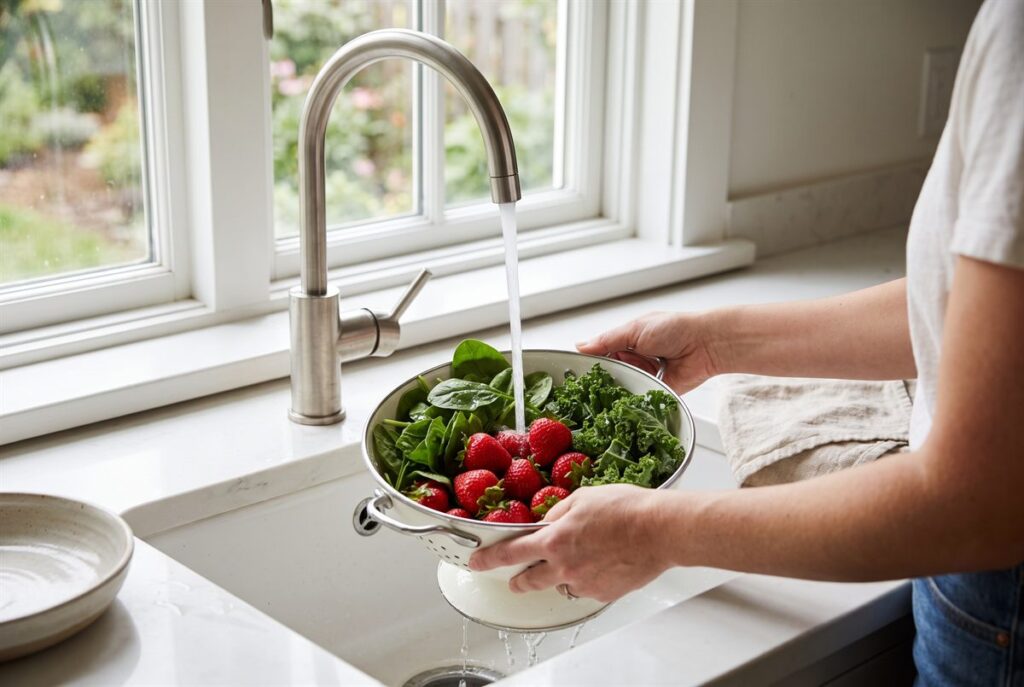
- Wash all produce under running water and rub firm produce. This removes some surface residue and dirt. Soap and produce washes are not needed.
- Do not skip fruit and vegetables because organic is too expensive. Frozen produce is a cheaper way to buy either kind.
What the USDA Organic Label Means
In the US, “organic” is a legal term under the USDA National Organic Program (7 CFR Part 205). Farms and processors must be certified by a USDA-accredited agent and inspected every year. The label you see depends on how much of the product is organic:
| Label | Organic content | USDA seal allowed? |
|---|---|---|
| 100% Organic | All ingredients organic (excluding water and salt) | Yes |
| Organic | At least 95% organic ingredients | Yes |
| Made with organic [ingredients] | At least 70% organic ingredients | No |
| Less than 70% | Organic items can only be named in the ingredient list | No |
Enforcement got stronger in 2024, when the USDA’s Strengthening Organic Enforcement rule took full effect. It added oversight of imports, brokers and traders, and required electronic import certificates to fight organic fraud.
“Organic” is not the same as “natural.” Natural has no formal FDA definition for most foods and requires no certification. See what “natural” means on food labels.
Is Organic Better for the Environment?
Partly. Organic farming bans synthetic pesticides and fertilizers, which reduces chemical runoff, and it tends to support more biodiversity on farms and healthier soil. But organic farms often produce lower yields, so they can need more land to grow the same amount of food. The overall environmental picture depends on the crop, the farm and how it is managed.
Why Organic Food Costs More
Organic food usually costs more because organic farming takes more labor (for example, weeding by hand or machine instead of with herbicides), yields can be lower, and certification adds paperwork and fees. Prices vary widely by product and store, and store-brand organic lines are often much cheaper than name brands.
Organic Processed Foods
An organic cookie is still a cookie. Organic chips, cereals and snacks can be just as high in sugar, salt and refined flour as conventional versions, and “organic” on the front can create a health halo. Check the Nutrition Facts label and ingredient list the same way you would for any packaged food. See how labels can mislead and whole foods vs processed foods.
Frequently Asked Questions
Is organic food healthier than non-organic food?
Not clearly. Vitamin and mineral levels are similar. Organic crops tend to have somewhat more antioxidants, less cadmium and fewer pesticide residues, and organic milk has more omega-3 fats, but there is no strong evidence that these differences improve health.
Is organic food pesticide-free?
No. Organic farmers may use a limited list of approved pesticides, most of them natural. Residues are found much less often on organic produce than on conventional produce.
Is organic food better for children?
Children eat more food for their body weight, so some parents choose organic to lower pesticide exposure. Pediatric experts emphasize that the most important thing is a varied diet with plenty of fruit and vegetables, organic or not.
Which foods are most worth buying organic?
Many shoppers prioritize items on EWG’s Dirty Dozen, such as spinach, kale, strawberries, grapes and apples, and buy conventional for Clean Fifteen items like avocados, pineapple, onions and bananas.
Does washing produce remove pesticides?
Rinsing under running water and rubbing or scrubbing firm produce removes some surface residues and dirt. It does not remove residues absorbed into the produce. Soap and commercial produce washes are not recommended.
Is “natural” the same as organic?
No. “Organic” is a certified, inspected standard. “Natural” has no formal legal definition for most foods.
Sources and Further Reading
- Are organic foods safer or healthier than conventional alternatives? A systematic review. Smith-Spangler C et al. Ann Intern Med. 2012.
- Higher antioxidant and lower cadmium concentrations and lower incidence of pesticide residues in organically grown crops. Barański M et al. Br J Nutr. 2014.
- Higher PUFA and n-3 PUFA, conjugated linoleic acid, α-tocopherol and iron, but lower iodine and selenium concentrations in organic milk. Średnicka-Tober D et al. Br J Nutr. 2016.
- Association of Frequency of Organic Food Consumption With Cancer Risk: Findings From the NutriNet-Santé Prospective Cohort Study. Baudry J et al. JAMA Intern Med. 2018.
- National Organic Program. USDA Agricultural Marketing Service.
- 7 CFR Part 205: National Organic Program (eCFR).
- Pesticide Data Program. USDA Agricultural Marketing Service.
- Shopper’s Guide to Pesticides in Produce. Environmental Working Group.