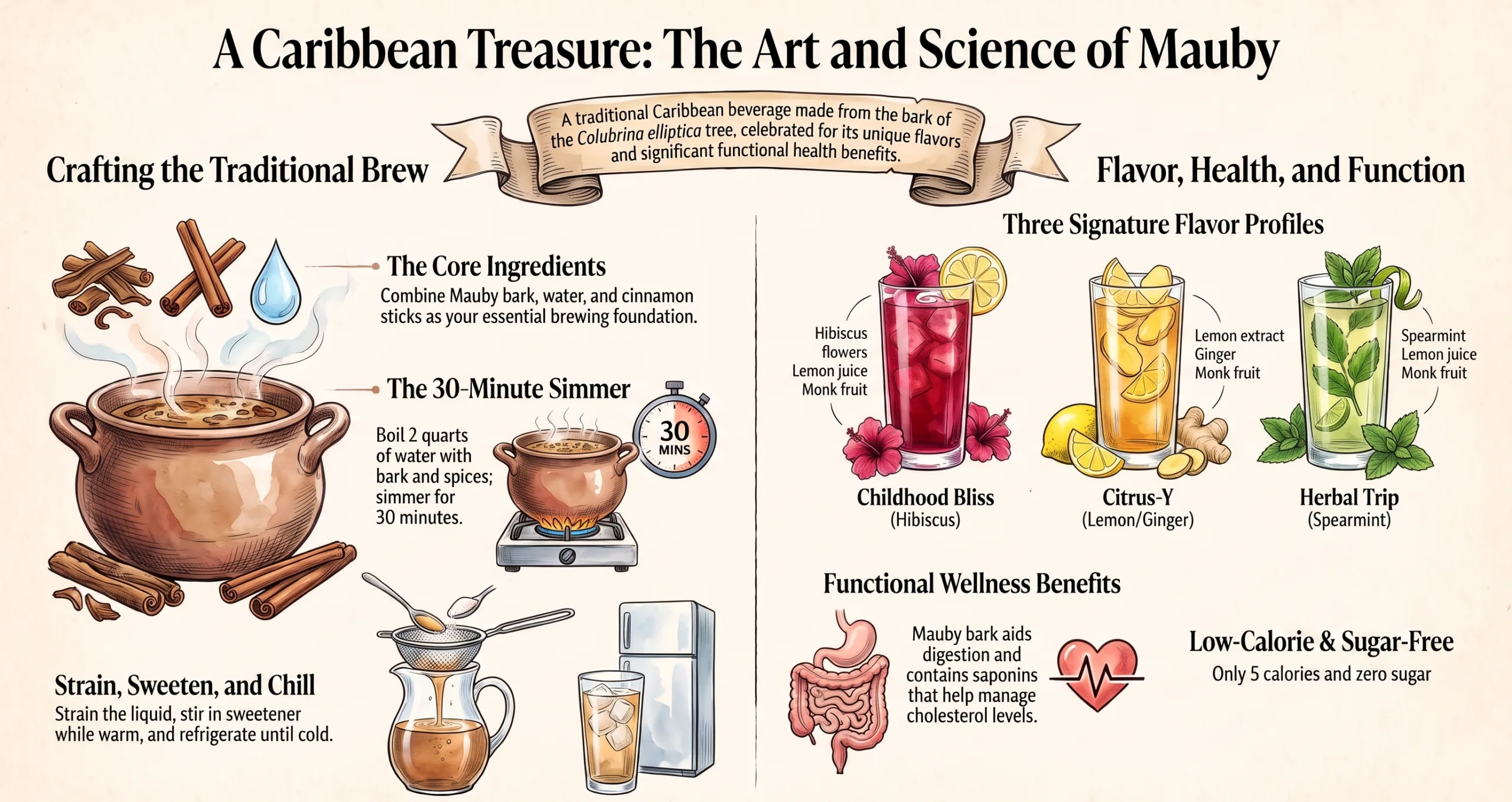
Mauby drink is one of those Caribbean classics you either grew up with or have never heard of. In Barbados, Trinidad, Antigua and across the eastern Caribbean it is sold from roadside coolers and bottled in shops, and it tastes like nothing else — bitter up front, sweet underneath, with a long liquorice-and-clove finish that people usually compare to root beer the first time they try it.
It is also easy to make at home from one dried ingredient, and that is most of what this article is about: the bark, the brew, and the three directions you can take the flavour.
The other thing this article does is take the health claims seriously enough to check them. Mauby is widely sold as a remedy, and you will find pages crediting it with lower blood pressure, lower cholesterol, better blood sugar, weight loss and joint relief. One of those has a small study behind it. The rest do not, and saying so is more useful than repeating them.
What Mauby Actually Is
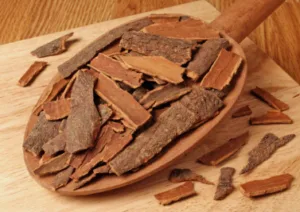
Mauby is an infusion of the bark of Colubrina elliptica, a small tree native to the Caribbean and parts of South Florida, also called mabi or soldierwood. The bark is dried, then steeped or simmered in water with spices and sweetened to taste. That is the whole drink.
The bitterness is the point, and it comes from tannins and saponins in the bark — the same class of compounds that make an over-steeped cup of tea pucker your mouth. Brewed well, that bitterness sits underneath the sweetness and the spice rather than dominating them. Brewed too long, it takes over completely, which is the single most common mistake first-time brewers make.
You can buy mauby bark dried, in strips or chips, from Caribbean grocers and online. Some shops sell a ready-made concentrate or a spiced bark blend instead; both work, though a blend will already contain its own mix of spices, so taste before you add more.
What You’ll Need
For about two quarts of finished drink:
- Mauby bark — a small handful of dried bark, roughly 1 oz / 30 g
- Water — 2 quarts, plus more for diluting
- Cinnamon sticks — 1 or 2
- Whole cloves — 4 to 6
- Star anise — 1 or 2 pods (optional, but it is where the liquorice note comes from)
- Nutmeg — a few gratings (optional)
- Sweetener — brown sugar is traditional; white sugar, honey or a sugar substitute all work
- Lime — for serving
A note on quantity: bark varies a lot in strength depending on how it was dried and how finely it is cut. Start at the low end, taste the concentrate before you dilute it, and write down what worked. Your second batch will be better than your first.
How to Brew It
- Bring 2 quarts of water to the boil in a large pot.
- Add the bark and the whole spices. Cinnamon, cloves and star anise all go in now.
- Simmer for 20 to 30 minutes. The liquid will darken to a deep reddish-brown. Twenty minutes gives a lighter, more approachable brew; thirty gives a stronger, more bitter one.
- Take it off the heat and strain out the solids. A fine sieve is enough; a cloth gives a clearer result.
- Sweeten while it is still warm, so the sugar dissolves properly. Add less than you think you want — the bitterness mellows as it cools and you can always add more.
- Cool, then refrigerate until properly cold.
- Dilute to taste and serve over ice with a wedge of lime.
What you have after step 5 is really a concentrate. Most people keep it in the fridge and dilute it a glass at a time, either with cold water or with sparkling water, which suits mauby particularly well. It keeps for about a week refrigerated.
The balance you are aiming for is sweet, bitter and spiced, with none of the three winning. If your brew is too bitter, dilute it further or add a little more sweetener. If it tastes flat, it usually needs more spice rather than more bark.
Three Ways to Flavour It
Once you can brew a decent base, the flavour is yours to steer. These three directions are a good place to start.
Floral and fruity
Steep dried hibiscus with the bark for the last five minutes of the simmer. Hibiscus is tart and deep red, and it softens mauby’s bitterness into something closer to a fruit cordial. Add a little extra sweetener to balance the acidity.
Citrus and ginger
Add a few coins of fresh ginger to the pot, and stir fresh lemon or lime juice into the finished, cooled concentrate rather than the hot one — heat dulls citrus. The result tastes like a grown-up lemonade with warmth behind it. This is the version that mixes best with sparkling water.
Herbal and minty
Add fresh spearmint or peppermint to the pot after you take it off the heat, and let it steep while the liquid cools. Mint and mauby go together more naturally than you would expect; the cooling note plays against the clove and makes the whole thing taste lighter.
Adjusting Sweetness and Spice
Sweetener. Brown sugar is the traditional choice and the best one — the molasses in it echoes the bark’s own darkness in a way white sugar does not. Honey works and brings its own floral note. If you are cutting sugar, monk fruit or stevia both work here, though they do not round off bitterness the way sugar does, so you may want a touch more dilution instead.
Worth knowing: traditional mauby is sweetened heavily. A commercially bottled or roadside mauby can carry as much sugar as a soft drink. Brewing your own is the easiest way to control that, and an unsweetened or lightly sweetened mauby is very close to calorie-free. That is the most practical health advantage the drink has, and unlike most of the claims made for it, it needs no research to support it — it is just arithmetic.
Spice. One cinnamon stick is a classic touch. One or two star anise pods add the liquorice note that makes a brew taste distinctly of mauby rather than of generic spiced tea. Cloves are powerful; four is plenty, six is assertive, ten will take over. The longer the spices steep, the more they dominate, so taste as you go.
Serving It
Mauby looks good in a tall, clear glass, where the colour shows. Plenty of ice, a wedge of lime on the rim, and either still or sparkling water to dilute.
Garnishes are worth bothering with here because they genuinely change the drink:
- Mint — cool and crisp against the spice
- Lime or lemon — sharpens the whole thing up
- A cinnamon stick — adds aroma as you drink
- A twist of orange peel — bright, and the oils carry
As a mixer it holds its own. A splash of light rum is the obvious pairing. It also works alongside Caribbean food — saltfish, callaloo, conch fritters — where the bitterness cuts through salt and oil the way a bitter aperitif does.
If you are serving it to people who have never had it, dilute it a little further than you would for yourself and say what it is first. Mauby divides opinion on the first sip and wins people over on the third.
What the Research Actually Says About Mauby Bark
Here is where most articles about mauby stop being useful, so it is worth being precise.
Mauby bark has a long history of medicinal use across the Caribbean, where it has been taken for high blood pressure, upset stomachs, aches and general tonic purposes for generations. That history is real and worth recording. It is not the same thing as evidence of effect, and the published research on mauby is very thin — a search of the medical literature turns up three papers in total.
Blood pressure: one small trial
This is the only health claim about mauby with a human study behind it. Researchers in the Caribbean gave 28 adults with hypertension one of four drinks for two weeks: bottled water, coconut water, mauby, or a mixture of coconut water and mauby. In the mauby group, 40% showed a significant fall in systolic blood pressure and 40% in diastolic. The combination of coconut water and mauby did better than either alone.
That is a genuinely interesting result and it points somewhere worth looking. It is also seven people drinking mauby for two weeks, published in 2005, and never repeated. It is not a reason to treat mauby as blood-pressure medicine, and it is certainly not a reason to stop taking anything you have been prescribed.
Anti-inflammatory compounds: chemistry, not people
Mauby bark contains triterpenoid saponins — a class of plant compounds that do show anti-inflammatory activity in laboratory tests. The compounds in mauby bark specifically were identified and described in a 1994 chemistry paper.
What that tells you is what is in the bark. It does not tell you what happens when a person drinks it, because nobody has tested that. A compound showing activity in a dish is a reason for researchers to keep going, not a reason for you to drink mauby for arthritis.
Cholesterol, blood sugar, weight loss and joints: not tested
You will find all four claimed confidently, usually with a journal named but no study you can actually open. As far as the published literature goes:
- Cholesterol — no study has tested mauby in people. Saponins as a class can bind cholesterol in a test tube, and saponins from other plants have been studied in humans, but mauby has not.
- Blood sugar — no trial has looked at mauby and blood glucose or insulin sensitivity. If you have diabetes or prediabetes, the thing about mauby that actually matters to you is how much sugar you put in it.
- Weight loss — the research behind this claim is in rats, and rodent findings on appetite and body weight often fail to carry over to people. The real effect is the swap: unsweetened mauby instead of a sugary drink removes calories from your day.
- Joints and arthritis — traditional use, yes. Tested, no.
One safety finding worth knowing
There is a published case report of a patient taking warfarin whose INR — a measure of how thinned the blood is — rose while they were drinking mauby. One case report does not establish an interaction, but it is the only safety signal in the literature and it points at a drug where the consequences of getting it wrong are serious. If you take warfarin or another blood thinner, mention mauby to your doctor or pharmacist before you start drinking it regularly.
The honest summary
Mauby is a good drink with a long cultural history and one small, unrepeated study suggesting it might do something for blood pressure. Everything beyond that is either laboratory chemistry or repetition. Drink it because it tastes like nothing else, and because an unsweetened version is a genuinely low-calorie alternative to soft drinks. Do not drink it instead of treatment.
Before You Try This
This article is for general information. It is not medical advice, and it is not a substitute for talking to someone who knows your history.
Food and drinks affect people differently, and a few of the ingredients here interact with common prescriptions. Talk to your doctor, pharmacist or a registered dietitian before you change your diet for a health reason, start a supplement, or try anything described here as a remedy — and especially if you are pregnant or breastfeeding, taking medication, managing a chronic condition, or buying for a child. There is at least one published case of mauby raising the INR of a patient taking warfarin, which increases bleeding risk, so if you take a blood thinner, ask before drinking mauby regularly.
If something you eat or drink makes you feel unwell, stop and get medical help.
Frequently Asked Questions
What is mauby drink?
Mauby is a traditional Caribbean drink made by steeping the dried bark of the Colubrina elliptica tree in water with spices, then sweetening it. It tastes bitter, sweet and aromatic at once, and most people compare their first sip to root beer.
What ingredients do I need to make mauby at home?
Dried mauby bark, water, a sweetener, and whole spices — cinnamon, cloves and star anise are the usual three. Lime for serving. Hibiscus, fresh ginger or mint if you want to steer the flavour.
Where can I buy mauby bark?
Caribbean and West Indian grocers usually stock it, sold as dried bark strips or chips, and sometimes as a ready-made syrup or concentrate. It is also widely available online. Check the label before you buy: a plain bark product should list nothing but bark, while syrups and concentrates often contain a lot of added sugar, which matters if you are trying to keep your mauby drink low in calories.
How long should I boil mauby bark?
Twenty to thirty minutes of simmering. Twenty gives a lighter brew, thirty a stronger and more bitter one. Longer than that and the bitterness becomes hard to balance, however much you sweeten it.
Why is my mauby so bitter?
Usually one of three things: too much bark, too long a simmer, or not enough dilution. Mauby is normally brewed as a concentrate and diluted by the glass. Try adding more water before you add more sugar.
How long does homemade mauby keep?
About a week in the fridge as a sweetened concentrate. Dilute it as you pour. If it smells sour, turns cloudy or starts to fizz on its own, it has begun to ferment, so throw it out and brew a fresh batch.
Is mauby drink healthy?
Made without much sweetener, mauby is nearly calorie-free, which makes it a good alternative to sugary drinks — that is its clearest benefit. Beyond that, the evidence is thin: one small trial found lower blood pressure in some people who drank it for two weeks, and laboratory work has identified anti-inflammatory compounds in the bark. Claims about cholesterol, blood sugar, weight loss and joints have not been tested in people. Traditional mauby, bottled or from a roadside cooler, is often heavily sweetened and can carry as much sugar as a soft drink.
Can I drink mauby if I take medication?
Ask your pharmacist, particularly if you take a blood thinner — see the note above. The same goes for blood-pressure medication, given the one study suggesting mauby may lower blood pressure.
Can mauby be mixed with alcohol?
Yes. Light rum is the natural pairing, and mauby also works as a mixer with sparkling water for a non-alcoholic version.
Sources and Further Reading
- The control of hypertension by use of coconut water and mauby: two tropical food drinks — Alleyne T, Roache S, Thomas C, Shirley A. West Indian Med J. 2005;54(1):3-8
- Mabiosides C-E: triterpenoid saponins from the bark of Colubrina elliptica — Phytochemistry. 1994
- Elevated International Normalized Ratio in a Patient Taking Warfarin and Mauby: A Case Report — J Pharm Pract. 2017;30(5):567-570
- NCCIH: Dietary and Herbal Supplements — National Institutes of Health
- Mauby — Wikipedia
- Colubrina elliptica — Wikipedia


One thought on “How to Make Mauby Drink: Recipe, Flavour Variations and What the Research Says”