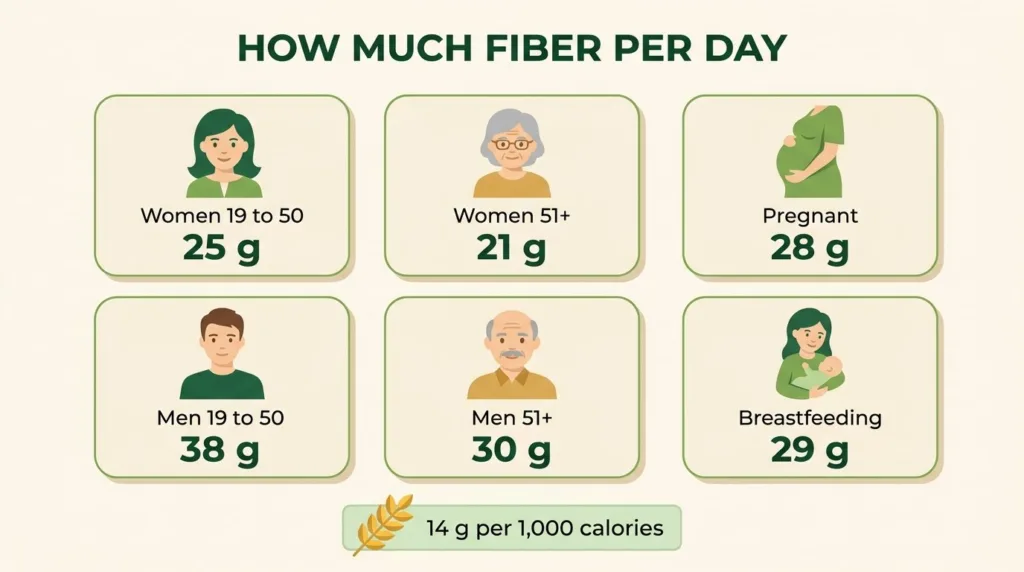
How much fiber per day do you need? Most adults need 25 to 38 grams a day: women 19 to 50 need 25 g (21 g after 50), and men 19 to 50 need 38 g (30 g after 50). Those targets come from the National Academies and work out to about 14 grams of fiber for every 1,000 calories you eat.
This guide shows how much fiber per day kids, teens, and pregnant or breastfeeding women need, plus a food chart with grams per serving. You’ll see what 25 g and 30 g of fiber look like on a plate, how much fiber is too much, and how to increase fiber intake without the gas and bloating. Use the free fiber calculator below to find your number and build a week-by-week plan.
Key Takeaways
- Daily fiber intake for adults: 25 g for women 19 to 50, 21 g for women 51 and older, 38 g for men 19 to 50, and 30 g for men 51 and older (Institute of Medicine, 2005).
- The rule behind the numbers: 14 g of fiber per 1,000 calories. If you eat about 2,000 calories, that’s 28 g.
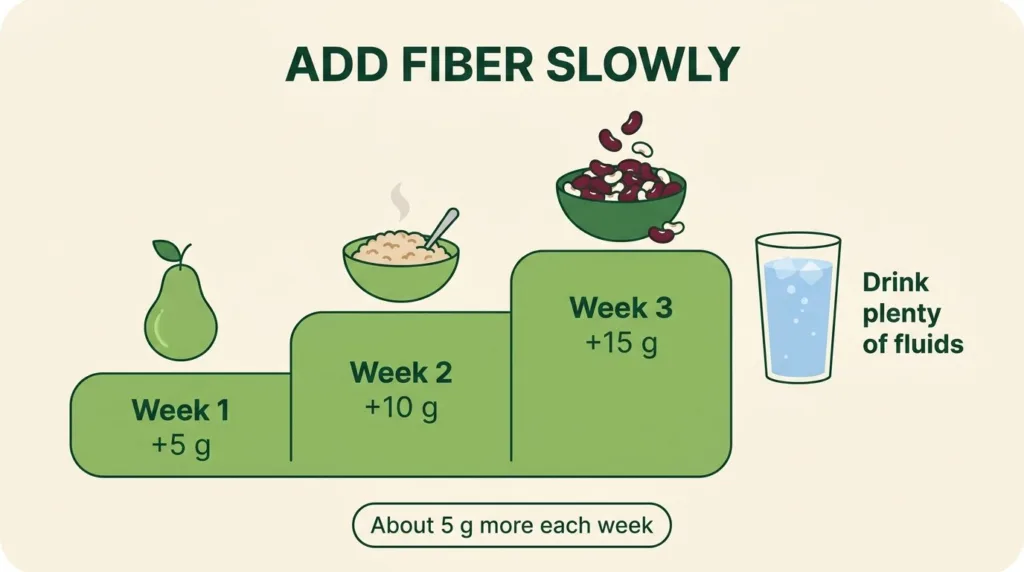
- Go slow: Add about 5 g a day, hold it for a week, then add 5 g more. Drink plenty of fluids as you go.
- Top foods: Chia seeds (9.8 g per ounce), split peas (8.1 g per 1/2 cup), raspberries (8.0 g per cup) and lentils (7.8 g per 1/2 cup).
- No official upper limit: No Tolerable Upper Intake Level has been set for fiber, but too much too fast can cause gas, bloating and cramping (Mayo Clinic).
Pick your age and sex, add your calories if you know them, then enter what you eat on a typical day, like a simple fiber tracker. The fiber calculator works out how much fiber per day you need and plans your ramp-up.
Fiber Calculator and Ramp-Up Planner
Find how much fiber you need per day, add up what you eat now, and get a week-by-week plan to close the gap without the bloating.
Targets are the Adequate Intakes from the National Academies (Institute of Medicine, 2005), set at 14 g of fiber per 1,000 calories. No upper limit has been set for fiber. The 5 g-a-week pace follows the Academy of Nutrition and Dietetics advice to raise fiber by no more than 5 g at a time. Food values are from USDA FoodData Central (SR Legacy). This is general information, not medical advice; ask your doctor first if you have a bowel condition such as Crohn’s disease, diverticulitis or a past bowel blockage.
The calculator needs JavaScript. The tables below give the same daily targets and food values.
How Much Fiber Per Day by Age and Sex
The official answer to how much fiber per day you need comes from the Adequate Intakes (AIs) set by the Institute of Medicine (now the National Academies) in its 2005 Dietary Reference Intakes report. Here is the recommended daily fiber for every group:
| Group | Age | Fiber per day |
|---|---|---|
| Children | 1 to 3 | 19 g |
| Children | 4 to 8 | 25 g |
| Boys | 9 to 13 | 31 g |
| Boys | 14 to 18 | 38 g |
| Girls | 9 to 13 | 26 g |
| Girls | 14 to 18 | 26 g |
| Men | 19 to 50 | 38 g |
| Men | 51 and older | 30 g |
| Women | 19 to 50 | 25 g |
| Women | 51 and older | 21 g |
| Pregnancy | All ages | 28 g |
| Breastfeeding | All ages | 29 g |
Source: Institute of Medicine, 2005, as reproduced in Health Canada’s Dietary Reference Intakes tables. Mayo Clinic gives the same adult numbers.
How Much Fiber Per Day for Women
How much fiber per day do women need? Women 19 to 50 need about 25 g. After 50, the target drops to 21 g. During pregnancy it rises to 28 g, and while breastfeeding to 29 g.
How Much Fiber Per Day for Men
How much fiber per day do men need? Men 19 to 50 need about 38 g, and men 51 and older need about 30 g. Men’s targets are higher mainly because men tend to eat more calories, as the next section explains.
Other Daily Fiber Intake Numbers You May See
You may see slightly different answers to how much fiber per day adults need. The National Institute of Diabetes and Digestive and Kidney Diseases (NIDDK) says adults should get 22 to 34 grams a day, depending on age and sex. The newest 2025 to 2030 Dietary Guidelines for Americans, released in January 2026, urge you to choose fiber-rich whole grains but don’t set a gram target, according to an American Academy of Family Physicians summary. So the gram targets on this page still come from the 2005 Dietary Reference Intakes.
Why 14 Grams per 1,000 Calories?
To decide how much fiber per day each group needs, the Institute of Medicine started with 14 g of fiber for every 1,000 calories. It then multiplied that by the typical (median) calorie intake for each age and sex group. That’s why the numbers go up for teen boys and men, who usually eat the most, and down for adults over 50, who tend to eat less.
That also means you can work out how much fiber per day you need from your own calories:
- 1,800 calories a day: about 25 g of fiber
- 2,000 calories a day: 28 g
- 2,500 calories a day: 35 g
The fiber intake calculator above does this for you when you enter your calories. It shows both your calorie-based target and the standard Adequate Intake for your group. If you don’t know your calories, use the table.
Fiber in Common Foods
Knowing how much fiber per day you need is only half of it. The other half is knowing what’s in your food. These two charts show the fiber in common foods, using USDA FoodData Central values. They are the same foods and numbers used in our fiber calculator.
Beans, Grains, Nuts and Seeds
| Food | Serving | Fiber |
|---|---|---|
| Chia seeds | 1 oz (about 2 tbsp) | 9.8 g |
| Split peas, cooked | 1/2 cup | 8.1 g |
| Lentils, cooked | 1/2 cup | 7.8 g |
| Black beans, cooked | 1/2 cup | 7.5 g |
| Kidney beans, cooked | 1/2 cup | 6.5 g |
| Chickpeas, cooked | 1/2 cup | 6.2 g |
| Quinoa, cooked | 1 cup | 5.2 g |
| Whole-wheat pasta, cooked | 1 cup | 4.6 g |
| Oatmeal, cooked | 1 cup | 4.0 g |
| Green peas, cooked | 1/2 cup | 3.6 g |
| Almonds | 1 oz (about 23) | 3.5 g |
| Popcorn, air-popped | 3 cups | 3.5 g |
| Brown rice, cooked | 1 cup | 3.2 g |
| Whole-wheat bread | 1 slice | 1.9 g |
| Flaxseed, ground | 1 tbsp | 1.9 g |
| White bread | 1 slice | 0.8 g |
Fruits and Vegetables
| Food | Serving | Fiber |
|---|---|---|
| Raspberries | 1 cup | 8.0 g |
| Blackberries | 1 cup | 7.6 g |
| Avocado | 1/2 fruit | 6.7 g |
| Pear, with skin | 1 medium | 5.5 g |
| Apple, with skin | 1 medium | 4.4 g |
| Sweet potato, baked | 1 medium | 3.8 g |
| Potato, baked, with skin | 1 medium | 3.8 g |
| Banana | 1 large | 3.5 g |
| Prunes | 5 prunes | 3.4 g |
| Orange | 1 medium | 3.1 g |
| Strawberries | 1 cup halves | 3.0 g |
| Broccoli, cooked | 1/2 cup | 2.6 g |
| Spinach, cooked | 1/2 cup | 2.2 g |
| Brussels sprouts, cooked | 1/2 cup | 2.0 g |
| Carrot, raw | 1 medium | 1.7 g |
Source: USDA FoodData Central (SR Legacy). Values are rounded to one decimal.

A few patterns stand out. Beans, peas and lentils give you the most fiber for the least food, at 6 to 8 g per half cup. Berries beat most other fruit. And small swaps add up: one slice of whole-wheat bread has more than twice the fiber of white bread (1.9 g vs 0.8 g). Prunes are a classic for regularity too; if that’s why you’re here, see our guide on How Much Prune Juice for Constipation?
What 25 Grams (and 30 Grams) of Fiber Looks Like
A gram target is hard to picture. Here is how much fiber per day 25 g and 30 g look like in real meals, built only from the foods above. Each total is simply the foods added up.
A 25-Gram Day
| Meal | Foods | Fiber |
|---|---|---|
| Breakfast | 1 cup oatmeal (4.0 g) with 1 tbsp ground flaxseed (1.9 g) | 5.9 g |
| Lunch | Sandwich on 2 slices whole-wheat bread (3.8 g), 1 medium apple (4.4 g), 1 raw carrot (1.7 g) | 9.9 g |
| Snack | 1 oz almonds | 3.5 g |
| Dinner | 1 cup brown rice (3.2 g) with 1/2 cup broccoli (2.6 g) | 5.8 g |
| Total | 25.1 g |
That meets the target for a woman 19 to 50 with no beans and no unusual foods.
A 30-Gram Day
| Meal | Foods | Fiber |
|---|---|---|
| Breakfast | 1 cup oatmeal (4.0 g) with 1 cup raspberries (8.0 g) | 12.0 g |
| Lunch | Lentil soup with 1/2 cup lentils (7.8 g), 1 slice whole-wheat bread (1.9 g) | 9.7 g |
| Snack | 1 raw carrot | 1.7 g |
| Dinner | 1 cup whole-wheat pasta (4.6 g) with 1/2 cup broccoli (2.6 g) | 7.2 g |
| Total | 30.6 g |
Need 38 g, the target for men 19 to 50? Add 1/2 cup black beans (7.5 g) to the pasta or a side salad, and the day comes to 38.1 g.
How to Increase Fiber Intake Without Bloating
Once you know how much fiber per day you need, the biggest mistake is jumping straight there from a low-fiber diet. Mayo Clinic warns that adding too much fiber too quickly can cause gas, bloating and cramping, and advises adding fiber slowly over a few weeks. That gives the natural bacteria in your gut time to adjust.
The 5 Grams a Week Ramp-Up
Michigan State University Extension passes on advice from the Academy of Nutrition and Dietetics: don’t raise your total fiber by more than 5 grams each day until you reach your goal. Our ramp-up planner takes a cautious reading of that. It adds about 5 g to your daily total, then has you hold that level for a full week before adding 5 g more.
Here is the plan the fiber calculator gives a woman 19 to 50 who eats about 12 g a day now. Her target is 25 g, so she has a 13 g gap:
| Week | Aim for | Try adding |
|---|---|---|
| Week 1 | 17 g a day | 1 pear with the skin (5.5 g) |
| Week 2 | 22 g a day | 1 cup oatmeal topped with 1 tbsp ground flaxseed (5.9 g) |
| Week 3 | 25 g a day | A small extra: 1 slice whole-wheat bread or 1/2 cup broccoli |
A man 19 to 50 who eats about 15 g now has a 23 g gap to his 38 g target. At the same pace, his plan takes 5 weeks. That slower pace is what keeps side effects mild.
More Tips to Add Fiber Gently
- Drink plenty of fluids. NIDDK says drinking plenty of liquids helps fiber work better. Water, clear soups and other drinks all count.
- Spread it out. Have some fiber at breakfast, lunch, dinner and snacks instead of one huge serving.
- Swap one grain at a time. MSU Extension suggests trading white bread for one whole-grain serving the first week, two the second, and so on.
- Prep beans with care. If you cook dried beans, MSU Extension suggests soaking them overnight and draining off the soaking water.
- Stay put if you need to. Some gas in the first days of a new step is common. If it’s uncomfortable, stay at that step for another week before adding more.
Soluble vs Insoluble Fiber
Fiber comes in two main types. Mayo Clinic explains the difference:
| Soluble fiber | Insoluble fiber | |
|---|---|---|
| What it does | Dissolves in water to form a gel; can help lower cholesterol and blood sugar | Helps material move through your digestive system; adds bulk to stool |
| Good sources | Oats, peas, beans, apples, citrus, carrots, barley, psyllium | Whole-wheat flour, wheat bran, nuts, beans, vegetables |
You don’t need to track the two types separately. When you add up how much fiber per day you eat, count total fiber, and a varied diet of beans, whole grains, fruit, vegetables and nuts gives you both.
How Much Fiber Is Too Much?
There is no official upper limit on how much fiber per day you can eat. When the Institute of Medicine set the fiber targets in 2005, it did not set a Tolerable Upper Intake Level (UL) for fiber. But Health Canada’s reproduction of those tables adds an important note: the lack of a UL does not mean that high intakes are safe. In other words, nobody has drawn a line, not that the sky’s the limit.
In practice, how much fiber is too much depends on you: how much you usually eat, how fast you increase it, and how much you drink.
Too Much Fiber Symptoms
Watch for these signs that you’ve added too much fiber too fast:
- Gas and bloating
- Cramping (Mayo Clinic lists gas, bloating and cramping)
- Loose stools
- Harder stools or constipation if you don’t drink enough. Fiber pulls water into the gut, so without enough fluid it can make constipation worse.
If you notice these, ease back to the last amount that felt fine, drink more fluids, and hold there for a week. The fiber calculator flags it when you enter more than your target, with similar advice.
When to Talk to Your Doctor First
Mayo Clinic notes that people with Crohn’s disease, a flare of ulcerative colitis, or diverticulitis may be told to eat less fiber for a time. If you have a bowel condition, have had a bowel blockage, or are changing your diet for a child with constipation, ask your doctor or a dietitian before you raise how much fiber per day you eat.
Do You Need a Fiber Supplement?
Most people can reach their daily fiber intake with food, and food is the best place to start. Whole foods bring other nutrients along with the fiber, and the sample days above show that 25 to 38 grams is doable with ordinary meals.
That said, supplements can help some people fill a gap. The Dietary Reference Intakes count total fiber, which is the fiber naturally in foods plus “functional fiber,” meaning isolated fibers that are added to foods or taken as supplements. So if you use a fiber supplement such as psyllium, count its grams (from the label) toward how much fiber per day you get. The calculator has a box for “Fiber from other foods” where you can add it.
The same ramp-up rules apply. Start with a small dose, raise it slowly, and drink plenty of fluids. If you take medicines, ask your pharmacist about timing.
Curious about cleanses and detox products for digestion? Our article Does Colon Cleansing Work? What Actually Helps Your Digestion looks at what the evidence supports, and fiber plays a big part.
Frequently Asked Questions
How much fiber should I eat a day?
The answer to “how much fiber do I need” depends on your age and sex. Most adults should eat 21 to 38 grams a day. Women 19 to 50 need 25 g and men 19 to 50 need 38 g. After 50, it’s 21 g for women and 30 g for men. For a personal number, multiply your daily calories by 14 g per 1,000 calories, or use the fiber calculator above.
What do 30 grams of fiber look like?
One example: 1 cup oatmeal with 1 cup raspberries (12.0 g), lentil soup with 1/2 cup lentils and a slice of whole-wheat bread (9.7 g), a raw carrot (1.7 g), and 1 cup whole-wheat pasta with 1/2 cup broccoli (7.2 g). That adds up to 30.6 g.
How do I get 25 grams of fiber a day?
Build a high-fiber food into each meal. For example: oatmeal with ground flaxseed for breakfast, a whole-wheat sandwich with an apple and a carrot for lunch, almonds as a snack, and brown rice with broccoli for dinner. That’s 25.1 g. If you eat much less now, get there over a few weeks.
Is 1 apple a day enough fiber?
No. A medium apple with the skin has 4.4 g of fiber, about a sixth of a 25 g target. It’s a great start toward how much fiber per day you need, but you need other high-fiber foods through the day too.
What food is the highest in fiber?
Among the foods in our chart, chia seeds have the most per serving at 9.8 g per ounce (about 2 tablespoons). Next come split peas (8.1 g), raspberries (8.0 g) and lentils (7.8 g). Beans, lentils and berries are the easiest way to add a lot of fiber with one food.
Is it okay to eat 60 grams of fiber a day?
There is no official upper limit for fiber, so there’s no set number that is “too much.” But Health Canada’s DRI tables point out that no UL does not mean high intakes are safe. If you eat far above your target, get there slowly, drink plenty of fluids, and cut back if you have gas, bloating or loose stools. If you have a bowel condition, ask your doctor first.
Is 20 grams of fiber too much in one meal?
No official guideline sets a per-meal limit. Some people who are used to high-fiber meals handle a big bean bowl just fine. If you’re still building up, though, spread fiber across your meals and snacks. That’s gentler on your gut than one large serving.
How do I tell if I’m eating too much fiber?
Common signs are gas, bloating, cramping, and changes in your stools. These usually mean you increased fiber too fast or aren’t drinking enough. Ease back to the last amount that felt fine, drink more, and hold for a week before adding again.
Final Thoughts on How Much Fiber Per Day You Need
For most adults, the answer to how much fiber per day is 25 to 38 grams: 25 g for women and 38 g for men up to age 50, and 21 g and 30 g after that. Or use 14 g for every 1,000 calories you eat. Beans, berries, whole grains, nuts and seeds make those numbers easy to reach.
The key is to get there slowly. Add about 5 grams a day, hold it for a week, and keep drinking fluids. Use the fiber calculator and ramp-up planner at the top of this page to see how much fiber per day you need, your gap and your week-by-week plan.
This article is general information, not medical advice. If you have a digestive condition, talk with your doctor before making big changes.
Sources and Further Reading
- Institute of Medicine. Dietary Reference Intakes for Energy, Carbohydrate, Fiber, Fat, Fatty Acids, Cholesterol, Protein, and Amino Acids. National Academies Press. 2005.
- Health Canada. Dietary Reference Intakes Tables: Reference Values for Macronutrients.
- Mayo Clinic. Dietary fiber: Essential for a healthy diet.
- National Institute of Diabetes and Digestive and Kidney Diseases. Eating, Diet, and Nutrition for Constipation.
- Michigan State University Extension. Get your fiber without the flatulence. May 10, 2024.
- American Academy of Family Physicians. Practice Guidelines: Dietary Guidelines for Americans, 2025 to 2030. American Family Physician. July 2026.
- US Department of Agriculture. FoodData Central (SR Legacy).