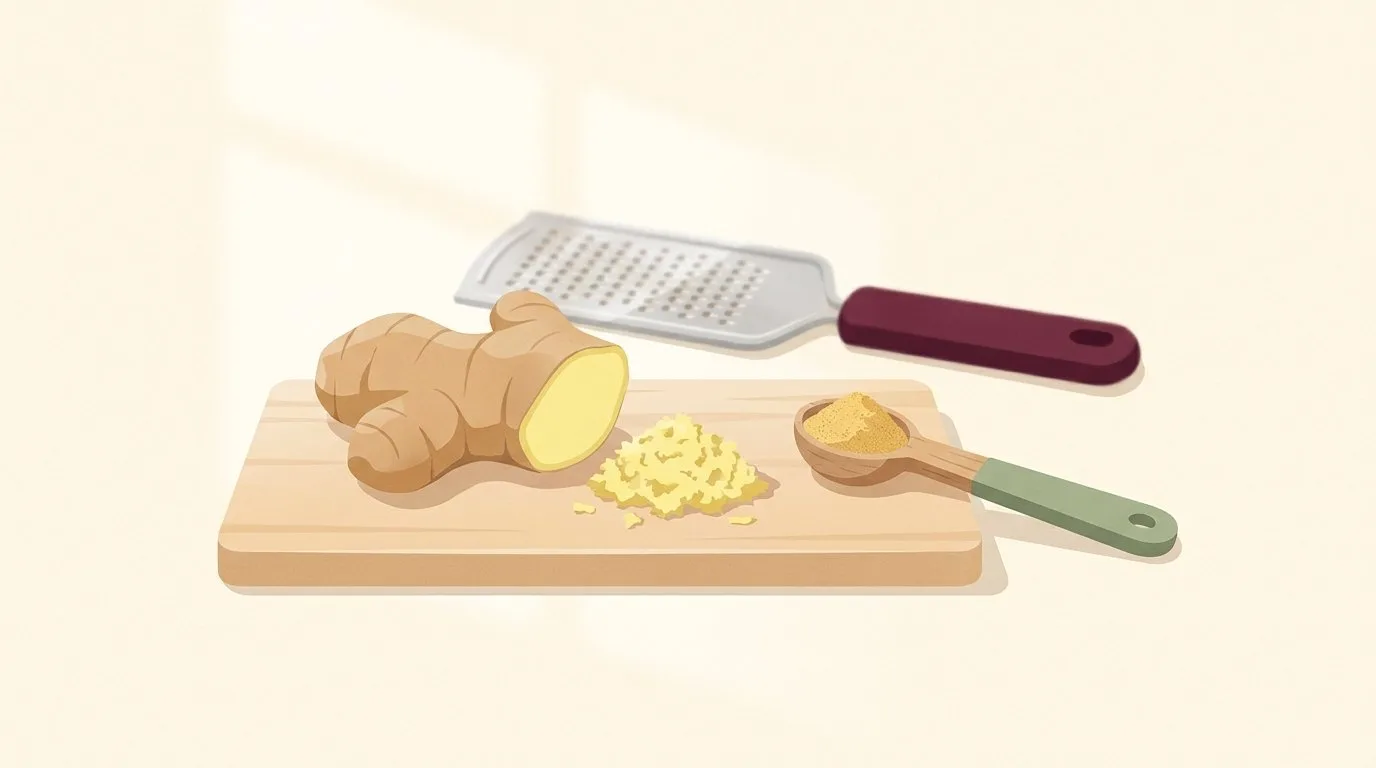
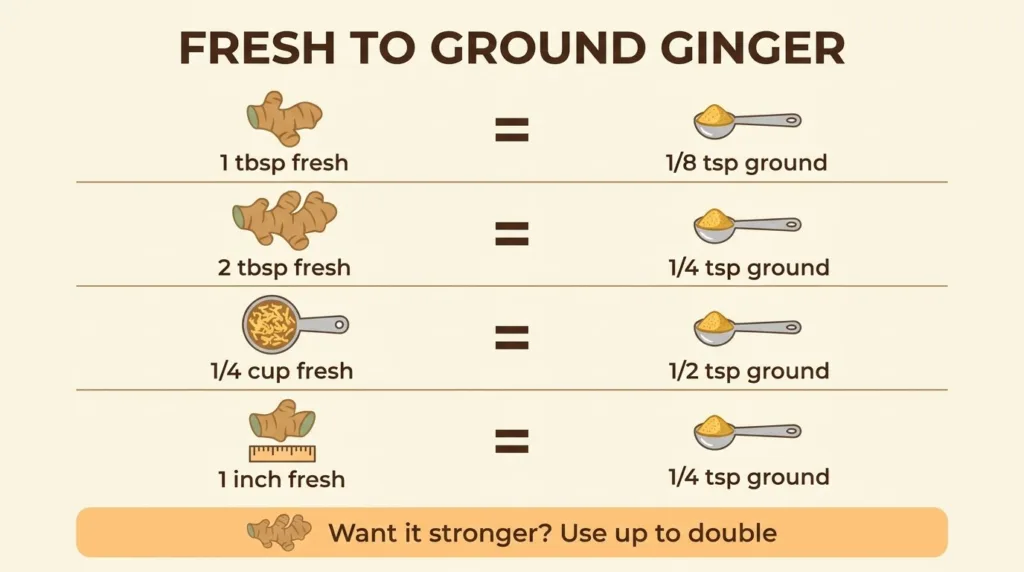
Converting fresh ginger to ground ginger is simple once you know the ratio: 1 tablespoon of grated fresh ginger equals about 1/8 teaspoon of ground ginger. That is the figure in university extension substitution guides. Many recipes use a stronger swap of 1/4 teaspoon, so start at 1/8 and taste.
This guide covers the fresh ginger to ground ginger swap in both directions. You’ll find a conversion chart, why sources disagree, how much ginger is in a “thumb,” and when ground ginger works as a stand-in. Use the converter below for any amount, then read on for the details.
Key Takeaways
- Standard fresh ginger to ground ginger ratio: 1 tbsp grated fresh ginger = 1/8 tsp ground ginger (Colorado State and New Mexico State extension guides).
- Stronger ratio: Many recipes use 1/4 tsp ground per 1 tbsp fresh. Neither is wrong. Start at 1/8 tsp and add more to taste.
- Reverse swap: 1/4 tsp ground ginger = about 2 tbsp grated fresh (standard) or 1 tbsp (stronger).
- Weigh when you can: 1 tsp grated fresh ginger is about 2 g and 1 tsp ground is about 1.8 g (USDA). A “thumb” of ginger varies a lot in size.
- Best uses: Ground ginger swaps in well for baking, curries, soups and spice rubs. Fresh is hard to replace in dressings, stir-fries, smoothies and ginger shots.
Enter the amount your recipe calls for, and the converter handles fresh ginger to ground ginger, or ground to fresh.
Fresh to Ground Ginger Converter
Swap fresh ginger for ground ginger, or ground for fresh. Enter the amount your recipe calls for.
Same amount, other ways to measure
| Measure | Amount |
|---|
Quick chart
| Fresh ginger | Ground, standard | Ground, stronger |
|---|
Tips for swapping
The standard ratio (1 tbsp raw ginger = 1/8 tsp powdered) is from Colorado State University and New Mexico State University Extension substitution guides. Many recipes use up to 1/4 tsp. Weights are from USDA FoodData Central (1 tsp grated fresh = 2 g, 1 tsp ground = 1.8 g). A “thumb” is about 15 g (Iowa State University Extension). Inch weights are our estimate for a root of that width; roots vary, so weigh when you can.
The converter needs JavaScript. The chart below gives the same conversions.
Fresh Ginger to Ground Ginger Conversion Chart
This chart shows the fresh ginger to ground ginger conversion for common recipe amounts. The middle column uses the standard extension ratio. The right column uses the stronger ratio that many recipes follow.
| Fresh ginger | Ground ginger, standard (1/8 tsp per tbsp) | Ground ginger, stronger (1/4 tsp per tbsp) |
|---|---|---|
| 1 tsp grated | A pinch (under 1/8 tsp) | 1/8 tsp |
| 1 tbsp grated | 1/8 tsp | 1/4 tsp |
| 2 tbsp grated | 1/4 tsp | 1/2 tsp |
| 1/4 cup grated | 1/2 tsp | 1 tsp |
| 1 inch piece (medium root, about 12 g) | 1/4 tsp | 1/2 tsp |
| 1 oz (28 g) | 5/8 tsp | 1 1/8 tsp |
Grated amounts assume about 2 g per teaspoon of grated fresh ginger, the USDA figure, so 1 tablespoon is about 6 g. The inch row is our estimate for a root about 1 inch across. Roots vary, so weighing gives the most reliable result. For a fresh ginger to ground ginger amount not shown here, use the converter.
The Fresh Ginger to Ground Ginger Ratio, and Why Sources Disagree
If you search for the fresh ginger to ground ginger ratio, you’ll see two answers: 1/8 teaspoon and 1/4 teaspoon of ground ginger per tablespoon of fresh. Both are in common use.
The Extension Ratio: 1/8 Teaspoon
Colorado State University Extension’s ingredient substitution chart lists 1 tablespoon of candied or raw ginger as equal to 1/8 teaspoon of powdered ginger. New Mexico State University’s “In a Pinch” substitution guide gives the same figure: 1/8 teaspoon of powdered ginger equals 1 tablespoon of raw ginger.
That fresh ginger to ground ginger swap is a lot smaller than the general herb rule. For leafy herbs, the Colorado State chart says 1 tablespoon fresh equals 1 teaspoon dried, a 3 to 1 swap. For ginger, the swap is 24 to 1. Ground ginger is far more concentrated than chopped dried herbs.
The Recipe Ratio: 1/4 Teaspoon
Plenty of cookbooks, spice companies and recipe sites use a stronger fresh ginger to ground ginger swap: 1 tablespoon fresh = 1/4 teaspoon ground. The Spice House, a Chicago spice merchant, uses that figure, and so does our own ginger tea recipe with a strength calculator. People who want a clear ginger flavor often prefer it.
Which Fresh Ginger to Ground Ginger Ratio Should You Use?
Think of the two numbers as a range, not a contest. Ground ginger brands differ in strength, and so do fresh roots. Young ginger is milder, while mature ginger is more pungent, according to Iowa State University Extension.
Our advice for converting fresh ginger to ground ginger:
- Start with 1/8 teaspoon ground ginger for each tablespoon of fresh.
- Stir it in early so the flavor spreads through the dish.
- Taste, then add more, up to 1/4 teaspoon per tablespoon.
It is easier to add ginger than to take it out. For baked goods you can’t taste as you go, pick the ratio that matches how gingery you want the result. The converter above has a switch for each.
Ground Ginger to Fresh Ginger: The Reverse Swap
Going from ground ginger to fresh ginger uses the same ratio as fresh ginger to ground ginger, just flipped. Each 1/8 teaspoon of ground ginger equals about 1 tablespoon of grated fresh ginger by the standard ratio, or 1/2 tablespoon by the stronger one.
| Ground ginger | Fresh ginger, standard | Fresh ginger, stronger |
|---|---|---|
| 1/8 tsp | 1 tbsp grated (about 6 g) | 1 1/2 tsp grated (about 3 g) |
| 1/4 tsp | 2 tbsp grated (about 12 g) | 1 tbsp grated (about 6 g) |
| 1/2 tsp | 1/4 cup grated (about 24 g) | 2 tbsp grated (about 12 g) |
| 1 tsp | 1/2 cup grated (about 48 g) | 1/4 cup grated (about 24 g) |
Those fresh amounts can look large. That is because ground ginger is so concentrated. If a recipe was written for ground ginger, starting with the smaller fresh amount in the right column and tasting is a sensible approach. Fresh ginger also brings a brighter, juicier flavor, so the dish will taste a little different either way.
How Much Is a Thumb of Ginger?
Recipes often say “a thumb of ginger” or “a 1-inch piece.” So how much is a thumb of ginger? There is no standard size, and sources give quite different answers.
- Iowa State University Extension (used in the converter for a thumb): Its AnswerLine service describes a recipe “thumb” as about 2 inches long and 1/2 inch across, weighing about 1/2 ounce (15 g) and yielding about 1 tablespoon minced. Finely grated ginger is fluffier than minced, so by USDA’s figure of 2 g per teaspoon the same 15 g fills about 2 1/2 tablespoons grated, which is what the converter shows.
- Our estimate for inches: A 1-inch piece of medium root, about 1 inch across, weighs roughly 12 g. We worked this out by treating the root as a simple cylinder, so thicker or thinner roots weigh more or less.
- Our ginger shot recipe: As our ginger shot recipe points out, “a 2-inch piece” can be anywhere from about 10 g to 40 g, depending on how thick and knobby the root is.
Real ginger is knobby, branched and uneven, so any inch or thumb figure is a rough guess. A kitchen scale solves the problem. Weigh your piece in grams, then enter that weight in the converter to get your fresh ginger to ground ginger amount. By USDA figures, about 6 g of fresh ginger is a tablespoon grated.

Ground Ginger vs Fresh Ginger: Flavor and When Each Works Best
Ground ginger vs fresh ginger is not just a question of strength. They taste different because drying changes the root’s chemistry.
Why They Taste Different
Fresh ginger’s bite comes mainly from compounds called gingerols. When ginger is dried or heated, gingerols lose water and turn into related compounds called shogaols. A 2015 review in Phytochemistry describes gingerols as the main pungent compounds of fresh ginger and shogaols as the main ones in dried ginger. A 2018 study found that shogaols are present only in trace amounts in fresh ginger, and that heating greatly increases them.
Shogaols are reported to be more pungent than gingerols. That helps explain why ground ginger tastes warmer and more peppery, while fresh ginger tastes bright, juicy and a little citrusy. It is also why any fresh ginger to ground ginger swap changes the flavor a little, whatever ratio you use.
Water Makes a Big Difference
USDA data shows fresh ginger root is about 79% water, while ground ginger is about 10% water. Per 100 g, ground ginger has about 335 calories and 14.1 g of fiber, compared with 80 calories and 2.0 g of fiber in fresh root. Most of what you grate is water, which is one reason the fresh ginger to ground ginger ratio is so lopsided.
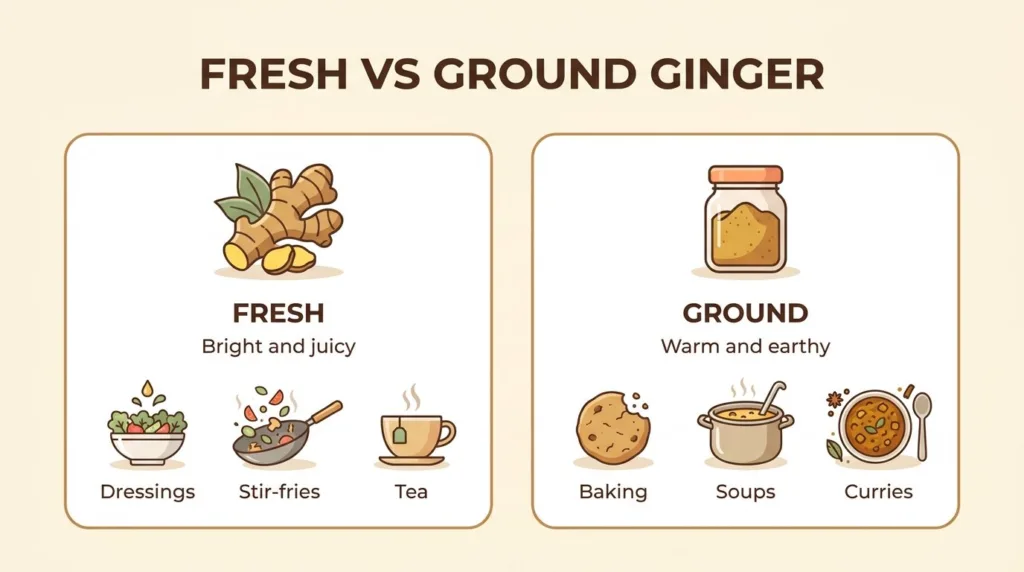
Ground Ginger vs Fresh Ginger at a Glance
| Fresh ginger | Ground ginger | |
|---|---|---|
| Flavor | Bright, juicy, sharp | Warm, earthy, peppery |
| Main pungent compounds | Gingerols | More shogaols |
| Water (USDA) | About 79% | About 10% |
| 1 tsp weighs (USDA) | About 2 g | About 1.8 g |
| Best for | Stir-fries, dressings, marinades, smoothies, tea, shots | Baking, spice blends, rubs, long-cooked curries and soups |
If you are curious about ginger beyond cooking, our post on ginger and cayenne pepper benefits covers that side.
When to Substitute Ground Ginger for Fresh, and When Not To
You can substitute ground ginger for fresh in many recipes. It works best where ginger is one flavor among many, and less well where ginger is the star.
Good Places to Use Ground Ginger
- Baking: Many gingerbread, cookie and quick bread recipes are written for ground ginger already. Fresh ginger also adds moisture, so ground is the easier fit.
- Curries and stews: Long cooking blends the flavor. Add ground ginger with the other spices so it can bloom in the oil.
- Soups: Stir it in early and taste before serving.
- Spice rubs and blends: Ground ginger mixes evenly with other dry spices.
Where Fresh Ginger Is Hard to Replace
- Stir-fries: Fresh ginger’s bright, sharp flavor is a big part of the dish. Ground ginger works in a pinch but tastes different.
- Marinades: Ground ginger works, but it lacks the fresh bite. Mix it into the liquid well so it doesn’t clump.
- Dressings and sauces: In raw dressings, ground ginger can taste dusty. Use fresh if you can.
- Smoothies: A small pinch of ground ginger is fine, but fresh gives the clean, zingy taste most people want.
- Ginger tea: Ground ginger makes a cloudy, gritty tea. Sliced or grated fresh root is the better choice.
- Ginger shots: These are all about fresh ginger juice. Ground ginger is not a real substitute here.
In short, the fresh ginger to ground ginger swap works best in cooked dishes and baking. For raw or ginger-forward recipes, try one of the other options below.
Other Fresh Ginger Substitutes
Out of fresh root? Ground ginger is the most common fresh ginger substitute, but it is not the only one.
Crystallized (Candied) Ginger
Both the Colorado State and New Mexico State guides list candied ginger alongside raw. New Mexico State says 1 tablespoon of candied ginger, rinsed of its sugar and finely cut, can stand in for the same 1/8 teaspoon of powdered ginger. In practice, that means you can use about 1 tablespoon of rinsed, finely chopped candied ginger in place of 1 tablespoon of fresh. It still adds some sweetness, so it suits baking and sweet sauces best.
Frozen Grated Ginger
Frozen ginger is the closest thing to fresh. Iowa State Extension suggests freezing grated or finely chopped ginger in small piles on parchment paper or in ice cube trays, then packing it once frozen. Use it spoon for spoon in place of fresh grated ginger.
Ginger Paste
Jarred ginger paste is grated ginger with added ingredients such as oil, salt or acid. Our tip: use about the same amount as grated fresh ginger, check the label for any brand-specific guidance, and taste. Because pastes vary, start a little low.
If You Have No Ginger at All
The Spice House suggests ground allspice, cinnamon, mace or nutmeg as stand-ins for ground ginger, alone or mixed. None tastes like ginger, but they give a similar warmth in baking. Nutmeg and mace are strong, so we suggest starting with about half the amount and tasting. In savory dishes, The Spice House suggests a squeeze of citrus or a pinch of black pepper to add brightness.
How to Measure and Prep Fresh Ginger
Good prep makes measuring fresh ginger easier and more accurate.
Peel with a Spoon
Iowa State Extension notes that peeling is optional, and that scraping is better than peeling with a knife if you do remove the skin. Scrape with the edge of a teaspoon. The thin skin comes off easily and you lose very little root. Young ginger with thin skin often doesn’t need peeling at all.
Grate It Finely
Use a fine grater or microplane. Grate across the fibers, and leave the stringy bits behind. Press the grated ginger lightly into the spoon to measure it. If you are converting fresh ginger to ground ginger for a recipe, weighing the grated ginger (about 6 g per tablespoon) is more accurate than counting inches.
Store It Well
Iowa State Extension gives these storage times:
- Room temperature: about 1 to 2 weeks, unpeeled.
- Refrigerator: about 4 to 6 weeks, unpeeled, in an airtight bag or container in the crisper drawer.
- Peeled pieces: about 2 to 3 weeks in the refrigerator, tightly wrapped.
- Freezer: best quality within about 3 months. Slice it, or grate it and freeze in small portions.
Throw ginger away if it shows mold, turns soft, changes color or smells off. When buying, choose firm roots with light brown skin.
Frequently Asked Questions
How much ground ginger equals 1 tablespoon of fresh ginger?
For 1 tablespoon fresh ginger to ground, use 1/8 teaspoon ground ginger by the extension ratio, or up to 1/4 teaspoon for a stronger ginger taste. Start at 1/8 and add more after tasting.
What is the fresh ginger to ground ginger conversion for 1 inch of ginger?
By our estimate, a 1-inch piece of medium root weighs about 12 g, which is about 2 tablespoons grated. That converts to about 1/4 teaspoon ground (standard) or 1/2 teaspoon (stronger). Roots vary, so weigh yours if you can.
Can I substitute ground ginger for fresh in a stir-fry?
Yes, though the taste will be warmer and less bright. Use 1/8 to 1/4 teaspoon ground per tablespoon of fresh, and add it with the oil early in cooking. A squeeze of citrus at the end can help bring back some brightness.
How do I convert ground ginger to fresh ginger?
Flip the ratio. Each 1/4 teaspoon of ground ginger equals about 2 tablespoons of grated fresh ginger (standard) or 1 tablespoon (stronger). Start with the smaller amount if you are unsure.
How much is a thumb of ginger in grams?
It depends on the root. Iowa State Extension puts a recipe thumb at about 1/2 ounce (15 g), which is what our converter uses. A “2-inch piece” can be anywhere from 10 to 40 g. Weighing is the only reliable way.
What is the best fresh ginger substitute?
Frozen grated ginger is closest, since it is still fresh ginger. After that, ginger paste or rinsed, finely chopped candied ginger work well. Ground ginger is the handiest option for cooked dishes and baking.
Is ground ginger stronger than fresh ginger?
Spoon for spoon, yes, by a wide margin. Ground ginger has most of its water removed, and drying turns some gingerols into more pungent shogaols. That is why, in a fresh ginger to ground ginger swap, only 1/8 to 1/4 teaspoon replaces a full tablespoon of fresh.
Final Thoughts on Fresh Ginger to Ground Ginger
To convert fresh ginger to ground ginger, remember one number: 1 tablespoon of grated fresh ginger equals about 1/8 teaspoon of ground. Go up to 1/4 teaspoon if you want more ginger flavor. Weigh your root instead of guessing at inches or thumbs, and taste as you go.
Ground ginger is a handy swap for baking, curries and soups. For dressings, stir-fries, tea and shots, fresh is still worth buying, and a bag of frozen grated ginger means you’ll always have some on hand.
Sources and Further Reading
- Colorado State University Extension. Ingredient Substitutions.
- New Mexico State University Cooperative Extension Service. Guide E-131: In a Pinch Ingredient Substitution. Revised May 2016.
- Iowa State University Extension and Outreach, AnswerLine. How to Store Fresh Ginger. 2019.
- USDA FoodData Central. Ginger root, raw (FDC 169231).
- USDA FoodData Central. Spices, ginger, ground (FDC 170926).
- Semwal RB, Semwal DK, Combrinck S, Viljoen AM. Gingerols and shogaols: Important nutraceutical principles from ginger. Phytochemistry. 2015;117:554-568. PubMed.
- Jung MY, et al. Heat-induced conversion of gingerols to shogaols in ginger as affected by heat type (dry or moist heat), sample type (fresh or dried), temperature and time. Food Science and Biotechnology. 2018;27(3):687-693.
- Pázmándi K, Szöllősi AG, Fekete T. The “root” causes behind the anti-inflammatory actions of ginger compounds in immune cells. Frontiers in Immunology. 2024.
- The Spice House. Ginger Substitute. 2018.