
Calcium carbonate vs calcium citrate: which one should you buy? For most healthy adults who take calcium with a meal, both work about equally well. Carbonate packs more calcium into each tablet and usually costs less. Citrate is the better pick if you take an acid reducer, have low stomach acid, want to take it without food, or get constipated on carbonate.
This guide settles the calcium carbonate vs calcium citrate question in plain terms, with a comparison chart, the absorption research, side effects, and how to take either one. It also covers algae calcium and other types of calcium supplements.
This article is general information, not medical advice. If you have kidney disease or kidney stones, take prescription medicines, are pregnant, or are buying calcium for a child, talk with your doctor or pharmacist first.
Key Takeaways
- Calcium carbonate is 40% calcium by weight. Calcium citrate is 21%. You need roughly twice as much citrate, by weight, for the same calcium.
- Take calcium carbonate with a meal. Calcium citrate is absorbed well with or without food.
- In calcium carbonate vs calcium citrate studies with food, the absorption gap is small, and some find none. On an empty stomach, or with low stomach acid, citrate does better.
- Carbonate is the form more often linked to gas, bloating and constipation.
- Your body absorbs calcium best in doses of 500 mg or less at a time.
- Food comes first. Many people need only a small supplement, or none, once they count what they eat.
- Calcium can block some antibiotics, thyroid medicine and osteoporosis medicine, so timing matters.
Use the calculator below to estimate how much calcium you may need from a supplement and how much of each form it takes.
Calcium Supplement Comparison Calculator
Tell it who you are and roughly how much calcium you eat. It shows how much you may need from a supplement, how to split it, and how much of each type of calcium supplement it takes to get there.
How much of each type it takes
| Type | Calcium in it | Per dose | Take it |
|---|
“Per dose” is the weight of the compound (the whole salt) that gives that much calcium. The Supplement Facts panel on a US label already lists calcium itself, so compare the “Calcium” line, not the tablet weight.
Tablet weight needed for 500 mg of calcium
Convert an ingredient amount
Tips for your choice
Ask your doctor or pharmacist first if you
General information, not medical advice. Daily targets and upper limits are from the NIH Office of Dietary Supplements. Dosing tips are from MedlinePlus. The food estimate is our rough rule of thumb: about 300 mg per serving (NIH figures for milk, yogurt and fortified soy milk) plus about 300 mg from other foods.
The calculator needs JavaScript. The comparison chart below gives the calcium content of each type.
Calcium Carbonate vs Calcium Citrate: Comparison Chart
This chart puts calcium carbonate vs calcium citrate side by side with the other three types of calcium supplements you’re most likely to find. The third column shows how much of the compound it takes to deliver 500 mg of calcium, the most you should take at one time.
| Type | Calcium by weight | Compound needed for 500 mg calcium | Take with food? | Best for | Drawbacks |
|---|---|---|---|---|---|
| Calcium carbonate | 40% | About 1,250 mg | Yes, with a meal | Most people who can take it with meals; lowest cost | Needs stomach acid; most linked to gas, bloating and constipation |
| Calcium citrate | 21% | About 2,380 mg | With or without food | Acid reducer users, low stomach acid, people constipated on carbonate | Costs more; bigger or more tablets |
| Algae calcium (red algae, such as Aquamin) | About 30% | About 1,670 mg | Follow the label | People who want a plant-sourced product with some magnesium | Few independent studies; claims often go beyond the evidence |
| Calcium lactate | 13% | About 3,850 mg | Follow the label | Rarely the first choice | Little calcium per tablet; no clear advantage |
| Calcium gluconate | 9% | About 5,560 mg | Follow the label | Rarely the first choice | Least calcium per tablet; many pills needed |
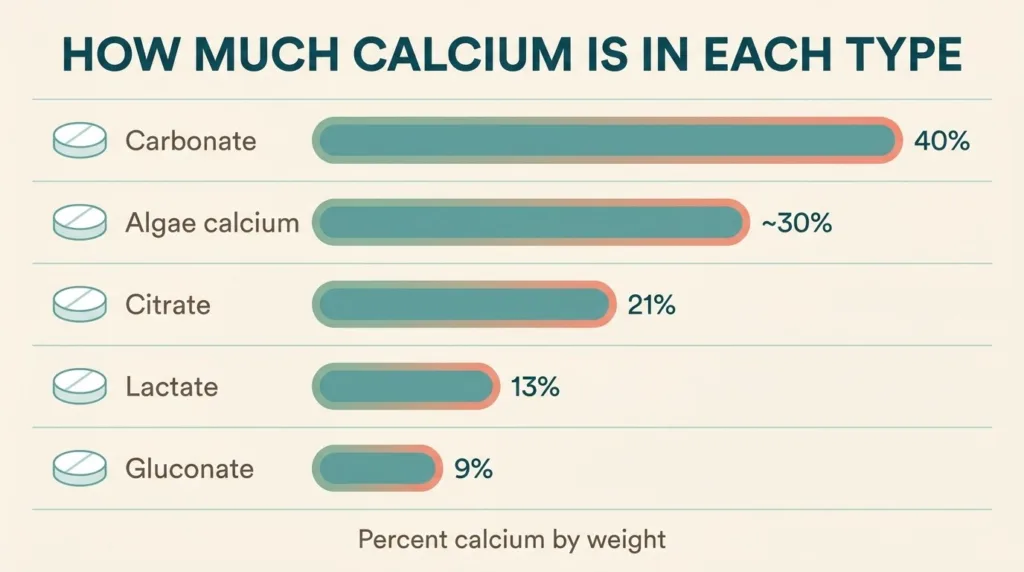
The percentages are simple chemistry. Calcium carbonate is a small molecule, so calcium makes up 40% of its weight. Calcium citrate, in its common tetrahydrate form, is much heavier, so calcium is only about 21% of it. That weight gap is the core of the calcium carbonate vs calcium citrate trade-off: more pills, or a pill you must take with food.
Tip: the Supplement Facts panel on a US label lists the calcium itself, not the compound’s weight. Compare the “Calcium” line and the number of tablets per serving.
Calcium Carbonate: Pros, Cons and Side Effects
In any calcium carbonate vs calcium citrate comparison, carbonate is the more common form. It’s the same compound found in many over-the-counter antacids, and it’s usually the cheapest way to buy calcium. MedlinePlus says to take it with meals.
Pros
- The most calcium per tablet, so you need fewer or smaller pills.
- Low cost. A study by Heaney and colleagues found it the more cost-effective choice, though a carbonate maker sponsored that study.
- Absorbed about as well as citrate when you take it with food.
Cons
- It needs stomach acid, so it should go with a meal.
- People with low stomach acid absorb it poorly on an empty stomach.
- It’s the form most often linked to digestive side effects.
Calcium Carbonate Side Effects
The most common calcium carbonate side effects are gas, bloating and constipation, and they are a practical difference in calcium carbonate vs calcium citrate. In a small 2022 crossover trial in people with hypoparathyroidism, 7 of 23 had constipation on carbonate compared with 1 of 23 on citrate.
MedlinePlus also lists upset stomach, belching and a metallic taste. Its fixes: more fluids, more high-fiber foods, or a switch to another form.
Too much calcium carbonate can cause milk-alkali syndrome: high blood calcium plus a shift in the body’s acid balance, which can damage the kidneys. MedlinePlus says it is almost always caused by too many calcium supplements, usually carbonate, and that high vitamin D intake can make it worse. Count antacid tablets like Tums toward your daily calcium.
Calcium Citrate: Pros, Cons and Who Should Pick It
Calcium citrate is the other half of the calcium carbonate vs calcium citrate choice. It costs more, and because it’s only 21% calcium, you take more tablets for the same dose. Its big advantage is flexibility: MedlinePlus says it is absorbed well on an empty or a full stomach.
Pros
- Doesn’t depend on stomach acid, so you can take it with or without food.
- Absorbed better by people with low stomach acid, which is more common after age 50.
- Easier on the gut. A 2019 review in the Indian Journal of Endocrinology and Metabolism notes citrate causes fewer digestive side effects.
Cons
- Higher cost per milligram of calcium.
- Bigger tablets, or more of them.
Who Should Choose Calcium Citrate
In the calcium carbonate vs calcium citrate decision, citrate is usually the better fit if you:
- Take an acid reducer, such as omeprazole (a proton pump inhibitor) or famotidine (an H2 blocker).
- Have been told you have low stomach acid.
- Would rather take your supplement between meals or at bedtime.
- Get gas, bloating or constipation on carbonate.
Is Calcium Citrate Better Than Calcium Carbonate? The Absorption Research
Is calcium citrate better than calcium carbonate for absorption? It depends on how you take it. The research on calcium citrate vs calcium carbonate lines up once you sort the studies by meals and stomach acid.
The Meta-Analysis That Favors Citrate
In 1999, Sakhaee and colleagues pooled 15 studies with 184 people. They found citrate was absorbed about 22% to 27% better than carbonate, both on an empty stomach and with meals. This is the study behind most “citrate wins” claims in the calcium carbonate vs calcium citrate debate.
Studies That Found No Real Difference With Food
The same year, Heaney and colleagues tested both salts in 37 healthy adults, given with a light breakfast at 300 mg and 1,000 mg of calcium. Across both tests, they found no net difference, and carbonate came out slightly ahead at the higher dose. They concluded that with food, calcium carbonate vs calcium citrate is close to a tie.
A 2001 crossover study by Heaney’s group in 24 postmenopausal women found both products raised blood calcium equally over 24 hours. A carbonate maker sponsored it.
That 1999 study also found people absorbed about 36% of a 300 mg dose but only about 28% of a 1,000 mg dose. Smaller doses are absorbed more efficiently.
Low Stomach Acid Changes the Picture
A 1985 study in the New England Journal of Medicine looked at people with achlorhydria, meaning little or no stomach acid. On an empty stomach, they absorbed about 4% of the calcium from carbonate and about 45% from citrate. In people with normal stomach acid, the two forms were about the same, roughly 23% to 24%. Taken with breakfast, carbonate was absorbed normally even with achlorhydria.
What About Acid Reducers?
A 2005 trial in older women (average age 76) found that a week of omeprazole cut absorption of fasting calcium carbonate from about 9% to about 4%. But a 2010 study that used a more precise method and normal meals found 30 days of omeprazole did not lower calcium absorption. The evidence is mixed. If you take an acid reducer, the calcium carbonate vs calcium citrate answer is simple: choose citrate, or take carbonate with a meal.
Calcium Carbonate vs Calcium Citrate Absorption: The Bottom Line
Here is how the calcium carbonate vs calcium citrate research adds up:
- With a meal and normal stomach acid: the difference is small. Carbonate is fine and costs less.
- On an empty stomach: citrate wins.
- Low stomach acid or acid reducers: citrate is the safer bet. Carbonate can still work if you always take it with food.
Algae Calcium: What It Is and What the Evidence Shows
Algae calcium is a third option that often comes up in the calcium carbonate vs calcium citrate debate. Most products come from red seaweed of the Lithothamnion genus. These algae build hard, mineral-rich skeletons. The skeletal remains are harvested, cleaned, dried and milled into powder.

What’s in It
The best-studied ingredient, Aquamin, is about 30% calcium by weight, with magnesium at roughly a 14:1 calcium to magnesium molar ratio, plus detectable amounts of 72 trace minerals. You need about 1,670 mg of it for 500 mg of calcium.
What the Research Shows
The main human trial comparing algae calcium with calcium carbonate ran for 90 days (Nutrients, 2021). Thirty adults at higher risk of colon cancer took Aquamin, calcium carbonate or a placebo, with 800 mg of calcium a day in both calcium groups. Aquamin changed some colon tissue markers more than carbonate or placebo and was well tolerated. The authors called the results preliminary, and the trial did not measure bone health or absorption.
That trial was NIH-funded, and the supplier donated the product. Much of the other Aquamin research involves the maker as a funder, supplier or co-author, and independent studies are scarce. No human trial has shown algae calcium builds more bone than carbonate. For the full picture, see our Aquamin evidence review.
Algae calcium is a reasonable option if you want some magnesium too. Just know the label claims usually go further than the evidence.
Other Types of Calcium Supplements
Beyond calcium carbonate vs calcium citrate, you’ll see a few other types of calcium supplements. MedlinePlus says forms like gluconate, lactate and phosphate offer no clear advantage over carbonate or citrate.
Calcium Lactate and Calcium Gluconate
Lactate is about 13% calcium and gluconate about 9%, so you’d need several large tablets to reach even 500 mg. Neither changes the calcium carbonate vs calcium citrate picture.
Calcium Phosphate
Tricalcium phosphate is about 39% calcium by weight, close to carbonate. Even so, MedlinePlus lists it among the forms with no clear advantage.
Oyster Shell, Bone Meal, Dolomite and Coral Calcium
MedlinePlus warns that calcium from unrefined oyster shell, bone meal or dolomite may contain lead or other toxic metals if it lacks the USP symbol. Look for “purified” or the USP symbol on the label.
Coral calcium needs a special note. In 2003, the Federal Trade Commission sued the marketers of a coral calcium product for claiming it could treat or cure cancer, multiple sclerosis and heart disease. The FTC said it knew of no reliable science behind those claims.
How Much Calcium Do You Need? Why Food Comes First
Before you settle calcium carbonate vs calcium citrate, work out whether you need a supplement at all. The NIH Office of Dietary Supplements sets these daily targets (RDA) and upper limits (UL) for calcium from food and supplements combined:
| Age | RDA (mg/day) | Upper limit (mg/day) |
|---|---|---|
| Teens 14–18 | 1,300 | 3,000 |
| Adults 19–50 | 1,000 | 2,500 |
| Women 51–70 | 1,200 | 2,000 |
| Men 51–70 | 1,000 | 2,000 |
| Adults 71 and older | 1,200 | 2,000 |
The upper limit counts everything: food, supplements and calcium antacids.
MedlinePlus notes that many people get enough calcium from their diet. Rich sources, with figures from the NIH Office of Dietary Supplements:
- Plain low-fat yogurt, 8 oz: about 415 mg
- Calcium-fortified orange juice, 1 cup: about 349 mg
- Sardines canned in oil with bones, 3 oz: about 325 mg
- Nonfat milk, 1 cup: about 299 mg
- Calcium-fortified soymilk, 1 cup: about 299 mg
- Firm tofu made with calcium sulfate, ½ cup: about 253 mg
The calculator uses a rough rule: about 300 mg for each serving of milk, yogurt, cheese or a fortified drink, plus about 300 mg from the rest of your diet. If your food already gets you close to your target, you may only need a small supplement. For more, see our guide to the difference between food and supplements.
How to Take Calcium Supplements
Whichever side of calcium carbonate vs calcium citrate you land on, the same rules apply. They come from MedlinePlus unless noted.
Split Your Dose and Start Low
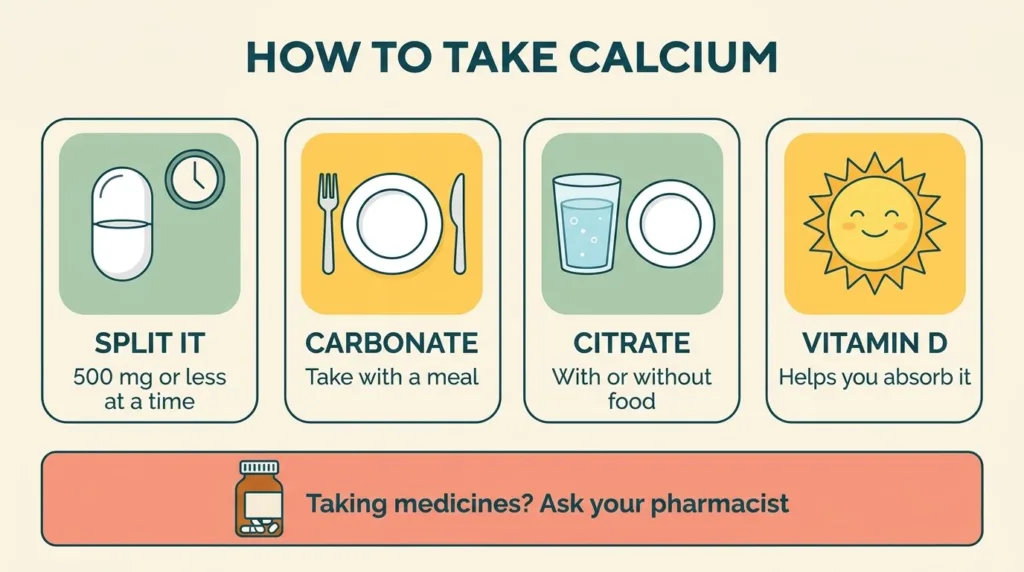
Don’t take more than 500 mg of calcium at a time. If you need 1,000 mg from a supplement, take 500 mg twice a day. Spreading it out improves absorption and cuts gas, bloating and constipation. Your provider may suggest starting with 500 mg a day for a week, then building up slowly.
Timing With Food
Timing is the most practical difference in calcium carbonate vs calcium citrate. Take carbonate with a meal. Citrate can be taken with or without food, which makes it easier to fit around other pills.
Vitamin D
Your body needs vitamin D to absorb calcium. Some calcium products include it. Ask your doctor whether you need extra vitamin D.
Medication Interactions
Interactions matter on both sides of calcium carbonate vs calcium citrate. Calcium can make some medicines less effective, so keep these apart:
- Thyroid medicine (levothyroxine): take calcium carbonate at least 4 hours before or after it.
- Quinolone antibiotics (such as ciprofloxacin): the NIH Office of Dietary Supplements lists these among the medicines calcium interacts with. The MedlinePlus ciprofloxacin page asks for calcium-containing antacids and multivitamins to be taken at least 6 hours before or 2 hours after it.
- Tetracycline antibiotics (such as doxycycline): separate them from calcium supplements and antacids.
- Osteoporosis medicine (alendronate): take supplements, including calcium, at least 30 minutes after alendronate.
- Iron pills: calcium can change how your body absorbs them. Too much calcium can also block iron, zinc, magnesium and phosphorus.
MedlinePlus also says not to take calcium carbonate within 1 to 2 hours of other medicines. Your pharmacist can help with a schedule.
Who Should Talk to a Doctor First
Wherever you land on calcium carbonate vs calcium citrate, check with your doctor or pharmacist before you start if you:
- Have had kidney stones or have kidney disease. MedlinePlus says long-term extra calcium raises kidney stone risk in some people. In the Women’s Health Initiative trial, women given 1,000 mg of calcium carbonate plus 400 IU of vitamin D daily for about 7 years had a 17% higher rate of kidney stones than the placebo group.
- Take prescription medicines, especially antibiotics, thyroid medicine, osteoporosis medicine or iron.
- Have high blood calcium or a parathyroid condition.
- Are pregnant or breastfeeding, or are buying calcium for a child. The tables above cover teens and adults only.
- Have heart disease or are worried about it.
A Note on Calcium Supplements and the Heart
This is still debated. A 2010 BMJ meta-analysis by Bolland and colleagues linked calcium supplements without vitamin D to about a 30% higher risk of heart attack, and a 2011 follow-up found a similar, modest increase. In 2016, the National Osteoporosis Foundation and the American Society for Preventive Cardiology concluded that calcium neither helps nor harms the heart in generally healthy adults when total intake stays within the upper limit. Food first, and no more supplement than you need, is a sensible middle path.
Frequently Asked Questions
What is the best form of calcium supplement?
There’s no single best form of calcium supplement for everyone. For most people who take calcium with meals, the calcium carbonate vs calcium citrate answer is carbonate: it works and costs the least. Citrate is the better choice if you take acid reducers, have low stomach acid, want to take it without food, or get constipated on carbonate.
Is calcium citrate better than calcium carbonate?
Not always. A 1999 meta-analysis found citrate absorbed about 22% to 27% better, but studies of carbonate taken with breakfast found little or no difference. Citrate clearly wins on an empty stomach and with low stomach acid, and it tends to cause fewer digestive side effects.
Calcium citrate vs calcium carbonate: which is better after 50?
Low stomach acid is more common after age 50, and acid reducers lower stomach acid too. That tips the calcium citrate vs calcium carbonate choice toward citrate for many older adults. If you prefer carbonate, take it with a meal every time.
Calcium carbonate vs calcium citrate: which is better for constipation?
Citrate. Carbonate is more often linked to constipation, and a small 2022 trial found less constipation on citrate. Before switching, try smaller doses, more fluids and more fiber.
What are the most common calcium carbonate side effects?
Gas, bloating and constipation, plus upset stomach and belching. Smaller doses, more fluids and more fiber often help. Very high intakes can cause milk-alkali syndrome, which can harm the kidneys.
Is algae calcium better than calcium carbonate?
There’s no good evidence yet that it’s better for bones. The one head-to-head human trial measured colon tissue markers, not bone.
What are the main types of calcium supplements?
The main types of calcium supplements are calcium carbonate (40% calcium), calcium citrate (21%), algae calcium (about 30%), calcium lactate (13%), calcium gluconate (9%) and calcium phosphate. Carbonate and citrate are by far the most common.
Calcium carbonate vs calcium citrate: which is cheaper?
Carbonate is usually cheaper. MedlinePlus describes it as inexpensive and citrate as costing more, and carbonate also needs fewer tablets per dose. Compare the cost per serving using the “Calcium” line on the label, not the price per bottle.
Calcium Carbonate vs Calcium Citrate: Final Thoughts
For most people, calcium carbonate vs calcium citrate comes down to habits, not chemistry. If you take calcium with meals and have normal stomach acid, carbonate is effective and cheaper. If you take it between meals, use an acid reducer, or get constipated, choose citrate. Either way, count your food first, take 500 mg or less at a time, and check with your doctor about your medicines.
Sources and Further Reading
- NIH Office of Dietary Supplements. Calcium: Fact Sheet for Health Professionals.
- MedlinePlus. Calcium supplements. Reviewed January 1, 2025.
- MedlinePlus. Calcium Carbonate.
- MedlinePlus. Milk-alkali syndrome.
- MedlinePlus drug pages: Levothyroxine, Ciprofloxacin, Doxycycline, Alendronate.
- Sakhaee K, et al. Meta-analysis of calcium bioavailability: a comparison of calcium citrate with calcium carbonate. Am J Ther. 1999;6(6):313-321.
- Heaney RP, et al. Absorption of calcium as the carbonate and citrate salts, with some observations on method. Osteoporos Int. 1999;9(1):19-23.
- Heaney RP, et al. Absorbability and cost effectiveness in calcium supplementation. J Am Coll Nutr. 2001;20(3):239-246.
- Recker RR. Calcium absorption and achlorhydria. N Engl J Med. 1985;313(2):70-73.
- O’Connell MB, et al. Effects of proton pump inhibitors on calcium carbonate absorption in women. Am J Med. 2005;118(7):778-781.
- Hansen KE, et al. Do proton pump inhibitors decrease calcium absorption? J Bone Miner Res. 2010.
- Garg MK, Mahalle N. Calcium supplementation: why, which, and how? Indian J Endocrinol Metab. 2019.
- Naciu AM, et al. Calcium citrate versus calcium carbonate in the management of chronic hypoparathyroidism. J Bone Miner Res. 2022;37(7):1251-1259.
- Aslam MN, et al. A multi-mineral intervention to modulate colonic mucosal protein profile: results from a 90-day trial in human subjects. Nutrients. 2021;13(3):939.
- Jackson RD, et al. Calcium plus vitamin D supplementation and the risk of fractures. N Engl J Med. 2006;354(7):669-683.
- Bolland MJ, et al. Effect of calcium supplements on risk of myocardial infarction and cardiovascular events: meta-analysis. BMJ. 2010;341:c3691.
- Bolland MJ, et al. Calcium supplements with or without vitamin D and risk of cardiovascular events. BMJ. 2011;342:d2040.
- Kopecky SL, et al. Lack of evidence linking calcium with or without vitamin D supplementation to cardiovascular disease in generally healthy adults. Ann Intern Med. 2016;165(12):867-868.
- Federal Trade Commission. Marketers of Coral Calcium Product Are Prohibited from Making Disease Treatment and Cure Claims in Advertising. 2004.