
How much prune juice for constipation is the right amount? For most adults, a small glass of about 4 ounces is a sensible place to start, while babies and children need much smaller amounts that depend on their age. Prune juice is a gentle, old-fashioned remedy, and getting the amount right matters more than most people expect.
This guide covers prune juice for constipation at every age, from babies to adults. You’ll find a serving chart, what the research shows, timing, side effects, and when to call a doctor. Use the calculator below to get a starting amount, then read on for the reasons behind it.
Prune Juice Serving Calculator
Pick who it is for. You get a starting amount, a daily limit, what that amount contains and when to call a doctor.
Start vs. daily limit
What that amount contains
| Nutrient | Start | Daily limit |
|---|
USDA FoodData Central values for canned prune juice and pitted dried prunes. Sorbitol from a published review of prune composition. Brands vary.
How to use it
Call a doctor if
General information, not medical advice. The amounts come from Seattle Children’s Hospital, the American Academy of Pediatrics and adult clinical trials. Check with your doctor or pediatrician, especially for babies, during pregnancy, or if you have kidney disease, diabetes or IBS.
The calculator needs JavaScript. The serving chart below gives the same amounts by age.
Quick Answer: How Much Prune Juice for Constipation
Adults: Start with 4 oz (120 ml) once a day. If you need more, you can work up to about 8 oz (235 ml) a day, split into two servings.
Children 1 to 17: Stay within the American Academy of Pediatrics (AAP) daily juice limits. That means up to 4 oz for ages 1 to 3, 4 to 6 oz for ages 4 to 6, and up to 8 oz for ages 7 and older.
Babies: From 3 months of age, about 1 oz per month of age per day, up to a maximum of 4 oz (120 ml). Check with your pediatrician first.
This article is general nutrition information, not medical advice. Prune juice may ease ordinary constipation, but it does not treat any disease. If you are worried about your symptoms or your child’s, talk with a doctor.
Prune Juice Serving Chart by Age
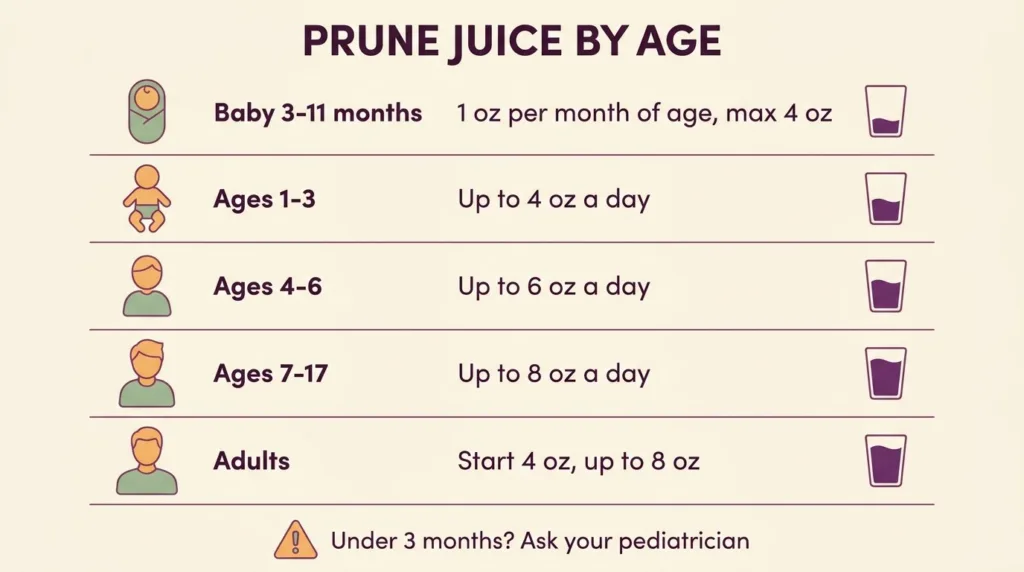
This chart combines guidance from Seattle Children’s Hospital, the AAP, and the adult studies described below. It shows how much prune juice for constipation is reasonable at each age. These are upper limits, not targets.
| Age | Prune juice per day | Notes |
|---|---|---|
| Under 1 month | None | No juice. Call your pediatrician about constipation at this age. |
| 1–2 months | Not yet | Prune juice is not used yet. Apple or pear juice, 1 oz per month of age, only if your pediatrician agrees. |
| 3–11 months | 1 oz per month of age | Maximum 4 oz (120 ml) a day. Pediatrician first. |
| 1–3 years | Up to 4 oz | AAP limit for all juice combined. |
| 4–6 years | Up to 4–6 oz | AAP limit for all juice combined. |
| 7–17 years | Up to 8 oz | AAP limit of about 1 cup of juice a day. |
| Adults | Start 4 oz (120 ml), up to about 8 oz (235 ml) | Take larger amounts as 2 servings. Drink plenty of water. |
How Much Prune Juice Should I Drink as an Adult?
If you are asking “how much prune juice should I drink,” the simple answer is to start with 4 oz (120 ml) once a day. That is about half a cup, a small juice glass. Give it a day or two before you decide whether to change anything.
This starting amount comes from the research. In a study by Piirainen and colleagues, adults drank 125 ml of prune juice twice a day for four weeks. Starting with one of those servings, rather than both, lets you see how your body responds before you take more.
If 4 oz does not help after a few days, add a second 4 oz serving later in the day. That brings you to about 8 oz (250 ml), the amount used in that trial. Going higher mostly adds sugar and the chance of gas or loose stools.
Here is a simple way to approach it:
- Drink 4 oz of prune juice once a day, at whatever time suits you.
- Follow it with a glass of water.
- Keep it up for a few days rather than judging it after one glass.
- If needed, add a second 4 oz serving, for a daily total of about 8 oz.
- If you get cramping, gas, or loose stools, cut back to the amount that felt fine.
For most healthy adults, that is all there is to deciding how much prune juice for constipation to drink. The rest is consistency, fluid, and fiber.

Prune Juice for Babies: Amounts by Month
Babies need special care, and the advice changes quickly in the first months. Call your pediatrician before giving any juice to a baby. The AAP does not routinely recommend fruit juice before 12 months. Small amounts for constipation are an exception, under your doctor’s guidance.
Under 1 Month
Do not give juice. Seattle Children’s Hospital advises seeking care right away if a breastfed baby under 1 month seems constipated. At this age, not stooling enough can mean a baby is not getting enough breast milk.
1 to 2 Months
Prune juice is not used yet at this age. Both Seattle Children’s and HealthyChildren.org (the AAP’s parent site) say that from 1 month, a little apple or pear juice may help. The rule of thumb is 1 oz (30 ml) a day per month of age, so a 2-month-old would get about 2 oz.
Seattle Children’s also advises contacting a doctor within 24 hours about constipation in a baby under 2 months, except for normal straining and grunting.
3 to 11 Months
After 3 months, Seattle Children’s says prune (plum) juice can be used. The same rule applies: about 1 oz per month of age per day. A 3-month-old would get 3 oz. The daily limit is 4 oz (120 ml), so a baby of 4 months or older still tops out at 4 oz.
So for infants, how much prune juice for constipation comes down to 1 oz per month of age, capped at 4 oz. Your pediatrician may suggest less.
Babies Eating Solid Foods
Once your baby eats baby foods, Seattle Children’s suggests adding high-fiber foods twice a day, such as peas, beans, apricots, prunes, peaches, pears, and plums. HealthyChildren.org also points to vegetables and fruits, especially prunes.
Call your pediatrician if diet changes don’t help, or if constipation lasts more than 1 week after diet changes.
Prune Juice for Toddlers and Kids
For children over 1 year, Seattle Children’s suggests increasing fruit juices such as apple, pear, cherry, grape, and prune. Citrus juices, like orange juice, are not helpful for constipation.
Here is how much prune juice for constipation the AAP limits allow, counting all juice combined:
- Ages 1 to 3: up to 4 oz a day
- Ages 4 to 6: 4 to 6 oz a day
- Ages 7 to 17: up to 8 oz (1 cup) a day
Our suggestion is to start at about half the limit: about 2 oz for a toddler, 2 to 3 oz for a 5-year-old, and 4 oz for an older child or teen. This is our own practical tip, not an official guideline.
Many kids find prune juice too strong. Mix it with a little water or another juice they like, keeping the total within the daily limit.
If you are unsure how much prune juice for constipation suits your child, or the problem keeps coming back, ask your pediatrician. Ongoing constipation in children sometimes needs more than a diet change.
How Many Prunes for Constipation?
Some people prefer whole prunes to juice. So how many prunes for constipation should you eat? A practical starting point for adults is about 5 prunes (roughly 50 g) a day, working up to about 10 prunes (100 g) if needed.
That range fits the research. In the Attaluri trial, adults ate 50 g of dried plums twice a day, about 10 prunes total. In the Lever trial, adults ate 80 g or 120 g of prunes a day.
Here is how 4 oz of prune juice compares with 5 prunes, based on USDA FoodData Central values:
| Nutrient | 4 oz prune juice | 5 prunes (48 g) |
|---|---|---|
| Calories | About 91 | About 114 |
| Sugars | About 21 g | About 18 g |
| Fiber | About 1.3 g | About 3.4 g |
| Sorbitol | About 7.8 g | About 7 g |
| Potassium | About 353 mg | About 348 mg |
Sorbitol values are estimates based on published averages for prunes and prune juice. Brands vary.
Prune Juice vs Whole Prunes: Which Is Better?
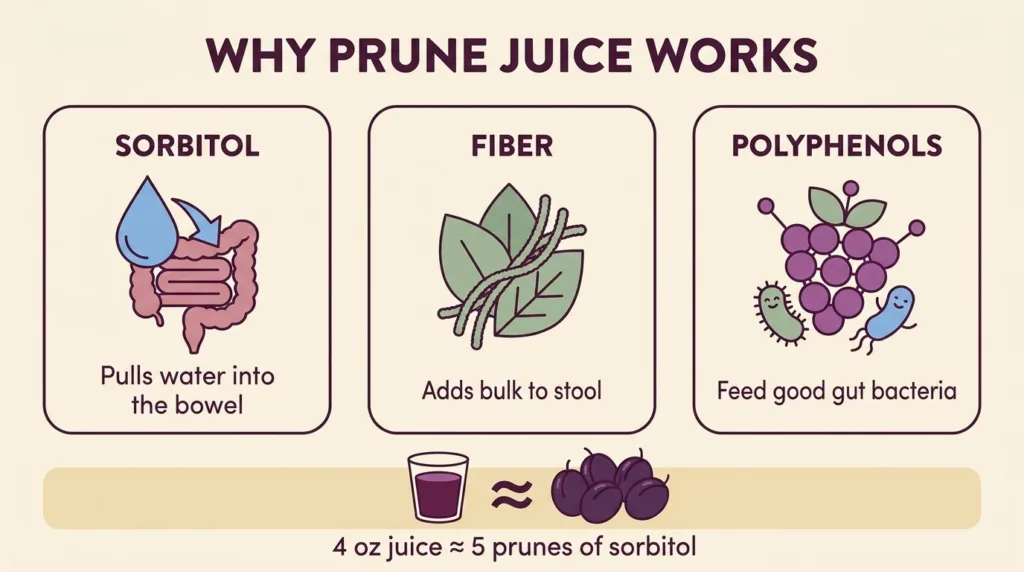
Four ounces of juice has about as much sorbitol as 5 prunes, and sorbitol is one of the main reasons prunes help. The big difference is fiber: whole prunes have about 2.5 times as much.
If you want more fiber, whole prunes may be the better pick. If prunes are hard to eat, or you are giving it to a child, juice is easier. Either way, how many prunes for constipation comes back to starting small and adjusting.
Does Prune Juice Help Constipation? What the Evidence Shows
Does prune juice help constipation, or is it just folk wisdom? The research is fairly encouraging, though most studies are small and several had prune industry funding.
Why Prune Juice Works
According to a review by Stacewicz-Sapuntzakis and colleagues, prunes contain about 14.7 g of sorbitol per 100 g, and prune juice contains about 6.1 g per 100 g. Sorbitol is a sugar alcohol that draws water into the bowel, which can make stools softer and easier to pass.
Prunes also contain fiber and phenolic compounds. Whole prunes keep much more fiber than the juice. Together, these likely explain why people use prune juice for constipation as a natural option.
Studies on Prune Juice
Piirainen and colleagues (2007): Adults with certain digestive symptoms drank 125 ml of prune juice twice a day for 4 weeks, compared with a placebo. The juice had a mild laxative effect and reduced difficulty with bowel movements. This was a small study.
Koyama and colleagues (2022): This double-blind, randomized controlled trial included 84 Japanese adults, ages 20 to 75, with chronic constipation. They took a daily prune juice product (54 g a day) or a flavor-matched placebo for 8 weeks.
The prune group had fewer hard or lumpy stools and more normal stools, without an increase in loose or watery stools. They also reported their constipation felt better. There were no adverse events and no liver or kidney lab abnormalities. The study was funded by the juice maker, MIKI.
Studies on Whole Prunes
Attaluri and colleagues (2011): 40 adults with chronic constipation ate dried plums (50 g twice a day, about 6 g of fiber a day) or took psyllium (11 g twice a day), for 3 weeks each. Complete spontaneous bowel movements rose from about 1.7 to 3.5 per week with prunes, compared with 2.8 with psyllium.
Stool consistency also improved more with prunes, and both were well tolerated. The study was single-blind, included mostly women, and was supported by the California Dried Plum Board.
Lever and colleagues (2019): 120 healthy adults with low fiber intake and 3 to 6 stools a week ate 80 g or 120 g of prunes a day (plus 300 ml of water), or drank water alone, for 4 weeks. Prunes increased stool weight and frequency. Transit time did not change. Prunes caused more gas, but were well tolerated.
What This Means for You
So, does prune juice help constipation? For many adults, the evidence suggests it probably does, especially with regular use. The studies are small and some have industry ties, so treat it as a reasonable first step, not a cure.
How Long Does Prune Juice Take to Work?
How long does prune juice take to work? Honestly, there is no good trial data on the number of hours. Many people say they notice a change within a day, but that is common experience, not a proven timeline.
The studies above measured benefits over 3 to 8 weeks of daily use. Prune juice seems to work best as a steady habit, not a one-time rescue.
If you have had prune juice regularly for a few days and nothing has changed, it may not be the answer for you. Look at your fluids, fiber, and activity, or talk with a doctor. Drinking more and more juice to force a result is not a good plan.
Knowing how much prune juice for constipation to take, and giving it a few days, tells you more than watching the clock after one glass.
How to Take Prune Juice for Constipation
Once you know how much prune juice for constipation to take, these practical tips make it easier.
Timing
No studies show that one time of day works better. Some people like it with breakfast, others in the evening. Pick a time you can stick with.
Warm or Cold?
Some say warm prune juice works faster. There is no evidence either way, so drink it the way you enjoy it. If you like a warm morning drink, a cup of homemade ginger tea is another soothing option to have alongside it.
Mixing It
Prune juice has a strong, sweet taste. Dilute it with water, mix it with another juice, or blend it into a smoothie. For adults, count only the prune juice toward your daily amount. For children, any other juice in the mix counts toward the AAP limit too.
Water
Sorbitol draws water into the bowel, so it makes sense to drink enough fluids. Follow your juice with a glass of water, and keep sipping through the day.
Fiber
Prune juice has only a little fiber. Pair it with fiber-rich foods like fruits, vegetables, beans, and whole grains. Whole prunes count too. For more ideas on fiber and fluids, see our guide to a natural colon cleanse, which covers what actually works.
Side Effects and Who Should Be Careful
Most people tolerate prune juice well. Still, it is not right for everyone, and more is not always better.
Common Side Effects
- Gas: Prunes caused more flatulence than water in the Lever trial.
- Bloating: Sorbitol and fiber can cause a full or bloated feeling, especially when you first start.
- Loose stools: Too much can swing you from constipated to runny. Cut back if this happens.
Starting small is the easiest way to avoid these problems. That is why our answer to how much prune juice for constipation begins with 4 oz rather than a full glass.
Diabetes and Blood Sugar
Prune juice is high in natural sugar. Based on USDA data, 4 oz contains about 21 g of sugars, and 8 oz about 42 g. If you have diabetes, count it toward your carbohydrates, and ask your doctor or dietitian if you’re unsure.
Kidney Disease and Potassium
Prune juice has about 353 mg of potassium per 4 oz, and 5 prunes have about 348 mg. If you have kidney disease or have been told to limit potassium, check with your doctor before using prune juice for constipation.
IBS and Low-FODMAP Diets
Sorbitol is a sugar alcohol, and sugar alcohols are limited on low-FODMAP diets. If you have IBS or follow a low-FODMAP plan, prune juice may trigger gas, bloating, or pain. Talk with your doctor or dietitian before trying it.
Medications
Drug interactions with prune juice are not established in the sources we used. If you take regular medications, it is still sensible to ask your pharmacist before making it a daily habit.
When to Call a Doctor
Prune juice is for ordinary constipation. Some signs mean you or your child should see a doctor instead.
For Babies and Children
Based on Seattle Children’s Hospital guidance:
- Seek care now if your baby is under 1 month old, breastfed, and constipated.
- Seek care now if your baby is under 12 months and has recently had a weak suck or weak muscles.
- Seek care now if stomach pain lasts more than 1 hour after following care advice.
- Contact a doctor within 24 hours if your baby is under 2 months old and constipated (except normal straining or grunting).
- Contact a doctor within 24 hours if there is bleeding from the anus.
- Call your doctor if constipation lasts more than 1 week after diet changes.
For Adults
These are general warning signs. See a doctor if you have:
- Constipation that lasts more than 3 weeks
- Blood in your stool, or black stool
- Weight loss you can’t explain
- Severe belly pain
- Vomiting
- No gas or stool at all
- A lasting change in your usual bowel habits
Frequently Asked Questions
How much prune juice for constipation is too much for an adult?
For most adults, there is little reason to go beyond about 8 oz (250 ml) a day, split into two servings. That was the amount used in the Piirainen study. More than that mainly adds sugar and raises the chance of gas, cramping, or diarrhea.
Can I give my baby prune juice?
Seattle Children’s says prune juice can be used after 3 months of age, at about 1 oz per month of age per day, up to 4 oz. Fruit juice is not routinely recommended under 12 months, so check with your pediatrician first. Babies under 1 month should not get juice.
How long does prune juice take to work for most people?
There is no reliable research on exact timing. Many people notice a change within a day, but that is common experience, not proven fact. Studies measured benefits over 3 to 8 weeks of daily use.
Is it okay to use prune juice for constipation every day?
The adult studies used prune juice or prunes daily for 3 to 8 weeks, and both were well tolerated. For a healthy adult, a small daily serving is usually fine. If you have diabetes, kidney disease, or IBS, ask your doctor first.
Does warm prune juice work better?
There is no evidence that warm prune juice works better or faster than cold. Choose whichever you prefer. The amount, regular use, and enough water matter more than temperature.
Why doesn’t orange juice help constipation like prune juice?
Seattle Children’s notes that citrus juices are not helpful for constipation. Juices like prune, apple, pear, cherry, and grape are better choices for children over 1 year. Prune juice also contains sorbitol, which draws water into the bowel.
Final Thoughts on How Much Prune Juice for Constipation
When it comes to how much prune juice for constipation to use, the simple rule is to start small. Adults can begin with 4 oz once a day and work up to about 8 oz. Children should stay within AAP juice limits for their age, and babies need a pediatrician’s okay first.
Give it a few days, drink plenty of water, and add fiber-rich foods. If constipation keeps coming back, or you notice warning signs, see a doctor. Prune juice for constipation is a helpful tool, not a replacement for medical care.
Sources and Further Reading
- Seattle Children’s Hospital. Constipation.
- HealthyChildren.org (American Academy of Pediatrics). Infant Constipation. Updated 2022.
- Heyman MB, Abrams SA. Fruit Juice in Infants, Children, and Adolescents: Current Recommendations. Pediatrics. 2017;139(6):e20170967.
- Piirainen L, et al. Prune juice has a mild laxative effect in adults with certain gastrointestinal symptoms. Nutrition Research. 2007. Search PubMed.
- Koyama T, et al. Prune Juice Containing Sorbitol, Pectin, and Polyphenol Ameliorates Subjective Complaints and Hard Feces While Normalizing Stool in Chronic Constipation: A Randomized Placebo-Controlled Trial. American Journal of Gastroenterology. 2022;117(10):1714-1717.
- Attaluri A, et al. Randomised clinical trial: dried plums (prunes) vs. psyllium for constipation. Alimentary Pharmacology and Therapeutics. 2011;33:822-828. Search PubMed.
- Lever E, et al. The effect of prunes on stool output, gut transit time and gastrointestinal microbiota. Clinical Nutrition. 2019;38(1):165-173.
- Stacewicz-Sapuntzakis M, et al. Chemical composition and potential health effects of prunes: a functional food? Critical Reviews in Food Science and Nutrition. 2001. Search PubMed.
- USDA FoodData Central. Prune juice, canned (FDC 167753).
- USDA FoodData Central. Plums, dried (prunes), uncooked (FDC 168162).
- National Institute of Diabetes and Digestive and Kidney Diseases. Constipation.