
Ginger and cayenne are the two spices most often sold to you as medicine. Search for ginger and cayenne pepper benefits and you will be told they boost your metabolism, burn fat, cleanse your system and fight disease.
Some of that is true. Most of it is not, and the parts that are true are narrower and more interesting than the marketing. Ginger has genuinely good evidence behind it for nausea and moderate evidence for knee pain. Capsaicin — the compound that makes cayenne hot — is the active ingredient in a prescription pain treatment. Meanwhile the metabolism claim, the one you see most, is the weakest of the lot.
This article covers both: what to cook with these spices, and what the research will and won’t support.
Key Takeaways
- Ginger for nausea is the strongest finding here. A systematic review of trials in pregnancy found it reduced nausea and vomiting, with a good safety record.
- Ginger for knee osteoarthritis has moderate support — a modest improvement in pain and function, from small trials.
- Capsaicin treats pain, but through the skin. High-concentration capsaicin patches are a prescription treatment for certain nerve pain. That is not the same as cayenne on your eggs.
- The metabolism claim is real but tiny. Capsaicin raises energy expenditure slightly and briefly. No trial shows either spice causes weight loss.
- Per-100-gram nutrition tables are misleading for spices. Nobody eats 100 g of cayenne.
- Both interact with medicines. Ginger adds to the effect of blood thinners; see the safety note before taking either as a supplement.
What’s Actually in Them

You will see impressive nutrition figures quoted for both spices — vitamin C, magnesium and potassium in ginger; vitamins A, C, E and B-complex in cayenne. Those figures are real, and they are per 100 grams.
Nobody eats 100 grams of cayenne pepper. A realistic pinch is a fraction of a gram, and a generous teaspoon of ground ginger is about two. At those amounts, both spices contribute a rounding error of vitamins, minerals and fibre to your day. The same goes for the fibre claim you will see made for ginger: fresh ginger has roughly 2 g of fibre per 100 g, so a few coins in a stir-fry contribute essentially none.
What they do contribute is flavour — and flavour is worth more to your diet than any micronutrient they carry, because it is what lets you cut back on salt, sugar and fat without feeling cheated. A roast vegetable that tastes of ginger and chilli does not need to taste of butter and salt. That is the real nutritional case for a well-stocked spice shelf, and it does not depend on any of the claims below.
For the record, the calorie figures: ground cayenne is about 318 kcal per 100 g and fresh ginger about 80. Both are irrelevant at the quantities you will use.
Ginger and Cayenne Pepper Benefits: What the Research Supports
Four claims are worth separating out, because they are not equally well supported.
Ginger for nausea — good evidence
This is the strongest finding on the page, and it is the one ginger is actually used for in clinical practice.
A systematic review and meta-analysis of randomised trials in pregnancy found that ginger reduced nausea and vomiting compared with placebo, with no evidence of harm at the doses studied. It has also been investigated for post-operative nausea and for nausea during chemotherapy, where results are more mixed but generally positive.
In practice that means ginger tea, crystallised ginger or ginger capsules are a reasonable first thing to try for travel sickness or morning sickness. If you are pregnant, raise it with your midwife or doctor first — not because ginger is dangerous, but because persistent vomiting in pregnancy sometimes needs more than a spice.
Ginger for knee pain — moderate evidence
A systematic review and meta-analysis of trials in knee osteoarthritis found that ginger modestly improved pain and function compared with placebo. “Modestly” is the operative word: the trials were small, the effect sizes were not large, and ginger is not a replacement for anything a rheumatologist would prescribe.
It is, however, one of the better-supported options among the many supplements marketed for joint pain, most of which have nothing behind them at all. A reasonable thing to try alongside treatment, not instead of it.
Capsaicin for pain — good evidence, in a form you can’t cook
Capsaicin genuinely blocks pain, and this is not folk wisdom: a high-concentration capsaicin cutaneous patch is a licensed prescription treatment in the US for the nerve pain that follows shingles (post-herpetic neuralgia) and for diabetic peripheral neuropathy of the feet. It is also being studied for nerve pain after surgery. It works by overwhelming and then desensitising the nerve endings that signal pain.
That treatment delivers capsaicin to the skin at a concentration far beyond anything in a spice jar, and it is applied in a clinical setting because the initial burning is substantial. It tells you that capsaicin is a real pharmacological agent. It does not tell you that sprinkling cayenne on your dinner relieves pain, and no study shows that it does.
Over-the-counter capsaicin creams at much lower concentrations are widely sold for muscle and joint aches. The evidence for those is weaker, and they are still topical — you rub them on, you don’t eat them.
Metabolism and weight loss — real, tiny, and not useful
This is the claim you will see most and the one with the least behind it.
Capsaicin does produce a measurable short-term increase in energy expenditure after you eat it. Two separate meta-analyses have looked at this and both found the effect to be genuine and very small — far too small to show up on a scale, and short-lived. For ginger the evidence is thinner still.
No trial has shown that adding either spice to your food causes weight loss. If spicy food helps you enjoy simpler, less-processed meals, or helps you eat more slowly, those are real benefits with real mechanisms. The thermogenic effect is not one of them.
Where the claims outrun the evidence entirely
Three things you will see promised that have no good support: that these spices boost immune function, that they detoxify anything, and that they prevent or fight specific diseases. If you see those, the research is not behind them.
Cooking With Them

Getting started
Both spices reward restraint at first and generosity later, once you know your tolerance.
- Start small. A pinch of cayenne or a teaspoon of ground ginger, and work up.
- Ginger goes in early or late, differently. Added at the start of cooking it mellows into warmth; grated in at the end it is sharp and bright. Both are useful; they are not interchangeable.
- Cayenne needs fat to spread. Bloom it briefly in oil at the start and the heat distributes evenly instead of arriving in hot pockets.
- Fresh and ground ginger are different ingredients. Ground is more concentrated and more earthy; fresh is juicier and more floral. Substituting one for the other by volume rarely works.
Easy places to use them: a pinch of cayenne in scrambled eggs, on roast potatoes, in a tomato sauce or stirred into mayonnaise. Grated ginger in a stir-fry, a marinade, a soup, a smoothie or steeped in hot water with lemon.
Pairing with other spices

Both spices get better in company.
- Turmeric — contains curcumin, which is heavily studied for inflammation. Worth knowing that most positive results use concentrated extracts at doses far above culinary use. In cooking, use it for colour and earthiness.
- Black pepper — piperine increases how much curcumin your body absorbs, which is why the two are so often paired. This one is a genuine, well-documented interaction.
- Garlic — associated with modest cardiovascular benefits in observational research, and it makes almost everything taste better.
- Cinnamon — studied for blood sugar with mixed and inconsistent results. Worth using for flavour; not a blood-sugar treatment. If you use a lot of it, note that cassia cinnamon contains coumarin, a reason to keep very large daily doses in check.
- Cumin, paprika and coriander — the workhorses that make ginger and cayenne into a spice blend rather than two separate notes.
A good starting trio for almost anything roasted: cumin, paprika and a little cayenne, with ginger and garlic if there is sauce involved.
How much is too much
Spices are food, and at food quantities both are safe for most people. The practical limits:
- Too much cayenne causes mouth and stomach burning, and it worsens reflux, gastritis and ulcers in people who have them.
- Too much ginger can cause heartburn and loose stools.
- Supplements are a different question. Capsules deliver doses far above culinary use, and that is where interactions and side effects become a real consideration — see the safety note below.
Everyone’s tolerance differs, and tolerance builds. Pay attention to how you feel afterwards rather than to what a dosage chart says.
Prefer to drink your ginger? Our ginger shot recipe and batch calculator works out the ginger, lemon and juice for any number of shots, and has a mild setting if you’re prone to heartburn.
Where These Spices Come From
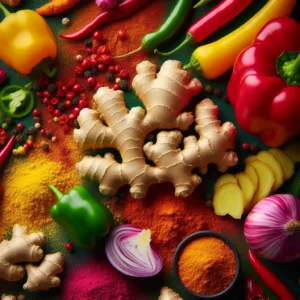
Ginger has been cultivated in southern Asia for several thousand years and travelled early along the trade routes — it was known in the Mediterranean world in antiquity, and it is one of the oldest documented plants in Asian medical traditions, most often for digestion and nausea, which is also where modern evidence has landed. That overlap between traditional use and clinical findings is unusual and worth noting.
Cayenne has a shorter history outside the Americas. Capsicum peppers were domesticated in Central and South America and only reached Europe, Africa and Asia after 1492, after which they spread with remarkable speed — within a century chillies were established in Indian, Sichuan, West African and Hungarian cooking, in each case becoming so central that they now read as indigenous.
Today both are kitchen staples almost everywhere, in fresh, dried and ground forms.
Myths Worth Correcting
“They can cure a cold.” No. Both may ease some symptoms — a hot ginger drink soothes a sore throat, chilli clears a blocked nose temporarily — but neither shortens an infection.
“They can replace prescription medication.” No, and the interaction risk runs the other way: ginger at supplement doses can add to the effect of blood thinners.
“Spicy food causes ulcers.” This one is backwards. Ulcers are usually caused by H. pylori infection or by long-term NSAID use. Chilli does not cause them, though it can irritate one you already have.
“More is better.” Not for either spice. Culinary amounts are where the safety record is.
Before You Try This
This article is for general information. It is not medical advice, and it is not a substitute for talking to someone who knows your history.
Food and supplements affect people differently, and a few of the ingredients here interact with common prescriptions. Talk to your doctor, pharmacist or a registered dietitian before you change your diet for a health reason, start a supplement, or try anything described here as a remedy — and especially if you are pregnant or breastfeeding, taking medication, managing a chronic condition, or buying for a child. Ginger can add to the effect of blood thinners such as warfarin, and large amounts of either spice can worsen reflux, ulcers or gallstone pain. Doses far above what you would cook with are a different question from seasoning your food, so treat ginger or cayenne capsules as a supplement and ask a pharmacist first.
If something you eat or drink makes you feel unwell, stop and get medical help.
Frequently Asked Questions
What are the main benefits of ginger and cayenne pepper?
Ginger has good evidence for reducing nausea and moderate evidence for easing knee osteoarthritis pain. Capsaicin, the active compound in cayenne, is an effective pain treatment when applied to the skin at prescription strength. Beyond that, the main benefit of both is culinary: they make simple, less-processed food taste good.
Can ginger and cayenne pepper help with weight loss?
Not meaningfully. Capsaicin produces a small, short-lived rise in energy expenditure — meta-analyses put it at a level that is real but far too small to affect your weight. No trial has shown that either spice causes weight loss.
Does cayenne pepper boost your metabolism?
Slightly, and briefly, after you eat it. The effect is measurable in a laboratory and inconsequential in daily life.
Is ginger safe during pregnancy?
Ginger is among the better-studied remedies for pregnancy nausea and the trial evidence found no signal of harm at the doses tested. Raise it with your midwife or doctor anyway, both because persistent vomiting sometimes needs more than ginger and because supplement doses differ from culinary ones.
Are there risks to eating ginger and cayenne?
For most people, at culinary amounts, no. Excessive amounts cause gastrointestinal irritation, and both can worsen reflux, gastritis and ulcers. Ginger interacts with blood thinners. Capsules and concentrated extracts are where real caution is warranted — talk to a healthcare provider before taking either as a supplement.
Does cayenne pepper help digestion?
Capsaicin acts on receptors in the digestive tract, which is part of why spicy food feels the way it does. Whether that helps or hurts depends entirely on the person: some people find chilli settles a sluggish stomach, while for others it worsens reflux or an ulcer. There is no good evidence that cayenne improves digestion in general.
Should I take ginger or cayenne as a supplement?
For nausea, a ginger supplement is a reasonable thing to try. For anything else, the food is the better bet — and capsules are where the interaction risks live. Supplements are not reviewed by the FDA for effectiveness before sale, which is one of several ways supplements and food are regulated differently.
Sources and Further Reading
- NCCIH: Ginger — National Institutes of Health
- A systematic review and meta-analysis of the effect and safety of ginger in the treatment of pregnancy-associated nausea and vomiting — Nutr J. 2014;13:20
- Effectiveness of Ginger on Pain and Function in Knee Osteoarthritis: A PRISMA Systematic Review and Meta-Analysis — Pain Physician. 2020;23(2):E151-E161
- Capsaicin 179-mg cutaneous patch in the treatment of post-surgical neuropathic pain: a scoping review — Expert Rev Neurother. 2021
- The effects of capsaicin and capsiate on energy balance: critical review and meta-analyses of studies in humans — Chem Senses. 2012;37(2):103-121
- The effect of Capsaicinoids or Capsinoids in red pepper on thermogenesis in healthy adults: A systematic review and meta-analysis — Phytother Res. 2021;35(3):1358-1377
- NIH Office of Dietary Supplements: Dietary Supplements for Weight Loss
- NIH Office of Dietary Supplements: Fact Sheets
- USDA FoodData Central — for the nutrient figures