Short answer: Food companies cannot legally put false statements on a label, but they can mislead within the rules. The biggest gap is GRAS (“generally recognized as safe”): since 1958, companies have been allowed to decide on their own that a new ingredient is safe and use it without telling the FDA. In August 2026 the FDA proposed making GRAS notification mandatory. Until a final rule takes effect, self-affirmed GRAS is still legal, along with tricks like small serving sizes, umbrella terms and ingredient splitting.
Under federal law, a food is misbranded if its label is “false or misleading in any particular.” Outright lies about what is in a product are illegal. But the rules leave room for companies to shape what you believe about an ingredient, or to put an ingredient in your food with no independent safety review. This guide explains the GRAS system, the 2026 proposal to change it, and five legal ways ingredient labels mislead.
What Is GRAS (Generally Recognized as Safe)?
GRAS is a category in US food law for substances that qualified experts generally agree are safe for their intended use in food. It was created by the Food Additives Amendment of 1958. Before a new substance can be added to food, it normally has to be approved by the FDA as a food additive, a process that requires the company to petition the agency and prove safety. GRAS substances are exempt from that approval.
Many GRAS substances are uncontroversial: salt, vinegar, baking soda, common spices such as ginger and cayenne. The concern is how new substances get GRAS status.
| Route to market | Who decides it is safe | Does the FDA review it? | Is it public? |
|---|---|---|---|
| Food additive petition | FDA | Yes, before use | Yes |
| GRAS notification (voluntary today) | The company and its experts | FDA reviews and responds, typically “no questions” or a concern | Yes, in the FDA’s GRAS notice inventory |
| Self-affirmed GRAS (legal today) | The company and its experts | No. The FDA may never know the substance is in food | No |
The FDA’s voluntary notification program has received more than 1,000 GRAS notices. But because notification is voluntary, nobody knows exactly how many self-affirmed substances are in the food supply. Watchdog groups and researchers have estimated the number in the hundreds to around a thousand.
The 2026 FDA Proposal to End Self-Affirmed GRAS
In March 2025 the Secretary of Health and Human Services directed the FDA to explore eliminating the self-affirmed GRAS pathway. On August 11, 2026 the FDA published a proposed rule to do that. Under the proposal:
- Notification would be mandatory. Anyone marketing a substance as GRAS based on its own conclusion would have to notify the FDA and submit the supporting safety information.
- It would cover existing ingredients, not just new ones. Substances already on the market under self-affirmed GRAS would have a time-limited pathway to submit their information.
- It would not become premarket approval. Companies could still market a GRAS substance after notifying, without waiting for an FDA response.
- Timing: public comments are due December 9, 2026. If the rule is finalized, it would take effect 60 days later, with an 18-month compliance period.
Until a final rule takes effect, self-affirmed GRAS remains legal.

5 Ways Ingredient Labels Mislead Without Breaking the Law
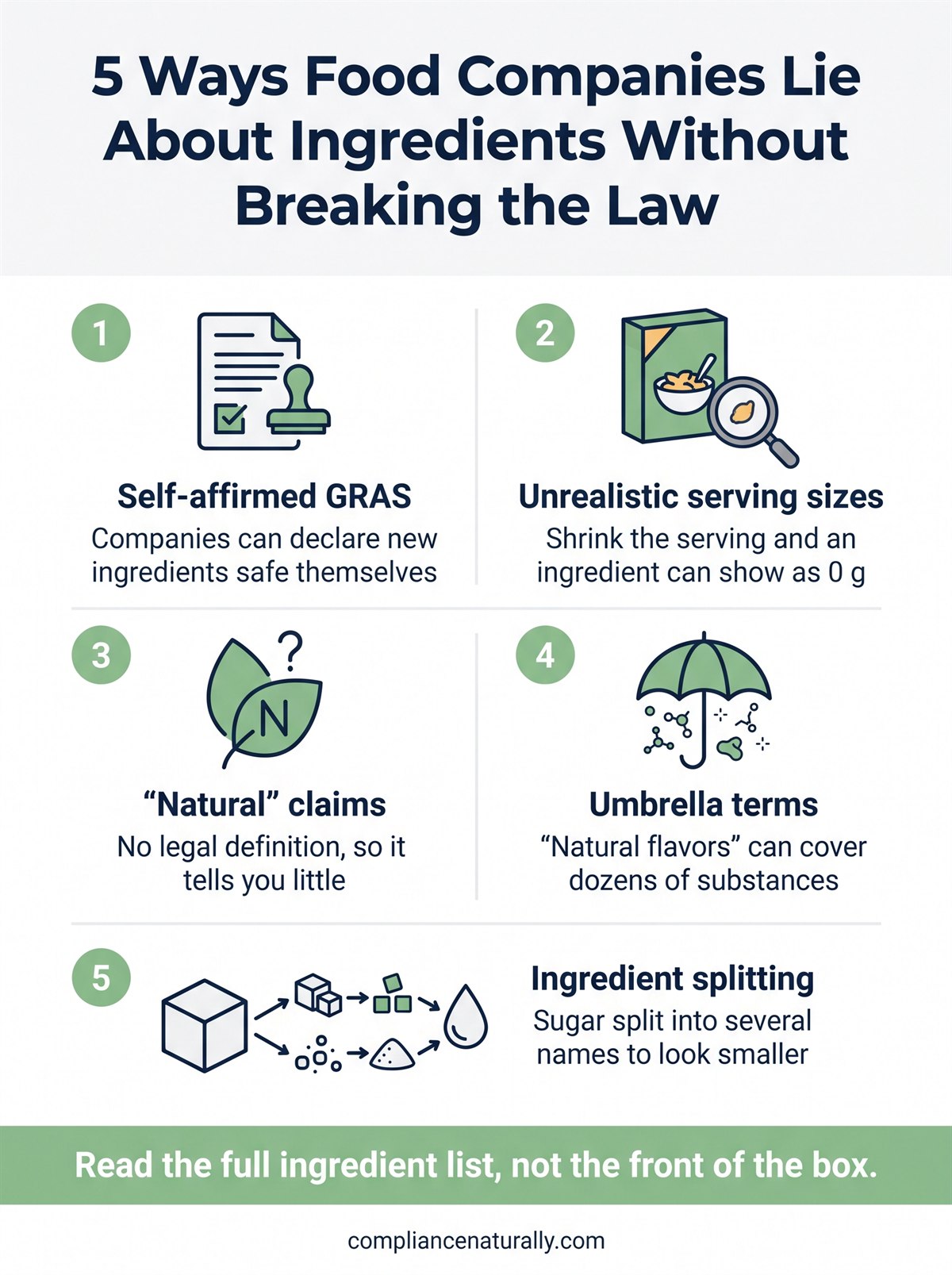
1. Self-affirmed GRAS ingredients
As explained above, a company can currently conclude on its own that a new ingredient is safe and use it without telling the FDA. You will see the ingredient on the label, but you cannot tell whether it went through any independent review.
2. Small serving sizes and rounding
Rounding rules let a label show 0 g of fat, sugar or trans fat when a serving has less than 0.5 g. A small enough serving can make an ingredient seem to disappear, even though a normal portion still contains it. Partially hydrogenated oils, the main source of artificial trans fat, are now largely banned, but rounding still applies to other nutrients. See how accurate nutrition labels are.
3. Umbrella terms that hide specifics
“Spices,” “natural flavors,” “artificial flavors” and “colorings” can each legally cover many individual substances without listing them. The exception is allergens: the nine major allergens (milk, eggs, fish, shellfish, tree nuts, peanuts, wheat, soybeans and sesame) must be declared even when they are part of a flavor or spice blend. See what “natural flavors” really means.
4. Ingredient splitting
Ingredients are listed by weight, so a maker can use several forms of sugar, such as cane sugar, brown rice syrup and dextrose, and push each one lower on the list. Added together, sugar may be the main ingredient. The “Includes Added Sugars” line on the Nutrition Facts panel shows the combined total.
5. Front-of-package claims that don’t match the ingredient list
Words like “natural,” “made with real fruit,” “made with whole grains” and “wholesome” have little or no legal definition. A product can feature strawberries on the box and contain very little strawberry. See 10 ways food labels mislead.
Ingredients Under Scrutiny in 2025–2026
- Synthetic food dyes: the FDA revoked authorization of Red No. 3 in food in January 2025, with removal required by January 2027, and has asked manufacturers to phase out other petroleum-based dyes.
- Processed meat preservatives: the World Health Organization’s cancer agency classifies processed meat as carcinogenic to humans, and nitrites used to cure meat are part of the concern. Sodium nitrite is an approved additive, and products cured with celery powder are labeled “uncured” even though celery powder is also a source of nitrite.
- Post-market review: the FDA has said it is building a more systematic process to reassess chemicals already in food, including GRAS substances.

How to Protect Yourself
- Read the full ingredient list, not the front of the package. See how to read nutrition labels.
- Compare the serving size with how much you actually eat.
- Check “Includes Added Sugars” rather than counting sugar names.
- Look up unfamiliar ingredients in the FDA’s GRAS notice inventory or Substances Added to Food inventory.
- Choose more whole and minimally processed foods, which have short ingredient lists to begin with. See whole foods vs processed foods.
Frequently Asked Questions
Is it illegal for food companies to lie about ingredients?
Yes. Under the Federal Food, Drug, and Cosmetic Act, a food is misbranded if its label is false or misleading in any particular. Companies that cross that line can receive FDA warning letters and face class-action lawsuits and Federal Trade Commission action over deceptive advertising.
What does “generally recognized as safe” mean?
It means qualified experts generally agree, based on scientific evidence, that a substance is safe for its intended use in food. GRAS substances do not need FDA approval as food additives.
Can companies add ingredients without FDA approval?
Yes, through GRAS. Today a company can decide on its own that an ingredient is GRAS and use it without notifying the FDA. The FDA’s August 2026 proposal would require notification, but it is not yet final.
Is GRAS self-affirmation being banned?
It has been proposed. The FDA’s proposed rule would make GRAS notification mandatory, including for many ingredients already on the market. Comments close December 9, 2026, and the rule would only take effect after it is finalized.
How can I report a misleading food label?
Contact the FDA Consumer Complaint Coordinator for your state, or your state attorney general’s consumer protection office. For misleading advertising, file a complaint with the FTC at ReportFraud.ftc.gov.
Why do companies mislead if lying is illegal?
Most don’t state outright falsehoods. They rely on legal gray areas that carry little risk and still shape what shoppers believe. That is why the ingredient list and Nutrition Facts panel matter more than any claim on the front of the box.
Sources and Further Reading
- Generally Recognized as Safe (GRAS). US Food and Drug Administration.
- FDA Issues Proposed Rule on Substances Generally Recognized as Safe (GRAS). Covington & Burling, August 2026.
- 21 CFR Part 170, Subpart E: Generally Recognized as Safe (GRAS) Notice (eCFR).
- 21 CFR Part 101: Food Labeling (eCFR).