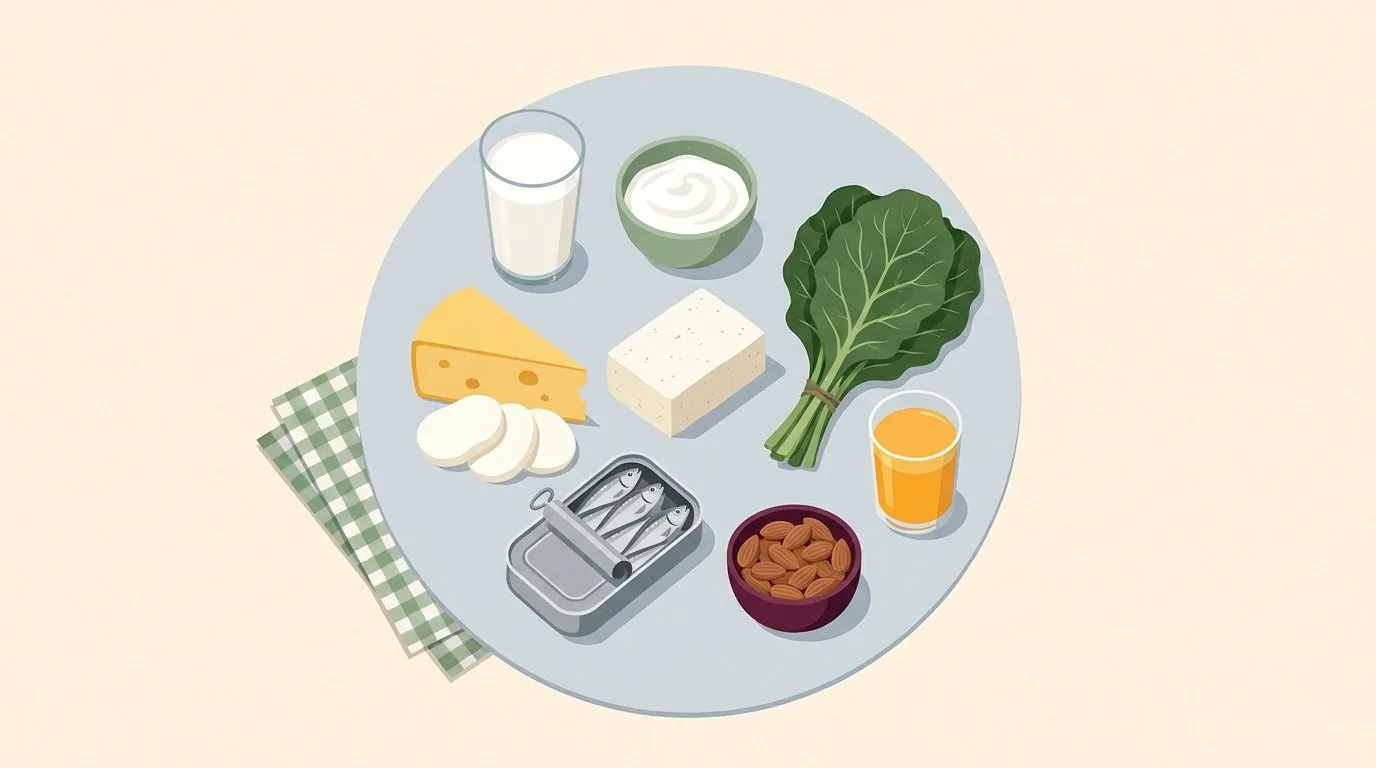
The top calcium rich foods are yogurt, calcium-fortified orange juice and plant milks, part-skim mozzarella, canned sardines with bones, milk, and tofu made with calcium sulfate. One serving of any of them gives you about 250 to 480 mg of calcium. That’s roughly a fifth to more than a third of the 1,300 mg Daily Value on food labels.
This guide ranks 36 calcium rich foods by milligrams per serving and %DV, so you can see which foods high in calcium are worth adding. You’ll also find how much calcium per day you need, the best non dairy calcium sources, and two sample days. Use the free calcium calculator below to add up what you eat now.
Key Takeaways
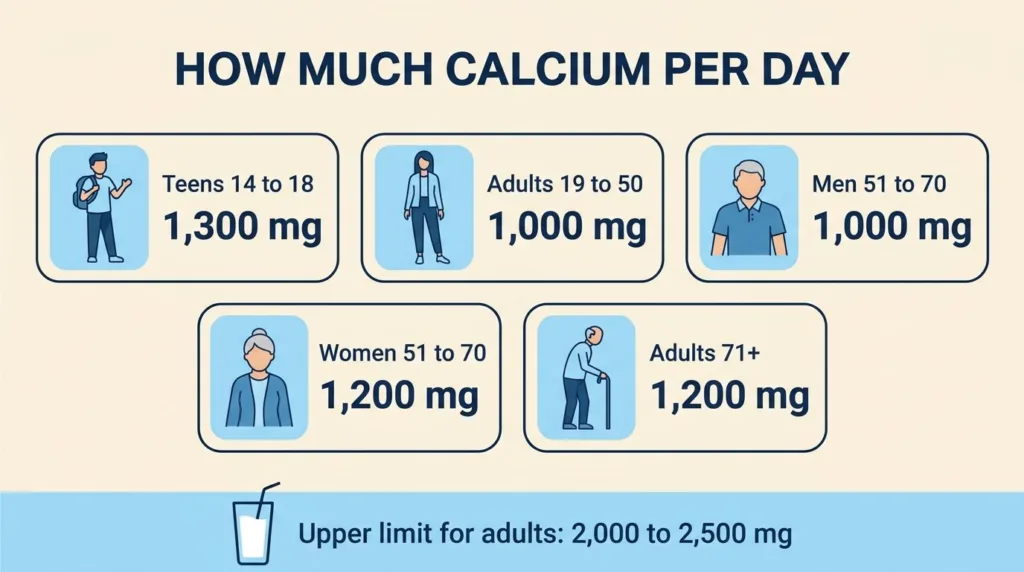
- How much calcium per day: Most adults need 1,000 mg. Women 51 to 70 and everyone over 70 need 1,200 mg, and kids and teens 9 to 18 need 1,300 mg (NIH Office of Dietary Supplements).
- Top calcium rich foods: Plain low-fat yogurt (415 mg per 8 oz), fortified orange juice (349 mg per cup), part-skim mozzarella (333 mg per 1.5 oz), sardines with bones (325 mg per 3 oz) and nonfat milk (299 mg per cup).
- No dairy? No problem: Fortified soy and almond milk, tofu made with calcium sulfate, canned fish with bones, collard greens, bok choy and white beans all help. Fortified foods vary by brand, so check the label.
- Absorption matters: Your body absorbs only about 5% of the calcium in spinach, compared with about 27% from milk (NIH).
- Upper limit: 2,500 mg a day for adults 19 to 50 and 2,000 mg from age 51, from food and supplements combined.
Pick your age and sex, tick the box if you skip dairy, then enter how many servings of each food you have on a typical day. The calcium calculator adds up your daily calcium intake and suggests easy calcium rich foods to close any gap.
Calcium Calculator: How Much Calcium Do You Get From Food?
Find your daily calcium target, add up the calcium in what you eat, and see the easiest foods to close any gap.
Targets are the Recommended Dietary Allowances and upper limits from the NIH Office of Dietary Supplements (Institute of Medicine, 2011). Food values are from the NIH Office of Dietary Supplements calcium fact sheet where it lists the food, and from USDA FoodData Central for the rest. Fortified foods vary by brand, so check labels. This is general information, not medical advice.
The calculator needs JavaScript. The tables below give the same daily targets and food values.
Calcium Rich Foods Chart: 36 Foods Ranked
Here is our calcium in food chart of 36 calcium rich foods, split into three groups so it fits on your phone. Within each group, foods are ranked from most to least calcium per serving. The %DV is based on the FDA Daily Value of 1,300 mg for adults and children 4 and older. The FDA considers a food with 20% DV or more a high source, but smaller amounts add up too.
These are the same foods and numbers used in the calculator above, from the NIH Office of Dietary Supplements (ODS) and USDA FoodData Central.
Dairy Foods High in Calcium
| Food | Serving | Calcium (%DV) |
|---|---|---|
| Yogurt, plain, low fat | 8 oz | 415 mg (32%) |
| Yogurt, fruit, low fat | 8 oz | 344 mg (26%) |
| Mozzarella, part skim | 1.5 oz | 333 mg (26%) |
| Milk, nonfat | 1 cup | 299 mg (23%) |
| Milk, 2% | 1 cup | 293 mg (23%) |
| Milk, whole | 1 cup | 276 mg (21%) |
| Cheddar cheese | 1 oz | 201 mg (15%) |
| Greek yogurt, plain, nonfat | 6 oz | 187 mg (14%) |
| Cottage cheese, 1% | 1 cup | 138 mg (11%) |
| Frozen yogurt, vanilla | 1/2 cup | 103 mg (8%) |
| Parmesan, grated | 1 tbsp | 43 mg (3%) |
Fortified Foods, Soy and Fish
| Food | Serving | Calcium (%DV) |
|---|---|---|
| Almond milk, fortified, unsweetened | 1 cup | 482 mg (37%) |
| Orange juice, calcium fortified | 1 cup | 349 mg (27%) |
| Sardines, canned, with bones | 3 oz | 325 mg (25%) |
| Soymilk, calcium fortified | 1 cup | 299 mg (23%) |
| Tofu, firm, made with calcium sulfate | 1/2 cup | 253 mg (19%) |
| Salmon, pink, canned, with bones | 3 oz | 181 mg (14%) |
| Tofu, soft, made with calcium sulfate | 1/2 cup | 138 mg (11%) |
| Soybeans, cooked | 1/2 cup | 131 mg (10%) |
| Cereal, fortified with 10% DV | 1 serving | 130 mg (10%) |
| Edamame | 1 cup | 98 mg (8%) |
Vegetables, Beans, Nuts and Seeds
| Food | Serving | Calcium (%DV) |
|---|---|---|
| Collard greens, cooked | 1 cup | 268 mg (21%) |
| White beans, cooked | 1 cup | 161 mg (12%) |
| Bok choy, cooked | 1 cup | 158 mg (12%) |
| Spinach, cooked (poorly absorbed) | 1/2 cup | 123 mg (9%) |
| Turnip greens, cooked | 1/2 cup | 99 mg (8%) |
| Kale, cooked | 1 cup | 94 mg (7%) |
| Chia seeds | 1 tbsp | 76 mg (6%) |
| Almonds | 1 oz (about 23) | 76 mg (6%) |
| Dried figs | 5 figs | 68 mg (5%) |
| Tahini | 1 tbsp | 64 mg (5%) |
| Pinto beans, canned | 1/2 cup | 54 mg (4%) |
| Orange | 1 medium | 52 mg (4%) |
| Corn tortilla | 1 (6 inch) | 46 mg (4%) |
| Whole-wheat bread | 1 slice | 30 mg (2%) |
| Broccoli, raw | 1/2 cup | 21 mg (2%) |
Sources: NIH Office of Dietary Supplements (Table 2) and USDA FoodData Central (SR Legacy). %DV is milligrams divided by 1,300, rounded.
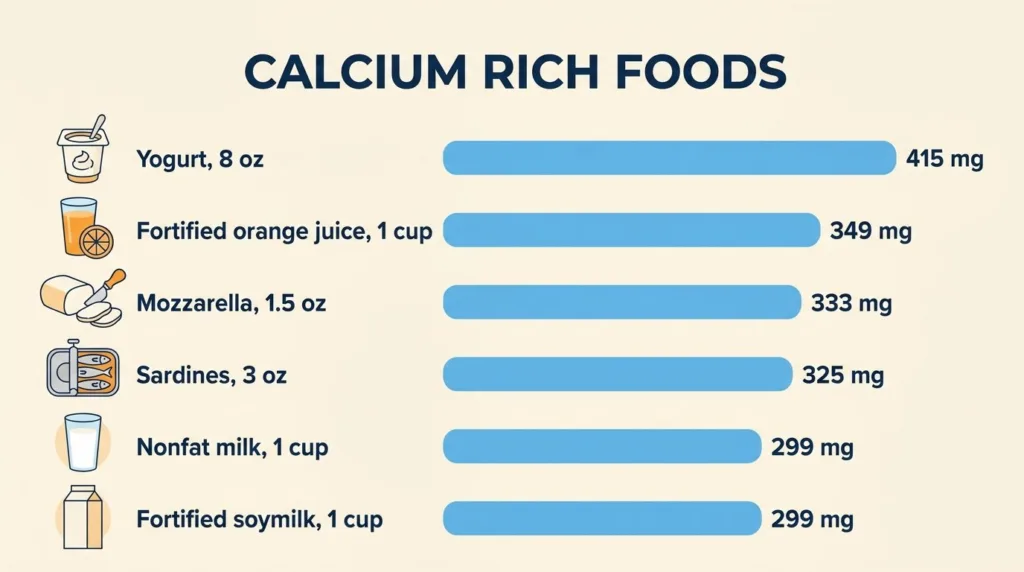
A few things stand out in this calcium foods list. Dairy and fortified drinks lead the calcium rich foods because one cup or one container delivers 250 mg or more. Fish counts only when you eat the soft bones. And fortified products vary a lot. ODS notes that tofu only provides much calcium if it is made with a calcium salt, so look for “calcium sulfate” on the label. Check the label on plant milks, juices and cereals too.
How Much Calcium Per Day Do You Need?
The calcium RDA (Recommended Dietary Allowance) was set by the Food and Nutrition Board of the National Academies in 2011, and ODS lists it in its fact sheet. Here is how much calcium per day each group needs:
| Group | Age | Calcium per day |
|---|---|---|
| Children | 1 to 3 | 700 mg |
| Children | 4 to 8 | 1,000 mg |
| Children | 9 to 13 | 1,300 mg |
| Teens | 14 to 18 | 1,300 mg |
| Women | 19 to 50 | 1,000 mg |
| Men | 19 to 50 | 1,000 mg |
| Women | 51 to 70 | 1,200 mg |
| Men | 51 to 70 | 1,000 mg |
| Adults | 71 and older | 1,200 mg |
| Pregnant or breastfeeding | 14 to 18 | 1,300 mg |
| Pregnant or breastfeeding | 19 to 50 | 1,000 mg |
Source: NIH Office of Dietary Supplements. Babies have Adequate Intakes instead: 200 mg a day from birth to 6 months and 260 mg a day from 7 to 12 months.
Notice that pregnancy and breastfeeding don’t raise the target. A pregnant woman needs the same calcium as other women her age.
Your daily calcium intake also has a ceiling. These are the Tolerable Upper Intake Levels (ULs), which count food and supplements together:
| Group | Age | Upper limit |
|---|---|---|
| Children | 1 to 8 | 2,500 mg |
| Children and teens | 9 to 18 | 3,000 mg |
| Adults | 19 to 50 | 2,500 mg |
| Adults | 51 and older | 2,000 mg |
Source: NIH Office of Dietary Supplements. The limits for pregnancy and breastfeeding are the same as for your age.
How Much Calcium Is in Milk?
Milk is the classic among calcium rich foods, and how much calcium in milk depends a little on the fat. One cup of milk has:
- Nonfat (skim) milk: 299 mg (23% DV)
- 2% milk: 293 mg (23% DV)
- Whole milk: 276 mg (21% DV)
ODS explains that the more fat a dairy food has, the slightly less calcium it contains. So skimming the fat does not cost you any calcium. MedlinePlus adds that milk is fortified with vitamin D, which your body needs to absorb calcium.
Three cups of nonfat milk give you 897 mg, close to a full day for most adults. If you’re lactose intolerant, ODS says lactose-free and reduced-lactose dairy have the same calcium as regular dairy. Fortified almond milk can beat cow’s milk (482 mg per cup in USDA data), but brands differ.
Non Dairy Calcium Sources
Plenty of calcium rich foods are not dairy, so you can meet your needs without it. It just takes a little planning. ODS notes that people who avoid dairy, including vegans and people with a milk allergy, have a higher risk of not getting enough. They can get calcium from some vegetables, canned fish with bones and fortified foods, but they typically need fortified foods or supplements to reach recommended amounts.
Here are the best non dairy calcium sources in our chart, ranked:
- Fortified almond milk: 482 mg per cup
- Calcium-fortified orange juice: 349 mg per cup
- Canned sardines with bones: 325 mg per 3 oz
- Calcium-fortified soymilk: 299 mg per cup
- Cooked collard greens: 268 mg per cup
- Firm tofu made with calcium sulfate: 253 mg per 1/2 cup
- Canned pink salmon with bones: 181 mg per 3 oz
- Cooked white beans: 161 mg per cup
- Cooked bok choy: 158 mg per cup
Vegan Calcium Sources
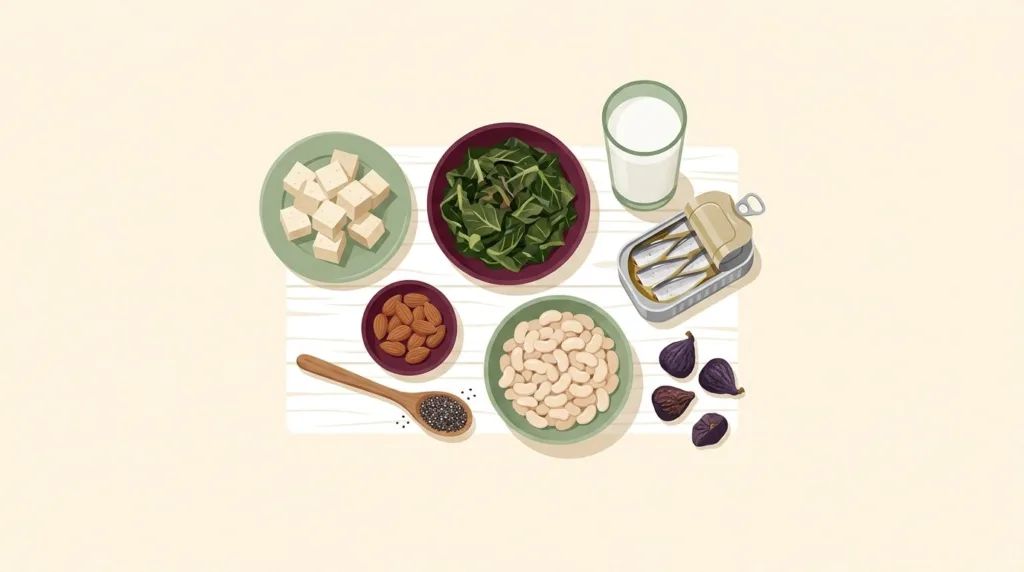
Skip the fish and the list of calcium rich foods still works. The strongest vegan calcium sources are fortified plant milks and juice, tofu made with calcium sulfate, and soy foods like soybeans (131 mg per 1/2 cup) and edamame (98 mg per cup). Add greens such as collards, bok choy, turnip greens and kale, plus white beans, chia seeds, almonds, tahini and dried figs. Each of these smaller sources adds 60 to 160 mg a serving.
Tick “I don’t eat dairy” in the calculator to hide the dairy foods and get dairy-free suggestions.
Absorption: Why Spinach Isn’t the Calcium Food It Seems
Not all calcium rich foods are equal. Spinach looks good on paper at 123 mg per 1/2 cup. But how much calcium you absorb matters as much as how much a food contains.
According to ODS, you absorb about 30% of the calcium in dairy and fortified foods. Some plants contain oxalic acid or phytic acid, which bind calcium into a form your gut can’t absorb. As a result, absorption is only 5% for spinach, compared with 27% for milk. So a half cup of spinach gives you far less usable calcium than a glass of milk, even though the label numbers look closer.
ODS lists other foods high in oxalic acid: collard greens, sweet potatoes, rhubarb and beans. The good news is that low-oxalate greens such as kale, broccoli and cabbage have calcium that is absorbed about as well as milk’s. They just have less of it per serving. And ODS says that when you eat a variety of foods, these oxalate effects probably make little difference overall.
Foods and Habits That Lower Calcium Absorption
- Oxalate-rich foods: spinach and rhubarb most of all (MedlinePlus, ODS).
- Wheat bran: MedlinePlus says certain fibers, such as wheat bran, can bind calcium.
- Caffeine and phosphorus: reduce absorption to a small extent (ODS).
- Low vitamin D: has a bigger effect. Vitamin D is required for calcium to be absorbed by active transport in the gut (ODS).
- Too much at once: the share you absorb falls as the dose rises. ODS gives the example of about 36% of a 300 mg dose vs 28% of a 1,000 mg dose.
Two easy fixes: spread calcium rich foods across your meals, and cook greens in a little water for a short time. MedlinePlus suggests steaming or sautéing instead of boiling to keep more calcium in the food. The calculator counts spinach at face value but flags it as poorly absorbed.
Sample Days With Calcium Rich Foods: 1,000 mg and 1,200 mg
Here is what 1,000 mg and 1,200 mg look like on a plate, built only from the calcium rich foods in the chart. Each total is just the foods added up.
A 1,000 mg Day With Dairy
| Meal | Foods | Calcium |
|---|---|---|
| Breakfast | 1 serving fortified cereal (130 mg) with 1 cup nonfat milk (299 mg) | 429 mg |
| Lunch | Sandwich on 2 slices whole-wheat bread (60 mg) with 1 oz cheddar (201 mg), plus 1 orange (52 mg) | 313 mg |
| Snack | 6 oz plain nonfat Greek yogurt | 187 mg |
| Dinner | Stir-fry with 1 cup cooked bok choy | 158 mg |
| Total | 1,087 mg |
That covers the 1,000 mg RDA for adults 19 to 50 and men 51 to 70. Need 1,200 mg as a woman over 50 or anyone over 70? Swap the Greek yogurt for 8 oz plain low-fat yogurt (415 mg), and the day comes to 1,315 mg.
A 1,200 mg Dairy-Free Day
| Meal | Foods | Calcium |
|---|---|---|
| Breakfast | 1 serving fortified cereal (130 mg) with 1 cup calcium-fortified soymilk (299 mg) | 429 mg |
| Lunch | Bean tacos: 1 cup white beans (161 mg) on 2 corn tortillas (92 mg) | 253 mg |
| Snack | 1 oz almonds (76 mg) and 5 dried figs (68 mg) | 144 mg |
| Dinner | 1/2 cup firm tofu made with calcium sulfate (253 mg) with 1 cup cooked bok choy (158 mg) | 411 mg |
| Total | 1,237 mg |
Only need 1,000 mg? Skip the snack and you’re at 1,093 mg. Keep in mind that beans are on the ODS list of high-oxalate foods, so some of their calcium is absorbed less well.
How Much Calcium Is Too Much?
How much calcium is too much depends on your age. The upper limit is 2,500 mg a day for adults 19 to 50 and 2,000 mg from age 51, counting food and supplements together. For children 1 to 8 it’s 2,500 mg, and for ages 9 to 18 it’s 3,000 mg.
ODS explains that these limits are based on evidence from the Women’s Health Initiative, which linked supplemental calcium (1,000 mg a day for 7 years) with a higher risk of kidney stones. Here is what ODS says about higher intakes:
- Kidney stones: higher intakes of supplemental calcium might increase the risk.
- Stomach upset: calcium supplements can cause gas, bloating, constipation, or a mix of these. Calcium carbonate seems to cause more of these side effects than calcium citrate.
- Heart: some research suggests calcium supplements could raise the risk of cardiovascular disease, while other studies have found no link.
Notice that most of these concerns involve supplements rather than calcium rich foods. MedlinePlus adds that too much calcium can keep your body from absorbing iron, zinc, magnesium and phosphorus. If your total in the calculator goes over your upper limit, it shows a warning and suggests you talk with your doctor before taking more.
Food First, Then Supplements
Start with calcium rich foods. The sample days show that 1,000 to 1,200 mg is doable with ordinary meals, with or without dairy. Then, if you still come up short, a supplement can fill the gap. Enter its calcium from the label in the calculator, and remember to count multivitamins and calcium-containing antacids too.
ODS and MedlinePlus both say your body absorbs supplemental calcium best in doses of 500 mg or less. If you need more than that from a pill, split it across the day. For which form to choose, how much elemental calcium each provides, and how to take it with your medicines, see our guide Calcium Carbonate vs Calcium Citrate: Which Is Better? (Comparison Chart + Calculator). Curious about calcium from seaweed? Read Aquamin Benefits: What the Research Actually Shows.
Frequently Asked Questions
What foods are rich in calcium?
The calcium rich foods with the most per serving are yogurt (415 mg per 8 oz plain low-fat), fortified almond milk (482 mg per cup), fortified orange juice (349 mg), part-skim mozzarella (333 mg per 1.5 oz), sardines with bones (325 mg per 3 oz), milk (276 to 299 mg per cup) and tofu made with calcium sulfate (253 mg per 1/2 cup). Collard greens, salmon with bones, white beans and bok choy are good runners-up.
How much calcium should I take a day?
Aim for your RDA from all sources: 1,000 mg for most adults, 1,200 mg for women over 50 and everyone over 70, and 1,300 mg for ages 9 to 18. Add up the calcium rich foods you eat first with the calcium calculator. Only the gap, if any, needs to come from a supplement, ideally 500 mg or less at a time.
How many milligrams of calcium is safe to take a day?
Stay at or below the upper limit for your age: 2,500 mg a day for adults 19 to 50 and 2,000 mg a day from age 51, counting food and supplements together. Teens 14 to 18 have a limit of 3,000 mg. Going above it, mostly through supplements, might raise the risk of kidney stones.
Which foods block calcium absorption?
Foods high in oxalic acid, such as spinach, rhubarb, collard greens, sweet potatoes and beans, bind some of their own calcium. Phytic acid and wheat bran can also bind calcium. Caffeine and phosphorus lower absorption slightly. Eating a varied diet and spreading calcium through the day keeps these effects small.
Where do vegans get calcium?
Vegans get calcium from plant-based calcium rich foods: fortified plant milks and orange juice, tofu made with calcium sulfate, soybeans and edamame, low-oxalate greens like bok choy and kale, and smaller amounts from white beans, chia seeds, almonds, tahini and figs. ODS notes that vegans usually need fortified foods or a supplement to reach their target.
What are the symptoms of calcium deficiency?
Low blood calcium (hypocalcemia) often causes no symptoms, especially when it’s mild. When symptoms do occur, ODS says the most common are numbness around the mouth, tingling in the hands and feet, and muscle spasms. ODS also notes that hypocalcemia is usually caused by a vitamin D or magnesium deficiency, a parathyroid problem, illness or certain medicines. If you have these symptoms, see your doctor.
What vitamins should not be mixed with calcium?
Vitamin D is the one you want with calcium, since it helps you absorb it. The bigger issue is minerals and medicines. MedlinePlus says too much calcium can block the absorption of iron, zinc, magnesium and phosphorus, and calcium supplements can change how your body absorbs some medicines, including certain antibiotics and iron pills. Ask your pharmacist how to space them.
Is milk the best source of calcium?
Milk is one of the best: about 300 mg per cup, absorbed well, and usually fortified with vitamin D. But plain yogurt has more per serving (415 mg per 8 oz), and fortified almond milk, fortified orange juice and calcium-set tofu are strong dairy-free calcium rich foods.
Final Thoughts on Calcium Rich Foods
The best calcium rich foods are yogurt, milk, mozzarella, sardines with bones, fortified plant milks and orange juice, and tofu made with calcium sulfate. Most adults need 1,000 mg a day, women over 50 and everyone over 70 need 1,200 mg, and kids 9 to 18 need 1,300 mg. Two or three servings of calcium rich foods, plus a few smaller sources like greens, beans and almonds, will get most people there.
Spread your calcium through the day, lean on low-oxalate greens instead of spinach, and get vitamin D. Use the calcium calculator at the top of this page to see how much calcium per day you get from food now and which calcium rich foods would close your gap. If you still fall short, a supplement can help, 500 mg or less at a time.
This article is general information, not medical advice. If you have kidney stones, take medicines, or are thinking about a supplement, talk with your doctor.
Sources and Further Reading
- NIH Office of Dietary Supplements. Calcium: Fact Sheet for Health Professionals. Updated June 22, 2026.
- MedlinePlus Medical Encyclopedia. Calcium in diet. Reviewed January 21, 2025.
- MedlinePlus Medical Encyclopedia. Calcium supplements. Reviewed January 1, 2025.
- US Department of Agriculture. FoodData Central (SR Legacy).