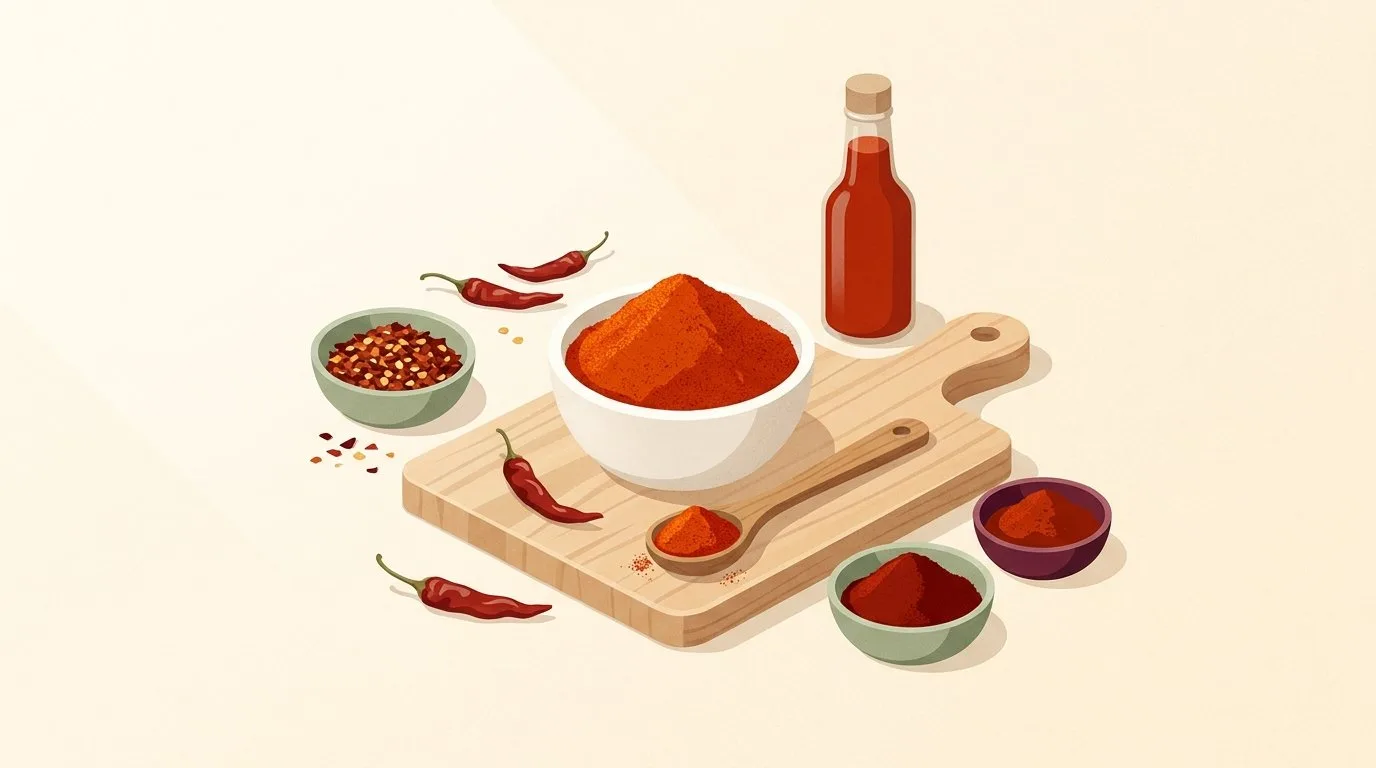
The best cayenne pepper substitute is red pepper flakes or a vinegar-based hot sauce like Tabasco, because both bring real chile heat. Hotter chile powders such as Thai or habanero work too, as long as you use less. Paprika and chili powder give you the red color and some flavor, but almost none of the heat.
This guide shows you exactly how much of each substitute for cayenne pepper to use. You’ll find a substitution chart, the Scoville heat numbers behind it, and plain answers to common questions like paprika vs cayenne and whether chili powder can stand in. Use the calculator below for any amount, then read on for the details.
Key Takeaways
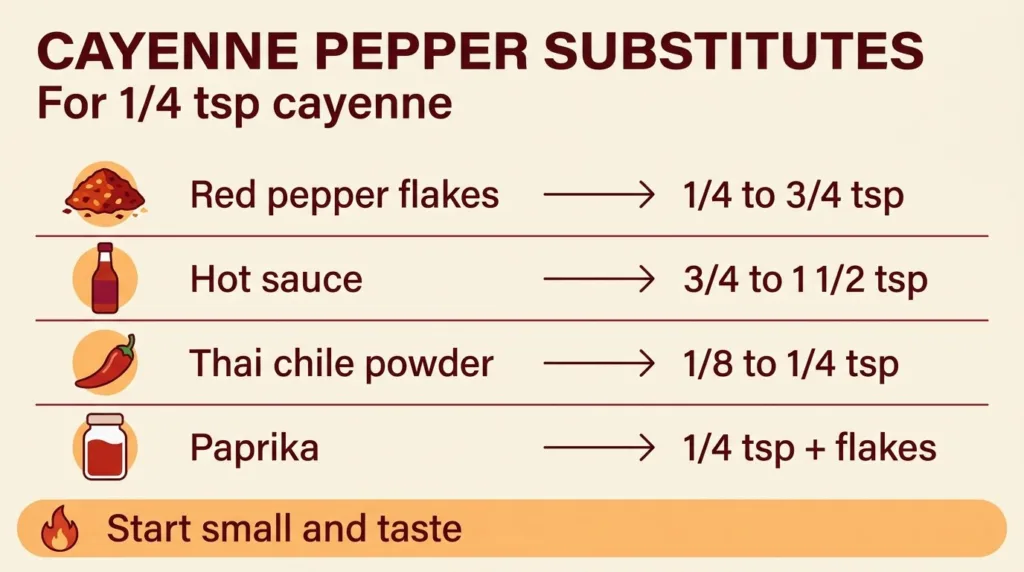
- Best swaps for heat: Red pepper flakes are the closest dry cayenne pepper substitute. For 1/4 tsp cayenne, start with 1/4 tsp flakes and add up to 3/4 tsp to taste.
- Hot sauce takes more: Tabasco-style sauce is much milder than cayenne and mostly water, so you need about 3 to 6 times the volume. For 1/4 tsp cayenne, use 3/4 to 1 1/2 tsp.
- Hotter powders take less: Thai chile and habanero powders are hotter than cayenne. Start with a pinch.
- Paprika and chili powder are too mild: As a cayenne pepper substitute, use the same amount for color and flavor, then add red pepper flakes for the heat.
- How hot is cayenne? 30,000 to 50,000 Scoville heat units (SHU), per NDSU and University of Illinois Extension. Our calculator uses 40,000.
Pick the cayenne pepper substitute you have and enter the amount of cayenne your recipe calls for. The calculator matches the heat, not just the spoonful.
Cayenne Pepper Substitute Calculator
Out of cayenne? Pick what you have and enter the amount of cayenne your recipe calls for. The calculator matches the heat, not just the volume.
Every substitute for this amount
| Substitute | How much to use |
|---|
How hot is each one?
Scoville heat units (SHU), log scale. Bars show the usual range.
Tips for swapping
Cayenne is 30,000 to 50,000 SHU (NDSU and University of Illinois Extension); the calculator uses 40,000. Other heat figures are from extension tables, spice sellers and the hot sauce maker, and brands vary, so treat results as a starting point and taste as you go. Hot sauce volumes use USDA FoodData Central weights (1 tsp cayenne = 1.8 g, 1 tsp Tabasco-style sauce = 4.7 g).
The calculator needs JavaScript. The chart below gives the same swaps for common amounts.
Cayenne Pepper Substitute Chart
This chart shows how much of each cayenne pepper substitute matches the heat of common cayenne amounts. Each cell is a range. For 1/2 tsp cayenne, halve the 1 tsp column, or use the calculator. Start with the smaller number, taste, then add more if you want.
| Substitute | 1/4 tsp cayenne | 1 tsp cayenne | 1 tbsp cayenne |
|---|---|---|---|
| Red pepper flakes | 1/4 to 3/4 tsp | 7/8 tsp to 1 tbsp | 2 1/2 tsp to 3 tbsp |
| Hot sauce (like Tabasco) | 3/4 to 1 1/2 tsp | 1 to 2 tbsp | 3 to 6 1/4 tbsp |
| Thai chile powder | 1/8 to 1/4 tsp | 3/8 to 3/4 tsp | 1 1/4 to 2 3/8 tsp |
| Habanero powder | A pinch to 1/8 tsp | 1/8 to 3/8 tsp | 3/8 to 1 1/4 tsp |
| Aleppo pepper | 1 tsp | 1 1/4 tbsp | 4 tbsp |
Some spices are too mild to match cayenne on their own. For these, the calculator says to use the same amount as the cayenne for flavor and color, plus red pepper flakes for the heat.
| Spice, plus flakes | 1/4 tsp cayenne | 1 tsp cayenne | 1 tbsp cayenne |
|---|---|---|---|
| Chipotle powder | 1/4 tsp + 1/8 to 5/8 tsp flakes | 1 tsp + 3/4 to 2 1/2 tsp flakes | 1 tbsp + 2 1/8 tsp to 2 1/2 tbsp flakes |
| Chili powder (blend) | 1/4 tsp + 1/4 to 3/4 tsp flakes | 1 tsp + 3/4 to 2 3/4 tsp flakes | 1 tbsp + 2 3/8 tsp to 2 3/4 tbsp flakes |
| Hot paprika | 1/4 tsp + 1/4 to 5/8 tsp flakes | 1 tsp + 3/4 to 2 3/4 tsp flakes | 1 tbsp + 2 3/8 tsp to 2 3/4 tbsp flakes |
| Sweet or smoked paprika | 1/4 tsp + 1/4 to 3/4 tsp flakes | 1 tsp + 7/8 tsp to 1 tbsp flakes | 1 tbsp + 2 1/2 tsp to 3 tbsp flakes |
Want less heat? The calculator has a “Milder (half)” setting that halves every amount of heat it aims for. For a cayenne pepper substitute amount not shown here, use the calculator.
How Hot Is Cayenne Pepper? The Cayenne Pepper Scoville Rating
Knowing cayenne’s heat is the key to picking a cayenne pepper substitute. Chile heat is measured in Scoville heat units, or SHU. So how hot is cayenne pepper? It is 30,000 to 50,000 SHU, according to both North Dakota State University (NDSU) Extension and University of Illinois Extension.
That puts cayenne well above a jalapeño, but far below a habanero:
| Pepper | Scoville heat units (SHU) |
|---|---|
| Bell pepper | 0 |
| Poblano | 2,500 to 3,000 |
| Jalapeño | 2,500 to 5,000 |
| Serrano | 5,000 to 15,000 |
| Cayenne | 30,000 to 50,000 |
| Thai | 50,000 to 100,000 |
| Habanero | 100,000 to 300,000 |
Source: University of Illinois Extension table. NDSU Extension gives the same figures for bell pepper, jalapeño, serrano, cayenne and habanero.
Where the Numbers Come From
Wilbur Scoville’s original test, described in a 1912 paper, used human tasters. As NDSU explains, chile extract was added to sweetened water. New Mexico State University (NMSU) adds that it was diluted until tasters could no longer detect heat, and defines a Scoville heat unit as “a single unit of dilution.” Today labs use a method called HPLC to measure the heat compounds, called capsaicinoids, directly.
Penn State Extension notes that heat is always a range, shaped by genetics and growing conditions, so our calculator gives a range too.
How the Calculator Matches Heat
The calculator treats cayenne as 40,000 SHU, the middle of its range, and sizes each cayenne pepper substitute with one formula:
Amount of substitute = amount of cayenne × 40,000 ÷ the substitute’s SHU
It runs the formula twice. The hot end of the substitute’s range gives the “start with” amount. The mild end gives the “up to” amount. For red pepper flakes (13,750 to 48,000 SHU), 1 tsp cayenne × 40,000 ÷ 48,000 is about 7/8 tsp, and × 40,000 ÷ 13,750 is about 3 tsp, or 1 tbsp.
- Hot sauce is adjusted for weight. Per USDA, 1 tsp of cayenne weighs about 1.8 g and 1 tsp of Tabasco about 4.7 g. So hot sauce ends up at about 3 to 6 times the volume of cayenne.
- Very mild spices get help. If a dry substitute would need more than 4 times the amount of cayenne, the calculator calls it too mild. It says to use the spice 1:1 for flavor, counts the little heat it adds, and makes up the rest with red pepper flakes.
This way of sizing a cayenne pepper substitute is our own estimate, not an official standard. Brands and batches vary, so treat the results as a starting point and taste as you go.
The Best Substitutes for Cayenne Pepper
Here’s each cayenne pepper substitute in the calculator, from closest match to least.
1. Red Pepper Flakes (Crushed Red Pepper)
Red pepper flakes are the closest dry substitute for cayenne pepper. They are made from dried red chiles, often including cayenne, so the heat is similar. Savory Spice lists its crushed red pepper at 13,750 SHU, and Spices Inc rates its crushed red pepper flakes at 32,000 to 48,000 SHU. Brands vary widely, so the calculator uses 13,750 to 48,000.
Use: 1/4 to 3/4 tsp flakes for 1/4 tsp cayenne. Flakes are coarse, so grind them in a spice grinder or mortar for rubs, or let them simmer in sauces and soups.
2. Hot Sauce (Tabasco-Style)
Hot sauce is a handy cayenne pepper substitute for wet dishes. Tabasco’s maker lists its Original Red Sauce at 2,500 to 5,000 SHU, and its ingredients are just vinegar, red pepper and salt. Per USDA it is also about 95% water, so it takes more by volume.
Use: 3/4 to 1 1/2 tsp hot sauce for 1/4 tsp cayenne, or 1 to 2 tbsp for 1 tsp. Keep an eye on salt. By USDA figures, Tabasco has about 30 mg of sodium per teaspoon, while a generic hot sauce averages about 124 mg. If you use a lot, cut back a little on other salt or acid in the recipe.
3. Thai Chile Powder and Other Hotter Chile Powders
Thai chiles run 50,000 to 100,000 SHU, per University of Illinois Extension. That makes Thai chile powder a strong cayenne pepper substitute, so use less.
Use: 1/8 to 1/4 tsp for 1/4 tsp cayenne.
4. Habanero Powder
Habaneros are 100,000 to 300,000 SHU, per NDSU and Illinois Extension. Savory Spice lists its habanero powder at 225,000. As a cayenne pepper substitute, it is several times hotter, with a fruity taste.
Use: a pinch to 1/8 tsp for 1/4 tsp cayenne. Add a small pinch first, then taste.
5. Aleppo Pepper
Aleppo pepper is a gentle cayenne pepper substitute with a fruity flavor and slow-building heat. Savory Spice lists its Aleppo at 10,000 SHU, about a quarter of cayenne’s heat.
Use: 1 tsp Aleppo for 1/4 tsp cayenne. That is 4 times the volume, right at the limit the calculator allows. If that feels like too much, try the “Milder (half)” setting or use part flakes.
6. Fresh Chiles
Fresh chiles are not in the calculator, since size and water content vary too much for a reliable swap. A jalapeño is 2,500 to 5,000 SHU and a serrano is 5,000 to 15,000, per NDSU, so both are milder than cayenne. Our tip: mince a little, add it early, and taste before adding more.
7. Chipotle Powder
Chipotle is smoked, dried jalapeño. Savory Spice lists its chipotle (morita) powder at 5,250 SHU, and the calculator uses a range of 2,500 to 8,000. As a cayenne pepper substitute it is too mild to match the heat alone.
Use: 1/4 tsp chipotle for smoky flavor, plus 1/8 to 5/8 tsp red pepper flakes for heat, in place of 1/4 tsp cayenne. It shines in chili, barbecue rubs and beans.
8. Chili Powder
Chili powder is a common cayenne pepper substitute, but American chili powder is a spice blend, not pure chile. It is built on mild chiles like ancho, plus cumin, garlic and oregano. Savory Spice lists its ancho powder at 1,250 SHU and mild red New Mexican chile powder at 2,000. Based on those, our estimate (used in the calculator) is about 1,000 to 2,000 SHU.
9. Paprika
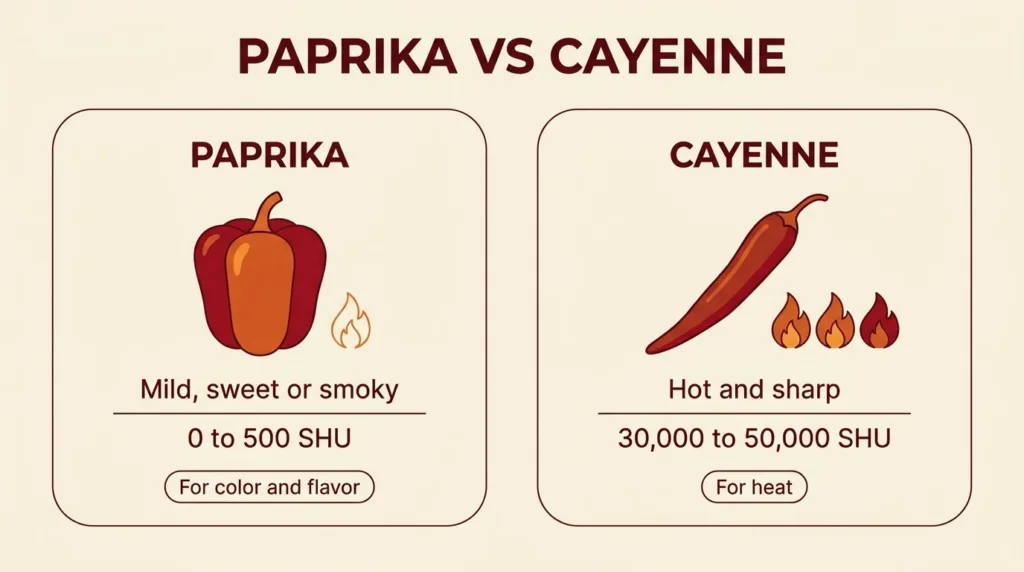
Paprika matches cayenne’s red color but not its heat. Sweet and smoked paprika are close to zero heat, and hot paprika varies a lot by brand. We could not find an authoritative SHU figure, so the calculator uses rough estimates: about 0 to 500 SHU for sweet or smoked, and 500 to 5,000 for hot. More on paprika vs cayenne below.
10. Black Pepper (No Chile at All)
No chiles at all? Black pepper adds a bit of bite, but a different kind. Its spicy compound is piperine, not capsaicin, and a 2019 lab study found piperine is a much weaker trigger of the same heat receptor. Black pepper has no Scoville rating and isn’t in the calculator. Add it to taste.
Paprika vs Cayenne
Paprika vs cayenne is a common mix-up, since both are red powders made from dried chiles. The big difference is heat.
| Paprika | Cayenne | |
|---|---|---|
| Heat (SHU) | Varies widely; sweet and smoked are near 0, hot paprika is usually far milder than cayenne (our estimates) | 30,000 to 50,000 (NDSU, Illinois Extension) |
| Flavor | Sweet, mild, sometimes smoky | Sharp, clean heat |
Using Paprika as a Cayenne Pepper Substitute
Paprika alone won’t give you cayenne’s kick. To match the heat, you’d need a pile of paprika many times larger than the cayenne, which would swamp the dish. That is why the calculator suggests a cayenne pepper substitute paprika combo instead: the same amount of paprika as cayenne, plus red pepper flakes. For 1/4 tsp cayenne, use 1/4 tsp sweet or smoked paprika plus 1/4 to 3/4 tsp flakes.
Cayenne Pepper vs Chili Powder
The difference between cayenne pepper vs chili powder is simple. Cayenne is one ground chile. Chili powder is a blend of mild ground chiles with cumin, garlic and oregano, so it tastes like a pot of chili.
Can I Substitute Chili Powder for Cayenne Pepper?
Yes, but not for heat. By our estimate chili powder is only about 1,000 to 2,000 SHU, so you’d need 20 to 40 times as much to match cayenne. That would bury the dish in cumin. Instead, use the same amount of chili powder as the recipe’s cayenne, then add red pepper flakes. For 1 tsp cayenne, use 1 tsp chili powder plus 3/4 to 2 3/4 tsp flakes.
Using Cayenne in Place of Chili Powder
Use much less. Our tip: replace each teaspoon of chili powder with a small pinch of cayenne, then add cumin, garlic powder and oregano to get the blend’s flavor. A little paprika brings back the red color.
Red Pepper Flakes vs Cayenne
Red pepper flakes vs cayenne come down to texture and consistency. Both are dried red chiles, and crushed red pepper vs cayenne is really the same question, since crushed red pepper is just another name for flakes.
- Texture: Cayenne is a fine powder that blends in right away. Flakes are coarse bits of skin and seeds that you can see in the dish.
- Heat: Cayenne is fairly steady at 30,000 to 50,000 SHU. Flakes vary much more by brand, from about 13,750 up to around 48,000 SHU, which is why the flakes range in a cayenne pepper substitute chart is so wide.
Is Cayenne Pepper the Same as Red Pepper?
Sort of. Is cayenne pepper the same as red pepper? Cayenne is one type of red chile, so all cayenne is red pepper, but not all red pepper is cayenne.
- “Ground red pepper” on US spice labels is often cayenne or a blend of hot red chiles. Recipes usually treat the two as the same thing.
- “Crushed red pepper” means flakes: a mix of dried red chiles, often including cayenne, with seeds.
- “Red pepper” in the produce aisle usually means a red bell pepper, which has 0 SHU, per NDSU. Don’t use it as a cayenne pepper substitute.
How to Use a Cayenne Pepper Substitute Without Overdoing the Heat
Matching heat is not an exact science. These tips help you get close.
- Start low. Use the smaller number in each range. Add a little at a time, let the dish simmer a few minutes, then taste. Heat builds as chiles cook, and it’s easier to add than to take out.
- Bloom dry chile in fat. Stir dry chile into a little oil or butter for about 30 seconds at the start of cooking. This brings out flavor and spreads the heat evenly.
- Add hot sauce late. Stir it in near the end of cooking so the flavor stays bright. For dry rubs and baking, use a dry substitute instead.
- Check the age of your spices. Ground chile loses strength as it ages, and heat varies between brands and even jars. An old jar may need a bit more.
- Fix a dish that’s too hot. Add more of the other ingredients, a spoon of sugar or honey, or a squeeze of lime. Serving with yogurt, sour cream or milk helps too. NDSU Extension notes that milk and other dairy products help neutralize capsaicin.
Handle Hot Chiles Safely
NDSU Extension says most experts recommend wearing plastic gloves when handling hot peppers, and warns against rubbing your eyes afterward. Capsaicin burns on contact with mucous membranes like the eyes and nose. This matters most with fresh chiles and habanero powder. Wash your hands, knife and cutting board well when you’re done.
Cayenne is also popular in drinks. Many people add a pinch to a ginger shot. If you’re curious about cayenne beyond cooking, our post on ginger and cayenne pepper benefits covers that side.
Frequently Asked Questions
What is the best substitute for cayenne pepper?
Red pepper flakes are the best dry substitute for cayenne pepper. For wet dishes, a Tabasco-style hot sauce works well. Use 1/4 to 3/4 tsp flakes or 3/4 to 1 1/2 tsp hot sauce for each 1/4 tsp of cayenne.
What can I use instead of cayenne pepper if I have no hot spices?
If you’re asking what can I use instead of cayenne pepper with nothing spicy on hand, try paprika for color and black pepper for a little bite. Neither will match cayenne’s heat, but the dish will still taste good. A dash of hot sauce from the fridge is another easy fix.
Can I substitute paprika for cayenne pepper?
Only for color and flavor. Paprika is far milder. For heat, use the same amount of paprika as cayenne, plus red pepper flakes. For 1/2 tsp cayenne, that’s 1/2 tsp sweet paprika plus 3/8 to 1 1/2 tsp flakes.
How much hot sauce equals 1/4 teaspoon of cayenne?
About 3/4 to 1 1/2 tsp of a Tabasco-style hot sauce. Hot sauce is milder than cayenne and mostly water, so it takes 3 to 6 times the volume. Start at the low end and taste.
What is the cayenne pepper Scoville rating?
Cayenne pepper is 30,000 to 50,000 SHU, according to NDSU and University of Illinois Extension. Savory Spice lists its cayenne powder at 40,000, the same figure our calculator uses.
What is a good cayenne pepper substitute for a dry rub?
Use a dry one. Finely ground red pepper flakes or Thai chile powder work best. Skip hot sauce, since it adds liquid. For a smoky rub, use chipotle powder 1:1 plus flakes for the heat.
Final Thoughts on Cayenne Pepper Substitutes
The easiest cayenne pepper substitute is red pepper flakes, with hot sauce close behind for soups and sauces. Hotter powders like Thai chile and habanero work in smaller amounts. Paprika and chili powder are great for color and flavor, but pair them with flakes if you want the heat.
Whatever you use, start with the smaller amount, let it cook a few minutes, and taste. You can always add more.
Sources and Further Reading
- Garden-Robinson J. Prairie Fare: Spice Up Your Menus With Hot Chili Peppers. North Dakota State University Extension. October 6, 2011.
- Fishburn J, University of Illinois Extension. Pepper heat table, reprinted by Lincoln Daily News. September 2020.
- Penn State Extension. Growing Hot Peppers: Can You Make Them Hotter?
- Bosland PW, Walker S. Guide H-237: Measuring Chile Pepper Heat. New Mexico State University Cooperative Extension Service. 2010.
- Spices Inc. Crushed Red Pepper Flakes (product page, heat rating).
- Savory Spice. Spices 101: Chile Heat Guide & the Scoville Scale Explained. May 2026.
- TABASCO brand. TABASCO Original Red Sauce.
- USDA FoodData Central. Spices, pepper, red or cayenne (FDC 170932).
- USDA FoodData Central. Tabasco sauce (FDC 174528).
- USDA FoodData Central. Sauce, ready-to-serve, pepper or hot (FDC 174527).
- Dong Y, Yin Y, Vu S, et al. A distinct structural mechanism underlies TRPV1 activation by piperine. Biochemical and Biophysical Research Communications. 2019;516(2):365-372.