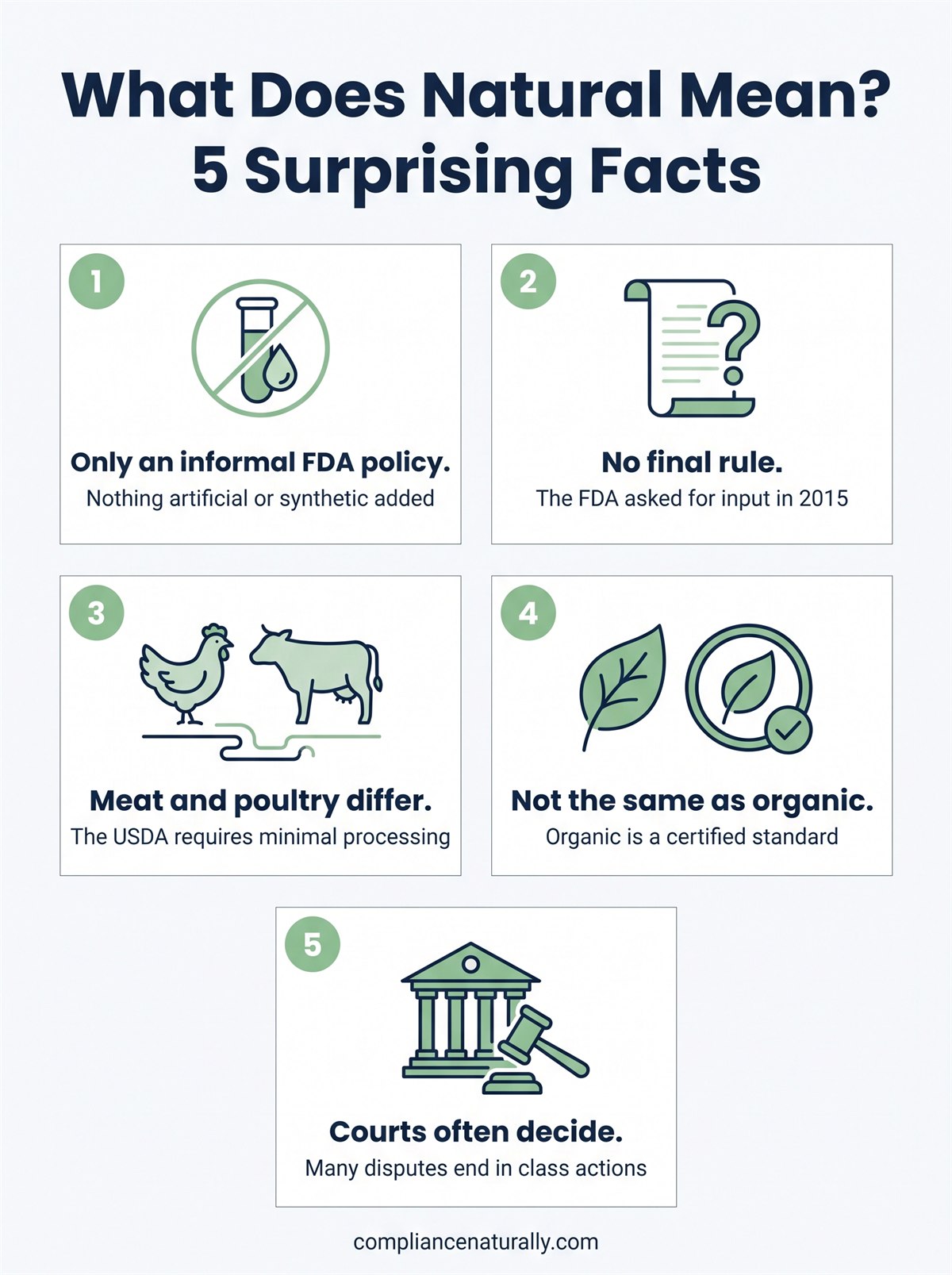
Short answer: “Natural” and “all natural” have no formal legal definition for most US foods. The FDA’s long-standing informal policy is that nothing artificial or synthetic, including any added color, has been added that would not normally be expected in the food. That policy says nothing about pesticides, GMOs, processing, sugar or nutrition. Meat and poultry are different: the USDA allows “natural” only for products with no artificial ingredients or added color that are minimally processed. “Natural” is not the same as organic.
“Natural” is one of the most common words on food packages and one of the least regulated. Surveys consistently find that shoppers assume it means no GMOs, no pesticides and minimal processing. It promises none of those things. This guide explains who regulates the word, what it does and does not mean, how it compares with organic, and how to read past it.
Who Regulates “Natural” on Food Labels?
| Food type | Regulator | What “natural” means |
|---|---|---|
| Most packaged foods, produce, seafood, drinks | FDA | No formal rule. Informal policy: nothing artificial or synthetic (including any added color) that would not normally be expected in the food. |
| Meat, poultry and processed egg products | USDA Food Safety and Inspection Service (FSIS) | No artificial ingredients or added color, and only minimally processed. The label must explain the claim, for example “no artificial ingredients; minimally processed.” |
| “Natural flavors” in an ingredient list | FDA (21 CFR 101.22) | A formal definition: flavoring derived from a plant or animal source, such as a spice, fruit, vegetable, meat or dairy product, whose main purpose is flavor, not nutrition. |
| Organic | USDA National Organic Program | A separate, certified standard with rules on pesticides, fertilizers, GMOs and animal care. See below. |
What the FDA’s “Natural” Policy Covers, and What It Doesn’t
The FDA has never written a formal definition of “natural.” Its policy, in its own words, is that the term means “nothing artificial or synthetic (including all color additives regardless of source) has been included in, or has been added to, a food that would not normally be expected to be in that food.”
The FDA states that the policy was not intended to address:
- Farming methods, such as pesticide use
- Processing or manufacturing methods, such as pasteurization, heat treatment or irradiation
- Nutrition or health benefits
It also does not address genetic engineering. Between 2015 and 2016 the FDA asked the public whether and how to define “natural,” after citizen petitions and requests from federal courts. It received thousands of comments, but as of 2026 it has not proposed a rule.
What “Natural” Does Not Tell You
| Many shoppers assume “natural” means… | What is actually true |
|---|---|
| No GMOs | Not required. Bioengineered foods must instead carry a separate USDA bioengineered (BE) disclosure. |
| No pesticides | Not addressed. Only organic restricts pesticides. |
| Minimally processed | Only for meat and poultry. Other “natural” foods can be heavily processed. |
| Healthy | No. “Natural” says nothing about sugar, salt, fat or calories. Sugar and salt are natural. |
| No antibiotics or hormones in meat | Not required. Those are separate claims (“raised without antibiotics,” “no hormones added”) with their own USDA rules. |
| Same as organic | No. See the comparison below. |
Natural vs Organic: What’s the Difference?
| What to compare | “Natural” | USDA Organic |
|---|---|---|
| Legal definition | Informal policy (FDA); short definition for meat and poultry (USDA) | Detailed federal regulation (7 CFR Part 205) |
| Certification and inspection | None | Required, with yearly inspections |
| Synthetic pesticides | Allowed | Mostly prohibited |
| GMOs | Allowed | Prohibited |
| Antibiotics and hormones in livestock | Allowed unless separately claimed | Prohibited |
| Artificial ingredients and colors | Not expected (FDA policy) | Restricted to an approved list |
| Processing | Not addressed (except meat and poultry) | Some processing aids and methods restricted |
| Price | Often similar to conventional | Usually higher |
If you care about how food is grown or raised, “organic” tells you far more than “natural.” For whether organic is worth it, see organic vs non-organic food.
“Natural” on Meat and Poultry
The USDA’s Food Safety and Inspection Service approves meat and poultry labels before use. A “natural” product must contain no artificial ingredients or added color and be no more than minimally processed, meaning processed in a way that does not fundamentally change the raw product, such as grinding or freezing. The label has to explain what “natural” means.
“Natural” says nothing about how the animal was raised. Look for separate claims, which FSIS also reviews:
- “No hormones added”: allowed on beef only if the producer documents it. On pork and poultry the label must add that federal rules already prohibit hormones in those animals, so the claim tells you nothing extra.
- “Raised without antibiotics” or “no antibiotics ever”: the producer must provide records to support it. In 2024 FSIS updated its guidance and strongly encouraged third-party verification of these claims.
- “Grass-fed,” “free-range,” “pasture-raised”: separate claims with their own documentation requirements.
What About “Natural Flavors”?
Unlike “natural” on the front of a package, “natural flavor” in the ingredient list has a formal FDA definition: a flavoring derived from plant or animal sources, such as spices, fruit, vegetables, herbs, meat, seafood, eggs or dairy, or their fermentation products, whose main function is flavor. Natural flavors can still be highly processed, can contain many individual compounds and carrier ingredients, and do not have to be listed individually. “Natural” describes the source, not the processing.
A 2026 Change: “No Artificial Colors”
In February 2026 the FDA changed its approach to “no artificial colors” claims. Previously, products with any added color, even one from a natural source, could not make that claim. Under the new guidance, companies can say “no artificial colors” if the product contains no petroleum-based synthetic dyes, such as Red No. 40 or Yellow No. 6, even if it uses colors from natural sources. The FDA also approved additional natural color sources. This does not change the FDA’s broader “natural” policy, which still treats any added color as inconsistent with “natural.”
Why “Natural” Claims End Up in Court
Because the FDA has no formal definition, disputes over “natural” are largely settled through consumer class-action lawsuits. Companies have been sued over “natural” products that contained high-fructose corn syrup, synthetic vitamins, solvent-extracted oils, genetically engineered ingredients or trace pesticide residues. Several federal courts paused cases to ask the FDA to define the term, which is part of why the agency opened its 2015 request for comments. Many companies have settled or dropped “all natural” from their packaging rather than risk a lawsuit. For more on how labels can be legal but misleading, see misleading food labels.
How to Evaluate a “Natural” Claim
- Read the ingredient list, not the front of the package. Long lists with refined sugars, oils and flavorings point to a processed food, whatever the label says. See whole foods vs processed foods.
- Check the Nutrition Facts panel for added sugars, sodium and saturated fat. “Natural” tells you nothing about them.
- Look for certified claims if farming methods matter to you: USDA Organic, or the bioengineered disclosure if you want to avoid GMOs.
- On meat and poultry, look at how-raised claims, not “natural.”
- Be wary of “all natural” on supplements, which follow different rules. See food vs supplements.
Frequently Asked Questions
What does “all natural” mean on food labels?
Legally, very little. For most foods, the FDA’s informal policy means nothing artificial or synthetic, including added color, has been added that would not normally be in the food. “All natural” has no stricter meaning than “natural.”
Is “natural” regulated by the FDA?
Only loosely. The FDA has a long-standing policy but no formal regulation defining “natural.” It asked for public comments in 2015 and 2016 and has not proposed a rule.
Is natural better than organic?
No. Organic is a certified standard with rules on pesticides, GMOs, fertilizers and animal care. “Natural” has no certification and covers none of those.
Can a natural product contain GMOs?
Yes. The FDA’s policy does not address genetic engineering. Foods with bioengineered ingredients must carry a separate USDA bioengineered food disclosure.
What does “natural flavors” mean?
Flavorings derived from plant or animal sources whose main purpose is flavor. They can be highly processed and made from many individual compounds.
What does “natural” mean on meat?
For meat and poultry, the USDA allows “natural” only if the product has no artificial ingredients or added color and is minimally processed. It says nothing about antibiotics, hormones or how the animal was raised.
Sources and Further Reading
- Use of the Term “Natural” on Food Labeling. US Food and Drug Administration.
- 21 CFR 101.22: Foods; labeling of spices, flavorings, colorings and chemical preservatives (eCFR).
- Meat and Poultry Labeling Terms. USDA Food Safety and Inspection Service.
- National Bioengineered Food Disclosure Standard. USDA Agricultural Marketing Service.
- National Organic Program. USDA Agricultural Marketing Service.