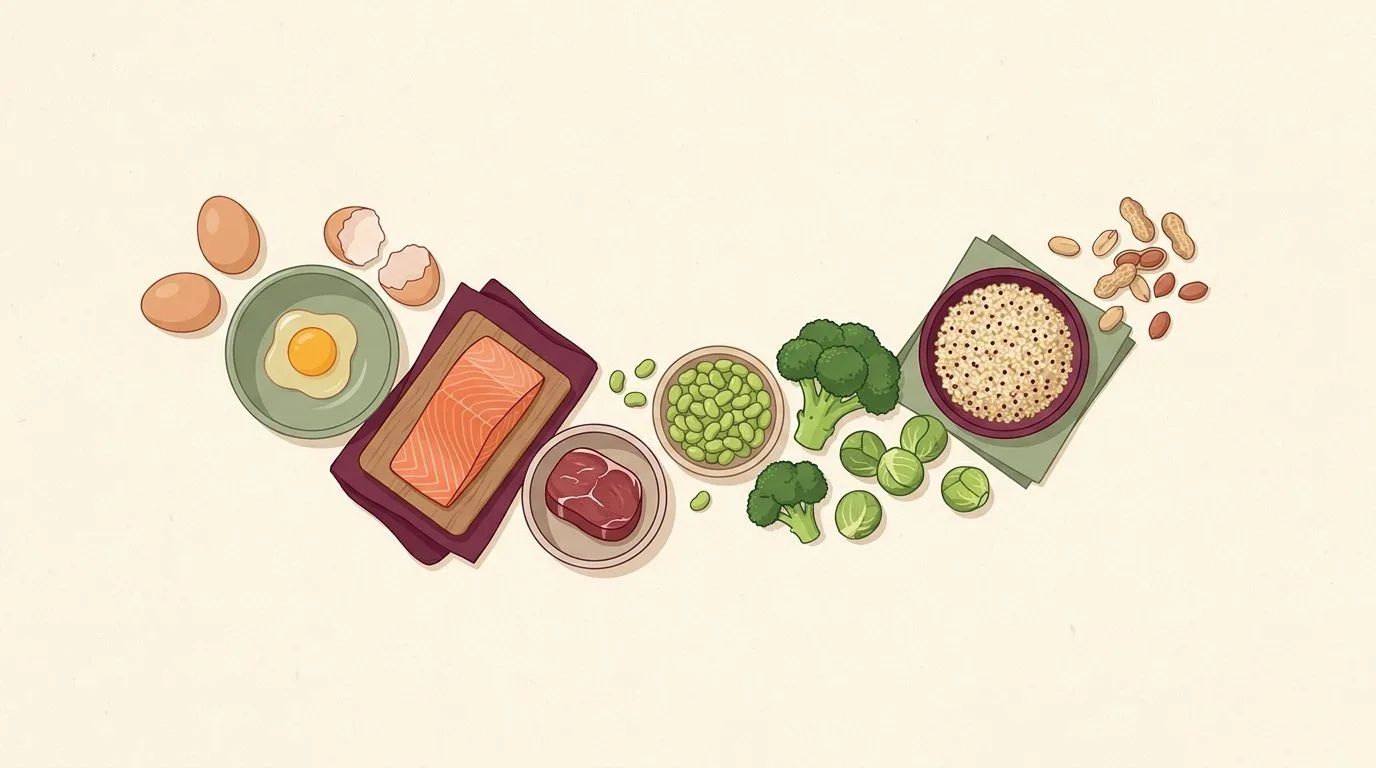
Choline is an essential nutrient that most Americans don’t get enough of, and it isn’t on most food labels. The best choline foods are eggs, liver, meat, fish and soybeans, with beans, cruciferous vegetables, quinoa and wheat germ as useful plant sources. The chart below lists 57 common foods with their choline content from USDA data. Enter what you eat and the calculator adds up your day against the amount recommended for your age, pregnancy or breastfeeding.
Choline Foods Chart and Daily Calculator
Sort or filter the chart, then enter servings next to the foods you eat. Your total is compared with the Adequate Intake for your life stage, the Daily Value and the upper limit.
Your foods
| Food | Serving size | Choline (mg) | %DV | mg per 100 g | Group | Animal or plant |
|---|---|---|---|---|---|---|
| Beef liver, pan-fried | 3 oz | 356 | 65% | 418 | Meat | Animal |
| Chicken liver, simmered | 3 oz | 247 | 45% | 290 | Poultry | Animal |
| Egg, whole, hard-boiled | 1 large egg | 147 | 27% | 294 | Eggs | Animal |
| Egg yolk | 1 large yolk | 139 | 25% | 820 | Eggs | Animal |
| Beef top round, lean, braised | 3 oz | 117 | 21% | 138 | Meat | Animal |
| Soybeans, roasted | 1/2 cup | 107 | 19% | 124 | Soy | Plant |
| Salmon, sockeye, cooked | 3 oz | 96 | 17% | 113 | Fish | Animal |
| Edamame, cooked | 1 cup | 87 | 16% | 56 | Soy | Plant |
| Salmon, Atlantic, farmed, cooked | 3 oz | 77 | 14% | 91 | Fish | Animal |
| Turkey, meat only, roasted | 3 oz | 76 | 14% | 89 | Poultry | Animal |
| Collard greens, boiled | 1 cup chopped | 73 | 13% | 38 | Vegetables | Plant |
| Chicken breast, roasted | 3 oz | 73 | 13% | 85 | Poultry | Animal |
| Ground beef, 93% lean, broiled | 3 oz | 72 | 13% | 85 | Meat | Animal |
| Cod, Atlantic, cooked | 3 oz | 71 | 13% | 84 | Fish | Animal |
| Sardines, canned in oil, drained | 1 can (3.75 oz) | 69 | 13% | 75 | Fish | Animal |
| Pork loin chop, lean, broiled | 3 oz | 65 | 12% | 76 | Meat | Animal |
| Chicken thigh, meat only, roasted | 3 oz | 61 | 11% | 72 | Poultry | Animal |
| Soy milk, unfortified | 1 cup | 57 | 10% | 24 | Soy | Plant |
| Red potato, baked, with skin | 1 large potato | 57 | 10% | 19 | Vegetables | Plant |
| Wheat germ, toasted | 1 oz | 51 | 9% | 179 | Grains | Plant |
| Milk, 1% fat | 1 cup | 43 | 8% | 18 | Dairy | Animal |
| Quinoa, cooked | 1 cup | 43 | 8% | 23 | Grains | Plant |
| Navy beans, boiled | 1/2 cup | 41 | 7% | 45 | Beans and peas | Plant |
| Kidney beans, canned | 1/2 cup | 39 | 7% | 31 | Beans and peas | Plant |
| Yogurt, plain, low fat | 1 cup | 37 | 7% | 15 | Dairy | Animal |
| Tofu, regular | 1/2 cup | 36 | 6% | 29 | Soy | Plant |
| Spinach, boiled | 1 cup | 36 | 6% | 20 | Vegetables | Plant |
| Chickpeas, boiled | 1/2 cup | 35 | 6% | 43 | Beans and peas | Plant |
| Milk, whole | 1 cup | 35 | 6% | 14 | Dairy | Animal |
| Lentils, boiled | 1/2 cup | 32 | 6% | 33 | Beans and peas | Plant |
| Brussels sprouts, boiled | 1/2 cup | 32 | 6% | 41 | Vegetables | Plant |
| Broccoli, boiled | 1/2 cup chopped | 31 | 6% | 40 | Vegetables | Plant |
| Pinto beans, boiled | 1/2 cup | 30 | 5% | 35 | Beans and peas | Plant |
| Black beans, boiled | 1/2 cup | 28 | 5% | 33 | Beans and peas | Plant |
| Shiitake mushrooms, cooked | 1/2 cup pieces | 27 | 5% | 37 | Vegetables | Plant |
| Greek yogurt, plain, nonfat | 1 container (6 oz) | 26 | 5% | 15 | Dairy | Animal |
| Tuna, white, canned in water | 3 oz | 25 | 5% | 29 | Fish | Animal |
| Cauliflower, boiled | 1/2 cup | 24 | 4% | 39 | Vegetables | Plant |
| Green peas, boiled | 1/2 cup | 24 | 4% | 30 | Beans and peas | Plant |
| Asparagus, boiled | 1/2 cup | 24 | 4% | 26 | Vegetables | Plant |
| Bok choy, boiled | 1 cup shredded | 21 | 4% | 12 | Vegetables | Plant |
| Peanut butter, smooth | 2 tbsp | 20 | 4% | 63 | Nuts and seeds | Plant |
| Pistachios, dry-roasted | 1 oz (49 kernels) | 20 | 4% | 71 | Nuts and seeds | Plant |
| Sunflower seed kernels | 1/4 cup | 19 | 4% | 55 | Nuts and seeds | Plant |
| Brown rice, cooked | 1 cup | 19 | 3% | 9.2 | Grains | Plant |
| Peanuts, dry-roasted | 1 oz | 18 | 3% | 65 | Nuts and seeds | Plant |
| Pumpkin seeds, dried | 1 oz | 18 | 3% | 63 | Nuts and seeds | Plant |
| Oatmeal, cooked with water | 1 cup | 17 | 3% | 7.4 | Grains | Plant |
| Cashews, dry-roasted | 1 oz | 17 | 3% | 61 | Nuts and seeds | Plant |
| Cabbage, boiled | 1/2 cup shredded | 15 | 3% | 20 | Vegetables | Plant |
| Sweet potato, baked | 1 medium | 15 | 3% | 13 | Vegetables | Plant |
| Almonds | 1 oz (23 almonds) | 15 | 3% | 52 | Nuts and seeds | Plant |
| Avocado | 1/2 avocado | 14 | 3% | 14 | Fruit | Plant |
| Whole-wheat bread | 1 slice | 8.7 | 2% | 27 | Grains | Plant |
| Flaxseed, ground | 1 tbsp | 5.5 | 1% | 79 | Nuts and seeds | Plant |
| Cheddar cheese | 1 oz | 4.7 | 1% | 17 | Dairy | Animal |
| Egg white | 1 large white | 0.4 | 0% | 1.1 | Eggs | Animal |
Adequate Intakes and upper limits: National Academies (NASEM), as listed in the NIH Office of Dietary Supplements choline fact sheet. No upper limit is set for infants. Food values: USDA FoodData Central, nutrient “Choline, total”. This tool is for general information, not medical advice.
The calculator needs JavaScript. The chart above lists every food and its choline content.
What Is Choline?
Choline is a nutrient your body uses to build cell membranes and to make acetylcholine, a messenger chemical involved in memory, mood and muscle control. It also helps carry fat out of the liver and plays a part in early brain development, which is why it gets attention in pregnancy.
Your liver makes some choline, but not enough to cover what you need, so the rest has to come from food. It isn’t a vitamin, though it’s often grouped with the B vitamins because it works closely with folate. When folate intake is low, the body leans more heavily on choline.
Choline sits alongside omega-3 fats as one of the nutrients most often linked to brain health. For the wider picture on diet and the brain, see our guide to brain health foods and what the research supports.
Top Choline Foods
These are the richest choline foods per typical serving in the chart above, using USDA FoodData Central values:
| Food | Serving | Choline (mg) | %DV |
|---|---|---|---|
| Beef liver, pan-fried | 3 oz | 356 | 65% |
| Chicken liver, simmered | 3 oz | 247 | 45% |
| Egg, hard-boiled | 1 large | 147 | 27% |
| Beef top round, lean, braised | 3 oz | 117 | 21% |
| Soybeans, roasted | ½ cup | 107 | 19% |
| Salmon, sockeye, cooked | 3 oz | 96 | 17% |
| Edamame, cooked | 1 cup | 87 | 16% |
| Turkey, roasted | 3 oz | 76 | 14% |
| Collard greens, boiled | 1 cup | 73 | 13% |
| Chicken breast, roasted | 3 oz | 73 | 13% |
A few patterns stand out:
- Eggs are the easiest big source. One large egg has about 147 mg of choline, roughly a third of what an adult woman needs. Almost all of it is in the yolk (139 mg). The white has less than 1 mg, so egg-white omelets miss nearly all of it.
- Organ meats are in a league of their own. A 3 oz serving of beef liver covers most of a day’s needs. Liver is also very high in vitamin A, so it’s best as an occasional food rather than a daily one, especially in pregnancy.
- Meat, poultry and fish are steady sources. Most 3 oz portions give 60 to 120 mg.
- Dairy helps a little. A cup of milk or yogurt gives 35 to 45 mg. Cheese is low, at about 5 mg per ounce of cheddar.
- Soy leads the plant foods, followed by greens such as collards, beans, potatoes, quinoa and wheat germ.
Values per 100 g in the chart let you compare foods fairly when serving sizes differ. Wheat germ, for example, looks modest per ounce (51 mg) but is one of the most concentrated plant sources by weight.
How Much Choline Do You Need?
The National Academies set an Adequate Intake (AI) for choline rather than a full recommended allowance, because there wasn’t enough data to set one. The AI is based on the amount that prevents liver damage in studies.
| Life stage | Adequate Intake (mg/day) | Upper limit (mg/day) |
|---|---|---|
| Infants 0–6 months | 125 | Not set |
| Infants 7–12 months | 150 | Not set |
| Children 1–3 years | 200 | 1,000 |
| Children 4–8 years | 250 | 1,000 |
| Children 9–13 years | 375 | 2,000 |
| Teens 14–18, boys | 550 | 3,000 |
| Teens 14–18, girls | 400 | 3,000 |
| Men 19+ | 550 | 3,500 |
| Women 19+ | 425 | 3,500 |
| Pregnancy | 450 | 3,000 (14–18) / 3,500 (19+) |
| Breastfeeding | 550 | 3,000 (14–18) / 3,500 (19+) |
Source: National Academies, as listed in the NIH Office of Dietary Supplements choline fact sheet.
Most people fall short. In national survey data (NHANES 2013–2014), men averaged 402 mg a day from food and women 278 mg, both below their AI. Children and teens aged 2–19 averaged 256 mg.
Your own needs can differ from these figures. They depend on how much folate and methionine you eat, your genes, and, in women, estrogen, which helps the body make its own choline. That is one reason premenopausal women may need slightly less from food than men.
Choline in Pregnancy and Breastfeeding
The AI rises to 450 mg a day in pregnancy and 550 mg while breastfeeding, because choline passes to the baby through the placenta and breast milk. It’s needed for the baby’s developing brain and spinal cord.
This is the group most likely to come up short. An estimated 90% to 95% of pregnant women eat less than the AI, and many prenatal vitamins contain little or no choline. Check the Supplement Facts panel on yours: if choline isn’t listed, it isn’t in there.
Two eggs a day provide about 294 mg, which is about two-thirds of the pregnancy AI. Add a serving of meat, fish, soy or beans and most of the gap is closed. If you don’t eat eggs or meat, or your prenatal has no choline, ask your doctor or midwife whether a separate choline supplement makes sense. Set the calculator to “Pregnancy” to see how your usual meals add up.
Vegan and Vegetarian Choline Sources
Plant foods have less choline per serving than eggs and meat, so a vegan diet needs a little more planning. These are the best plant sources in the chart:
- Roasted soybeans: 107 mg per ½ cup
- Edamame: 87 mg per cup
- Collard greens, cooked: 73 mg per cup
- Soy milk, unfortified: 57 mg per cup
- Red potato, baked with skin: 57 mg per large potato
- Wheat germ: 51 mg per ounce
- Quinoa, cooked: 43 mg per cup
- Navy beans, kidney beans and chickpeas: 35 to 41 mg per ½ cup
- Tofu: 36 mg per ½ cup
- Broccoli and Brussels sprouts: about 31 mg per ½ cup
A sample vegan day could look like this: ½ cup roasted soybeans as a snack (107 mg), a cup of soy milk (57 mg), a cup of cooked collards (73 mg), a cup of quinoa (43 mg), ½ cup of chickpeas (35 mg), a baked potato (57 mg) and ½ cup of broccoli (31 mg). That comes to about 403 mg, close to the 425 mg AI for women. A sprinkle of wheat germ on breakfast takes it past.
Vegetarians who eat eggs and dairy have it easier: one or two eggs a day does most of the work.
Signs of Low Choline Intake
True choline deficiency is rare in healthy people, even though most don’t meet the AI, probably because the body makes some of its own. When it does happen, mainly in studies where people were fed choline-free diets or in patients on long-term intravenous feeding, it can cause:
- Fatty liver (nonalcoholic fatty liver disease)
- Liver damage, seen as raised liver enzymes in blood tests
- Muscle damage
There is no simple symptom that tells you your choline is low. Tiredness or “brain fog” have many causes and aren’t reliable signs. If you’re concerned, the practical step is to look at your diet with the calculator. People at higher risk of low intake include pregnant women, people who eat few animal foods, and people with certain common gene variants that affect folate and choline metabolism.
Choline Supplements vs. Food
For most people, food is the better route. Eggs, meat, fish, soy and beans bring protein and other nutrients along with the choline. Supplements make sense mainly when food intake is clearly low, for example in pregnancy without eggs or meat. For more on how the two are regulated, see the difference between food and supplements.
Choline supplements usually contain 10 to 250 mg per serving. Common forms are choline bitartrate, phosphatidylcholine and lecithin. No studies have compared how well the body absorbs each form. You may also see citicoline (CDP-choline) and alpha-GPC, which are sold for brain health. These are mostly studied as drugs or high-dose supplements, and the evidence for memory benefits in healthy people is limited.
Too much is possible. The upper limit for adults is 3,500 mg a day from food and supplements combined. That’s very hard to reach from food alone, but high doses can cause a fishy body odor, vomiting, heavy sweating and salivation, and low blood pressure. Higher choline intake also raises levels of TMAO, a compound produced by gut bacteria that has been linked to heart disease risk in some studies. Stick to food or modest supplement doses unless a doctor advises otherwise.
Choline on the Nutrition Facts Label
Choline has a Daily Value on food labels: 550 mg for adults and children 4 years and older, set by the FDA in the 2016 label update. That’s the figure behind the %DV column in the chart. (If you want a refresher on what changed in that update, see our post on FDA Nutrition Facts label changes.)
But choline is a voluntary nutrient. The FDA doesn’t require food labels to list choline unless choline has been added to the food, so most foods you buy, including eggs, won’t show it. When a label does list it, the usual FDA rules for %DV apply:
- 20% DV or more (110 mg or more) per serving is a high source.
- 5% DV or less (28 mg or less) is a low source.
Because the number is often missing, labels aren’t much help for tracking choline. That’s where a chart based on USDA data is more useful. For tips on reading the rest of the panel, see how to read Nutrition Facts labels correctly.
How the Numbers in This Chart Were Made
Every value in the chart comes from USDA FoodData Central (SR Legacy data), nutrient “Choline, total”. Each food’s FoodData Central ID is recorded, so you can look up any value on the USDA site. Serving weights come from the USDA portion data for each food. Half-cup servings are half of USDA’s cup weight. Values are for foods as eaten (cooked, where relevant), and real foods vary with breed, feed and cooking method, so treat the numbers as good estimates rather than exact amounts.
The calculator multiplies each food’s choline per serving by the number of servings you enter. It doesn’t account for choline added to fortified foods, supplements or infant formula.
This post is general information, not medical advice.
Frequently Asked Questions
What food is highest in choline?
Beef liver, with about 356 mg in 3 ounces. Among everyday foods, eggs are the top source, at about 147 mg per large egg. For plant foods, roasted soybeans lead at about 107 mg per ½ cup.
How much choline is in an egg?
A large hard-boiled egg has about 147 mg of choline, according to USDA data. About 139 mg of that is in the yolk, and the white has less than 1 mg.
How much choline do I need per day?
Adult men need 550 mg a day and adult women 425 mg. The amount rises to 450 mg in pregnancy and 550 mg while breastfeeding. Children need 200 to 375 mg depending on age. The full table is above, and the calculator uses the same figures.
Can you get enough choline on a vegan diet?
Yes, with planning. Soy foods, collard greens, beans, potatoes, quinoa and wheat germ can add up to the AI, as the sample day above shows. Pregnant vegans should talk to a doctor or dietitian, since the target is higher and a supplement may be needed.
Is it possible to get too much choline?
From food alone it’s very unlikely. The upper limit for adults is 3,500 mg a day, and problems such as fishy body odor and low blood pressure are linked to high-dose supplements.
Why isn’t choline listed on most food labels?
Listing choline is voluntary. The FDA only requires it when choline has been added to the food. The Daily Value for labels is 550 mg.
Sources and Further Reading
- Choline: Fact Sheet for Health Professionals — NIH Office of Dietary Supplements (Adequate Intakes, upper limits, intake data, deficiency and supplement information)
- USDA FoodData Central — SR Legacy food composition data, nutrient “Choline, total”, for every food in the chart
- Dietary Reference Intakes for Thiamin, Riboflavin, Niacin, Vitamin B6, Folate, Vitamin B12, Pantothenic Acid, Biotin, and Choline — National Academies (Institute of Medicine), 1998
- Daily Value on the Nutrition and Supplement Facts Labels — U.S. Food and Drug Administration